Omar Kelly: What we've learned about the 2026 Dolphins
Published in Football
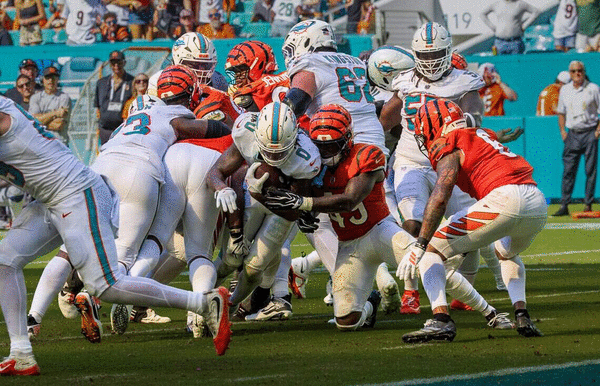
MIAMI — The Miami Dolphins have 12 more chances to avoid book-ending the 1972 Perfect Season with the Imperfect Season, becoming the first team in NFL history to go 0-17.
Avoiding infamy needs to become head coach Jeff Hafley’s top priority because that kind of blemish doesn’t come off a resume for anyone involved.
That means the investment being made into the roster’s youngsters needs to bear fruit at some point in the final 12 games, producing a win.
Oddly, this Dolphins team has more talent than the 2019 squad, which is the most recent, and comparable rebuild South Florida’s NFL franchise embarked on.
In that season Miami got into the win column with a 26-18 Week 9 home victory over the New York Jets, which happens to be Miami’s next opponent.
What this 2026 squad lacks is a savvy veteran quarterback such as Ryan Fitzpatrick, who carried that franchise to five wins, which were all achieved after beginning that season with a seven-game losing streak.
This team has upside and potential, especially now that they are relatively healthy and coming off a bye week. But can they turn the season’s struggles into a positive? We will soon discover if they can.
Here is what we have learned about the 2026 Dolphins, strengths, weaknesses and areas that need addressing:
1. Dolphins can run the football
Miami has a respectable rushing game despite the loss of Pro Bowl tailback De’Von Achane, who sustained a season-ending knee injury last month, and it has been the offensive line that has served as the driving force for Miami’s physicality. Behind the running of second-year back Ollie Gordon II, who is averaging 5.0 yards per carry, the Dolphins entered this week ranked 11th in the NFL in rushing, averaging 126.6 yards per game, and 4.9 yards per carry. And keep in mind Miami hasn’t had a lead in a game all season, and has consistently been forced to abandon the ground game because of large scoring deficits.
2. Dolphins have consistently stopped the run
The Dolphins entered this weekend ranked 16th rushing defense, holding opponents to 110.6 rushing yards per game and 3.7 yards per carry. Heading into Sunday’s games, only six teams have allowed fewer rushing yards per attempt than Miami, which could improve now that Kenneth Grant, the team’s 2025 first-round pick, is back from a toe injury that forced him to begin the season on injured reserve. Jacob Rodriguez is clearly gaining his footing as an NFL inside linebacker, so expect his production to consistently improve. What Miami needs to find is better edge-setting and a more effective play at strong-side linebacker (which might be Trey Moore when he returns from his ankle injury).
3. Malik Willis must become a more efficient QB
Willis enters this weekend as the least productive quarterback of everyone who has thrown at least 50 passes this season. He has struggled in his first five starts for the Dolphins, but shouldn’t take all the blame for his lackluster play (68.4 passer rating) thus far. Miami’s subpar pass protection, inexperience at receiver and troublesome play calling have been contributing factors. If Willis found more completions per games (take the check downs more often), scrambled for two or three more first downs per game, and learned to throw the ball away on busted plays he would become more efficient, and that’s a starting point.
4. Young receivers need to master the playbook
Being forced to lean on three rookie receivers — Caleb Douglas, who has missed first three games with an ankle injury, Chris Bell, who is still recovering from a knee injury sustained last November, and rookie slot receiver Kevin Coleman Jr. — isn’t ideal for a young quarterback who has started 11 NFL games. But those are the cards Willis has been dealt. If Miami’s receivers, which includes Malik Washington in his third season, turned up the volume of their understanding of their assignments, hot routes, route depths, scramble drill rules it’s possible that the volume would be turned up on Miami’s passing game.
5. Tight ends are being underutilized
While the league has been carving Miami up with tight ends, the Dolphins have been ignoring their own for most of the season. Greg Dulcich and Will Kacmarek have been on the field for 320 of the team’s 293 offensive snaps (factoring in two tight-end packages) and have only been targeted 23 times, contributing 151 receiving yards on 16 receptions. That breaks down to 4.6 targets per game, which seems extremely low for an offense that’s struggling. Isn’t the saying that a tight end is a young quarterback’s best friend? That’s why it would benefit the Dolphins to make Dulcich and Kacmarek more than window dressing.
6. Dolphins need better play calling on offense
Is it a coincidence that the Dolphins offense is seemingly plagued by the same mistakes that cost Bobby Slowik his job as the Houston Texans offensive coordinator after two seasons? In fairness to Slowik, it’s not like he’s working with a veteran quarterback, or an arsenal of weapons. He has also coached the past three games without Miami’s top tailback (Achane) and receiver (Douglas). But the Dolphins have to place easier-to-cook items on the menu for Willis. That should help them find an offensive identity, which this team lacks thus far.
7. Tight end coverage must improve
Opposing tight ends have carved Miami’s defense up in the first five weeks, and it’s not just the elite ones such as George Kittle and Travis Kelce who have shredded the Dolphins. Opposing tight ends have caught 37 passes, which they have turned into 381 yards and four touchdowns in the first five games. They are also responsible for 22 first downs, keeping many scoring drives alive. Hafley claims Miami’s giving defenses those open zones in a strategy meant to prevent the big play. But NFL teams often build on what leads to success for other offenses, and at this point targeting tight ends should be the No. 1 thing on their menu based on how Miami’s defense plays.
8. Special teams needs to get its act together
When a team isn’t that talented on offense and defense the one area it needs to be strong in is special teams, and that hasn’t been the case in the first five games, and it has cost Miami a ton from a field position standpoint. Chris Tabor has an impressive resume as a special teams coordinator, a role he has held for all but three seasons in his 19-year NFL career. But he needs to find a stable, consistent cast of five or six core special team contributors he can lean on.
9. Jon-Eric Sullivan needs to continue churning the roster
The Dolphins have made 16 waiver wire claims or practice squad poaches since training camp opened. While it hasn’t unearthed the next Zach Sieler, who was a waiver wire claim in 2019, there’s no telling what tailback Kaytron Allen, the newest addition, might become if given the opportunity to showcase himself. Miami also needs to continue rewarding players who perform well in practice, such as edge rusher Rodney McGraw, who has been elevated from the practice squad for two straight games, providing them an opportunity to prove themselves.
10. Volume needs to be turned up on pass rushing
There has been one game this season (Minnesota) where the Dolphins defense has produced sacks (four) and more than a handful of pressures, and that happened to be the lone game in 2026 where the defense was respectable (until the Vikings’ final possession). The lack of pressure placed on opposing quarterbacks is why Miami’s on pace to allow an NFL record 76.6% of passes to be completed, and is allowing opposing quarterbacks to have a 115.0 passer rating. This defense needs to find a way to make quarterbacks uncomfortable without becoming blitz crazy, and that means Chop Robinson, Josh Uche and Malik Herring must step up and win more of their 1-on-1 assignments.
____
©2026 Miami Herald. Visit miamiherald.com. Distributed by Tribune Content Agency, LLC.






Comments