Chris Perkins: Evaluating Dolphins QB Malik Willis at the one-quarter mark of season
Published in Football
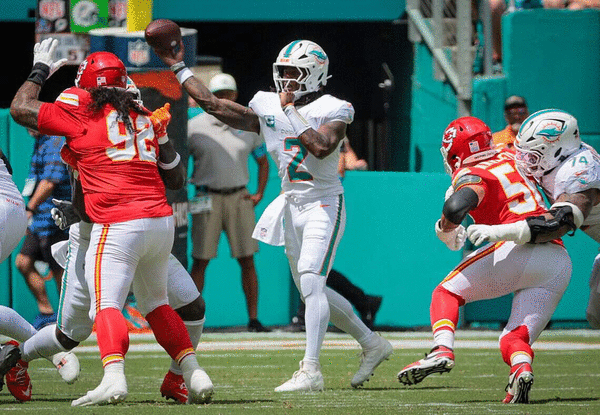
MIAMI GARDENS, Fla. — I wasn’t a fan of the Miami Dolphins signing quarterback Malik Willis in the offseason. So what’s my evaluation of Willis after four games, roughly the one-quarter mark of the 17-game season?
I kinda like him. I see potential there.
Yeah, this represents a bit of a change.
I’m the guy who wrote two columns during the offseason saying that the Dolphins should not sign Willis. It was business, not personal.
I wrote a column saying general manager Jon-Eric Sullivan and coach Jeff Hafley would be risking their early reputations by signing Willis. I also wrote a column giving examples of quarterbacks who, such as Willis, were backups for at least the first four years of their careers. That list includes Hall of Famer Kurt Warner, Jimmy Garoppolo, Jay Fiedler and David Garrard.
But Willis, the fifth-year player and first-year starter, is slightly better than I thought he’d be in a few ways, and at this point I’d say the Dolphins wouldn’t need to use their 2027 first-round NFL draft pick on a quarterback.
My thought for now, in early October, is that quarterback won’t be Miami’s No. 1 problem/concern/need at the end of the season. I favor using the first-round pick on an edge rusher.
Don’t get it twisted. I’d still recommend that the Dolphins select a quarterback in the second or third rounds.
And there’s still a chance that Willis’ 2026 performance could necessitate that the Dolphins must select a quarterback in the first round. Willis hasn’t shown me that he’s the so-called franchise quarterback. But that’s fine. He’s only made 10 career starts, including his four with the Dolphins.
Using the metrics that I think are most important to judge Willis, he’s showing progress.
Here’s the list:
Is Willis putting offense in advantageous situations?
For the most part, yes. But this remains a work in progress for the entire team, not just Willis. Self-inflicted damage is an issue for Willis and the offense. The Dolphins have scoring drives 17, 17, 12 and 10 plays. They’re slowly learning to put together plays. They now must learn how to score touchdowns in the red zone. They’re 3 of 9, last in the league, in red-zone offense (touchdowns only) at 33.3%.
Willis acknowledges he must make better decisions such as throwing the ball away while scrambling from the San Francisco 6-yard line against the 49ers instead of running out of bounds and taking a four-yard loss.
But here’s a fact: After Week 2, offensive coordinator Bobby Slowik said the Dolphins led the league in penalties on the opponent’s side of the field, or were tied for the league lead. He also said the Dolphins led the league in sacks on the opponent’s side of the field. Hafley referenced the situation Monday.
“We’ve got to stop shooting ourselves in the foot,” he said. “It’s, ‘We cross the 50, we go back. We get to the 40, we go back.’ We have to be disciplined and have that mental stamina to do right longer in those key situations, and we need to practice that way.”
Consider what surrounds Willis
Willis’ offense is talent-bare, even for rebuild purposes. Pro Bowl running back De’Von Achane (knee) is out for the season after being injured on the fifth play of the Kansas City game, meaning he’s practically missed two games. Rookie wide receiver Caleb Douglas, who is second on the team in receiving yards (113) and tied for third in receptions (seven), has also been sidelined for two games. Slot receiver Malik Washington (17 receptions, 219 yards) is Willis’ No. 1 target, by far.
The offensive line has been so-so. But their penalties are part of the problem once Miami crosses the 50-yard line. For example, rookie left guard Kadyn Proctor had a holding call at the San Francisco 3-yard line that pushed the offense back to the 13-yard line.
Right tackle Austin Jackson’s four penalties are tied for third-most among offensive linemen. Left tackle Patrick Paul has three penalties, excluding one holding call that was declined. Proctor and center Aaron Brewer have two penalties apiece. These often put Willis in tough down-and-distance situations, known as “playing behind the chains.”
Has Willis made those around him better?
Not yet. Willis isn’t at that stage. Perhaps he gets there around Thanksgiving. Perhaps he won’t get there until next season. Remember, this is a process and there will be setbacks. Success isn’t linear.
Does Willis make good decisions?
No, not always. But the big key here is that Willis doesn’t frequently make bad decisions. That’s important for a developing quarterback.
Does Willis repeat mistakes?
Not often. Willis seems to be a quick learner. He’s far from a finished product so, yes, sometimes he’ll repeat mistakes. However, Willis is making progress overall.
When judging Willis, it’s probably better to look month-to-month rather than week-to-week. Under that lens, it’s fair to say Willis is a better quarterback in early October than he was in early September.
Is Willis a leader?
Yes. Players respect and like Willis. You see this in locker room interactions. I’ve often seen Willis talking to groups of players and individual players. Sometimes it’s business, sometimes it’s for fun.
From my on-field and locker room observations, Willis mixes with players better than any Dolphins quarterback of the past five years except for Teddy Bridgewater, who was sort of a people’s champion. But Willis’ interactions are more smooth and natural than those of Tua Tagovailoa (who got along with teammates very well), Skylar Thompson, Tyler “Snoop” Huntley, Mike White (who also got along with teammates very well) and all the others.
Stats
The numbers are fairly ugly but they require perspective, which is provided above.
Willis is 58 of 103 (56.3%) for 712 yards, one touchdown, two interceptions, 11 sacks, two lost fumbles and a 73.0 passer rating.
Willis has twice as many turnovers (four) as touchdowns produced (two, one passing, one rushing). That’s unacceptable. Also, he ranks in the second half or bottom of the league in a few categories including completion percent (28th) and passer rating (26th).
And he ranks near the top of the league in sacks (tied for third most), which helps illustrate his overall predicament.
Summary
Willis doesn’t need to be a Hall of Fame quarterback, he just needs to be effective in the Dolphins’ system. Brace yourself for this hard truth: In the NFL, it’s not all about the quarterback. It’s more about overall talent and system.
As I tell people, there’s a reason that Philadelphia Eagles quarterback Jalen Hurts and the Seattle Seahawks’ Sam Darnold, who have no MVP awards, have won Super Bowls, while the Buffalo Bills’ Josh Allen and Baltimore Ravens’ Lamar Jackson, who have three MVP awards, haven’t even been to a Super Bowl.
For now, the arrow is pointed upward on Willis. At this point I think he can develop into an effective starter. It’s not panic time.
©2026 South Florida Sun-Sentinel. Visit sun-sentinel.com. Distributed by Tribune Content Agency, LLC.




Comments