What mattered in the NFL preseason for fantasy football drafts
Published in Football
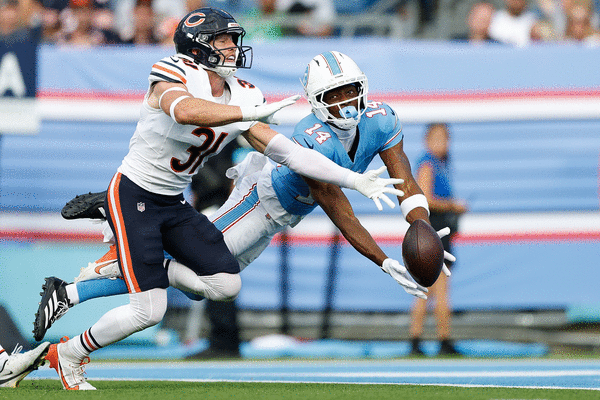
The NFL finally killed the Pro Bowl, which leaves preseason football with a compelling case as the worst product the league still asks us to watch.
The games don’t count, the best players barely play and by the fourth quarter, broadcasts are identifying receivers by their colleges. It’s primarily because most of the audience — and an assortment of their teammates — have no idea who they are.
Season-ticket holders pay real money for this.
To be fair, preseason football isn’t really designed to entertain us. Coaches are taking a microscope to roster spots 48 through 53, determining who’s responsible for throwing the challenge flag and deciding which third-string linebacker is about to become considerably more familiar with LinkedIn.
And yet millions of us watch anyway.
The Hall of Fame Game drew roughly 7 million viewers this summer. Even ordinary NFL Network exhibitions can attract audiences comparable to nationally televised regular-season games in other major sports.
That Cardinals-Panthers exhibition — a game whose outcome meant absolutely nothing — drew a larger audience than the average game of both the 2026 NBA Playoffs (5.3 million) and the 2025 MLB postseason (6.33 million).
Some of that is simply America’s inability to say no to football.
Fantasy football gives us another excuse.
Because if you know what you’re looking for, these games contain useful information. Certainly not the final scores, and its useless knowing which running backs ran for 100 yards against defenders destined for the UFL.
What matters most is usage and circumstance.
Which running back stayed on the field on third down? Which receiver played in two-wide sets? Who got the goal-line work? Which rookie opened with the starters? When injuries struck, who saw the biggest jump in reps?
And, perhaps most revealing, who was considered valuable enough to get the night off entirely during the final week of the preseason?
The scores are meaningless, but the snaps aren’t.
QUARTERBACKS
— Jordan Love, Packers: Josh Jacobs’ indefinite absence could force Green Bay away from its run-heavy tendencies. Increased passing volume gives Love considerably more upside and raises the ceiling of everyone attached to the Packers’ passing game.
— Kyler Murray, Vikings: Sometimes August simply removes uncertainty. Murray gives Minnesota a proven veteran quarterback and protects its pass catchers from the volatility that often accompanies a developing starter.
— Malik Willis, Dolphins: Miami committing to Willis creates an intriguing late-round bet. His legs provide a fantasy floor when the passing fails and should create additional space for De’Von Achane.
— Tua Tagovailoa, Falcons: Michael Penix Jr. still looms as Atlanta’s eventual starter, making Tagovailoa more bridge than long-term answer. Tua can keep the offense efficient with quick throws and YAC opportunities, but Penix’s eventual takeover could unlock a more aggressive vertical passing game.
— Kirk Cousins, Raiders: Cousins opens as the starter, but No. 1 pick Fernando Mendoza is waiting behind him. The veteran profiles as a streamer, while Las Vegas’ pass catchers carry added volatility in a quarterback situation that feels more temporary than settled.
— Deshaun Watson, Browns: He won Cleveland’s competition without inspiring much fantasy optimism. A sluggish preseason makes Watson a low-ceiling option and Browns receivers largely volume-dependent bets.
RUNNING BACKS
— Jahmyr Gibbs, Lions: David Montgomery’s departure removed the most obvious obstacle between Gibbs and nuclear-level fantasy volume. We already know what Gibbs can do per touch. The possibility of substantially more of them puts him squarely among the players capable of finishing No. 1 overall at the position.
— Jeremiyah Love, Cardinals: Eight of Arizona’s first 11 running-back snaps in the opener belonged to Love, an encouraging signal. Tyler Allgeier handling the red-zone work was less so. Love’s talent still warrants an aggressive draft price despite a high ankle sprain, but limited goal-line opportunities could make the early returns frustrating.
— Jadarian Price, Seahawks: Seattle resting Price alongside starters after one preseason appearance was the strongest endorsement possible. With Zach Charbonnet unavailable, Price should lead the backfield early, even if 20-plus touches aren’t guaranteed.
— TreVeyon Henderson, Patriots: Calling Henderson New England’s “1B” may have been too optimistic. The preseason suggested Rhamondre Stevenson still owns the valuable dirty work: pass protection, early downs and the goal line. Henderson does remain the more explosive option.
— MarShawn Lloyd, Packers: Jacobs’ absence creates immediate opportunity. Lloyd has the most intriguing ceiling in Green Bay’s replacement committee and has moved firmly into the RB2/RB3 conversation.
— Tyjae Spears, Titans: Spears out-snapped Tony Pollard and ran more routes alongside Cam Ward. That’s enough evidence to treat Tennessee as a genuine committee — and Spears as the cheaper half worth targeting.
— Emmett Johnson, Chiefs: Johnson established himself as Kenneth Walker’s primary backup with impressive elusiveness and receiving ability. That gives him premium-handcuff appeal with a little more standalone upside than most insurance policies.
— Kaelon Black, 49ers: Black played every snap across San Francisco’s first three possessions in the finale and appears to have secured the No. 2 job over Jordan James. He has little standalone value, but he’s the Christian McCaffrey handcuff to roster.
WIDE RECEIVERS
— Nico Collins, Texans: Jayden Higgins’ season-ending injury further consolidates Houston’s targets. Kayshon Boutte can help without threatening Collins’ alpha role, leaving a massive ceiling if Collins stays healthy.
— Tetairoa McMillan, Panthers: Increased slot usage should help Carolina manufacture favorable matchups and easier targets. After a volatile rookie year, that versatility should raise McMillan’s weekly floor.
— Parker Washington, Jaguars: Forget the “WR1” camp chatter. What matters is Washington appearing headed for two-receiver sets, which would materially increase his routes and fantasy opportunity.
— Carnell Tate, Titans: Zero catches on six preseason targets isn’t fatal, but it isn’t meaningless for a rookie. Draft the talent while preparing for early volatility rather than assuming immediate flex production.
— Josh Downs, Colts: Downs staying on the field in two-wide personnel would be significant. His production has improved whenever his snap rate climbs, and Indianapolis has every reason to expand his role.
— De’Zhaun Stribling, 49ers: Injuries created the opportunity and Stribling capitalized. A starting perimeter role in Kyle Shanahan’s offense makes the second-round pick one of the more intriguing late-round swings. I’m not ready to declare him the next Jerry Rice, but I believed coming out of the draft he could eventually fill the role Brandon Aiyuk vacated — perhaps with considerably less drama attached.
— Ja’Kobi Lane, Ravens: Baltimore resting Lane alongside its starters was the strongest preseason signal yet that the rookie has secured a meaningful role. He projects to be on the field regularly in 11 personnel, giving him enough route volume to warrant late-round interest even in an offense that may not support consistent weekly targets.
— Kyle Williams, Patriots: Williams authored the sort of preseason stat line that starts sleeper stampedes: six receptions, 166 yards and three touchdowns, including another 45-yard score in the finale. Unfortunately, playing while four established receivers rested showed where he actually sits. Ignore him in most redraft leagues; stash him in dynasty.
TIGHT ENDS
— Tucker Kraft, Packers: Kraft progressed from ACL restrictions to unrestricted team work. Better health plus the possibility of increased Green Bay passing volume keeps him squarely in the TE1 conversation.
— Harold Fannin Jr., Browns: Full-time routes plus legitimate inline usage is exactly what fantasy managers want to see. Cleveland’s offense may limit touchdowns, but Fannin’s opportunity gives him a legitimate breakout path.
— Isaiah Likely, Giants: New York didn’t treat Likely like a traditional tight end during its first-team preseason work. He was used extensively from the slot and detached from the formation, essentially giving the Giants another receiving weapon who happens to qualify at fantasy’s thinnest position.
— Charlie Kolar, Chargers: The Chargers’ preseason usage provided considerably more clarity than their depth chart. Kolar ran a route on four of Justin Herbert’s five first-team dropbacks and played six of seven snaps, while David Njoku ran two routes and Oronde Gadsden just one.
©2026 The San Diego Union-Tribune. Visit sandiegouniontribune.com. Distributed by Tribune Content Agency, LLC.




Comments