John Romano: What's at stake? Just millions, a Buccaneers season and Vita Vea's career.
Published in Football
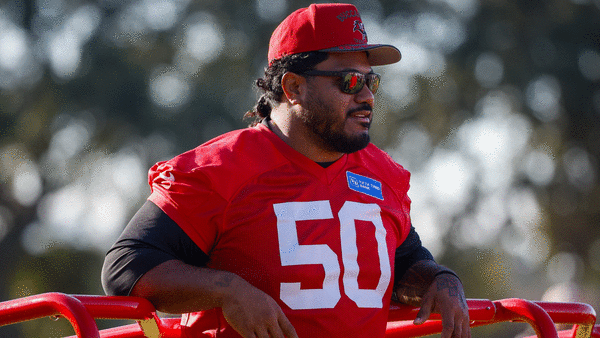
TAMPA, Fla. — Preseason games are now officially underway, and the defensive tackle is still way underpaid.
It’s a quandary, no doubt about it. Vita Vea has been loitering around training camp to avoid being fined, but he’s missed the first dozen or so practices. Officially, he’s sidelined with a minor back injury. Realistically, he’s suffering from bruised feelings.
Vea has been an integral cog in Tampa Bay’s recent successes, but his $17.75 million average salary no longer reflects that. It’s a hefty sum, for sure, but there are roughly 20 NFL defensive tackles making more money in 2026.
That’s the backdrop for Vea’s request to be traded.
It’s also a fork in the road for the upcoming season.
Vea’s agent recently told Tampa Bay Times NFL writer Rick Stroud that a trade is the only way this stalemate ends. That’s meant to sound ominous to fans. Buccaneers general manager Jason Licht says he has no intention of trading Vea. That’s meant to sound reassuring to fans.
Either way, this is the bottom line:
The Bucs cannot afford to lose Vea in any circumstance, be it trade or holdout or injury. While his statistics are not eye-popping, he may be the most important player in the defensive huddle. He’s one of the game’s top run-stoppers and he often draws double teams, which makes life easier for the other 10 guys on defense.
You can argue that he voluntarily signed his contract four years ago and, therefore, should get his butt on the field. And if this were baseball, where all contracts are guaranteed, that would be a rational argument.
But NFL contracts are skewed toward ownership. The four-year, $71 million deal Vea signed in 2022 had roughly $34 million in guarantees. So the Bucs could have cut him at various points while paying out less than half the contract’s value. It’s not a stretch to say NFL players need to get their money while they can because careers are short and injuries are practically inevitable.
Now, does that sound like I am siding with Vea? I suppose, but only to a point.
The Bucs need to worry about setting a precedent by allowing a player to hold them hostage by not putting on his shoulder pads. They also need to be concerned with salary-cap implications, particularly since Vea is 31 and, by necessity, carrying a lot of weight.
In other words, the solution in this case is not simple. This isn’t like Jahmyr Gibbs in Detroit or Bijan Robinson in Atlanta. Both running backs started recent training camps on the sideline before signing record-breaking deals. But they’re both 24 years old and coming off their entry contracts. It’s a little different for a player in his 30s who’s already taken a big bite of the apple.
So how will this standstill end? History has some thoughts on that.
Vea signs a new deal
We’ve seen a lot of this the past few seasons. Usually in the last week or two of training camp. Trey Hendrickson, Terry McLaurin, James Cook, Cameron Heyward, Nick Bosa and CeeDee Lamb all signed new contracts in mid to late August or early September of 2023-25. If Vea is using the trade demand simply as leverage, there’s a decent chance this is the result.
Vea is traded
Hard to see this scenario. While Micah Parsons (2025), Matthew Judon (2024) and Jadeveon Clowney (2019) forced trades during training camp, it’s not the usual outcome. Considering how important Vea is to the Bucs (and has a relative lack of trade value due to his age) there’s not a lot of upside for the team to deal him. It was before Licht’s time in Tampa Bay (but during the Glazer era) when Keenan McCardell staged a holdout in 2004. It wasn’t until the Bucs stumbled to a 1-5 start before they dealt him to the Chargers at the trade deadline.
Vea relents before the opener
It’s possible, but I wouldn’t bet on it. Returning without a new contract is a blow to the ego. It would also likely mean the end of Vea’s time in Tampa Bay. If he plays the 2026 season on his current deal, free agency would be his reward. But there is risk involved. Earl Thomas returned to the field in Seattle without a new contract in 2019 but blew out his knee a month later and his career was effectively ruined without the megadeal he expected.
Vea refuses to play
Worst-case scenario for everyone involved. That would include Vea, the Bucs and fans. There are some cases of players sitting out an entire season and successfully resuming their careers elsewhere after an offseason trade (Trent Williams is a good example) but those are pretty rare. The more memorable cases are guys like Haason Reddick and Le’Veon Bell who staged extended holdouts, lost millions of dollars and their careers were never the same.
This has not yet reached crisis mode for the Bucs but, by this time next week, the ticking of the clock will begin to grow noticeably louder.
____
©2026 Tampa Bay Times. Visit tampabay.com. Distributed by Tribune Content Agency, LLC.





Comments