Eddie Brown: Want to win your fantasy football draft? Follow the missing touches.
Published in Football
The sports calendar has its own collection of unofficial holidays.
Opening Day in baseball. The first Sunday of the NFL season.
That glorious first Thursday of March Madness tipping off while half the country is technically at work and spiritually sitting in a sportsbook.
And then comes fantasy football’s version of the groundhog emerging from its burrow.
The league group chat stirs after eight months of silence.
A message from the commissioner and suddenly people who have barely communicated since Christmas emerge from digital hibernation.
One person responds instantly. Another needs four days to make the decision to play for the 17th consecutive year despite threatening to quit the last dozen.
Someone asks when the draft is. Someone else wants to eliminate kickers and replace them with a superflex. The commissioner briefly wonders why they volunteered for this.
We are so back.
I’m in four fantasy leagues, which, by my standards, qualifies as restraint.
Thankfully, I am no longer commissioner of any of them.
Everyone should have to serve as fantasy commissioner once, though.
Forget jury duty. Fantasy commissioner should be the mandatory civic obligation.
You will learn more about democracy administering a 12-team league than you will watching six hours of cable news.
There is taxation, otherwise known as collecting league dues from someone who has been promising to pay since the draft.
There is constitutional law, generally involving a rule nobody has read since the league was formed.
There is representative government, where half the league votes and the other half complains about the outcome.
There are lobbyists, usually managers seeking reforms that would improve their own playoff chances.
There is judicial review whenever two teams make a trade everyone else hates.
And eventually there is authoritarianism, when the commissioner realizes democracy has failed and simply makes a ruling.
Commissioners begin every season believing in consensus and usually finish it with a newfound appreciation for Machiavelli.
I have served my time and regained my freedom. Now I can focus on a more noble pursuit — finding undervalued players before everyone else does.
And as fantasy drafts approach, one of the best places to begin is simple.
Follow the missing touches.
Follow the money in real life if you’re investigating politics. Follow opportunity in fantasy football if you want to win.
Every offseason, receivers, tight ends and running backs leave behind targets, carries and red-zone opportunities that must be redistributed. Vacated volume does not transfer automatically. Sometimes three players split it. Sometimes an offense changes. Sometimes a rookie simply isn’t ready.
The trick is identifying where talent and opportunity intersect.
Last season supplied the blueprint. Dallas signed Javonte Williams after Rico Dowdle left, and Williams responded with a career-high 1,201 rushing yards and 11 touchdowns. The Rams added Davante Adams after Cooper Kupp departed, and Adams drew 114 targets, scored 14 touchdowns and finished as a top-10 PPR receiver.
So where should we look this year?
DeVonta Smith, WR, Eagles
Start here. Philadelphia traded A.J. Brown to New England, creating 121 available targets and nearly 1,500 air yards. Smith’s targets per route run jump from roughly 20% to 30% without Brown. First-rounder Makai Lemon adds competition, but Smith finally has a clear path to becoming the Eagles’ unquestioned No. 1 receiver.
Emeka Egbuka, WR, Buccaneers
Mike Evans is gone, taking his targets and end-zone looks with him. Egbuka was fantasy’s WR3 through five weeks before injuries and shaky quarterback health slowed him as a rookie. With Evans gone and more pre-snap motion coming, expect more volume.
Ladd McConkey, WR, Chargers
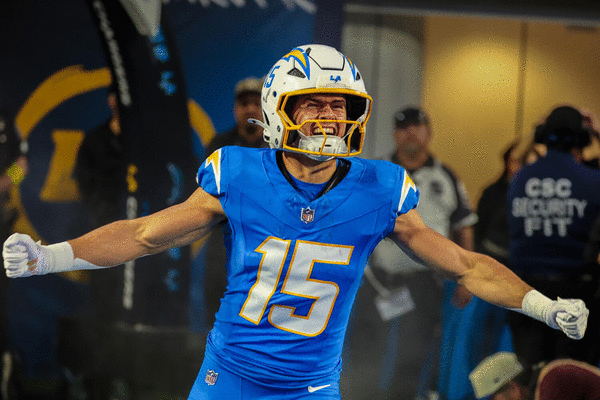
Keenan Allen’s 122 targets are gone, including 15 in the red zone. Tre Harris and Quentin Johnston will get some, but McConkey should inherit many slot looks. Mike McDaniel likes motion, mismatches and space. McConkey gets open. Justin Herbert throws to open people. Syllogism complete.
Rome Odunze, WR, Bears
DJ Moore’s trade leaves 85 receiver targets and nearly 1,000 air yards available. Odunze commanded a 21.9% target rate and scored six touchdowns in 12 games. Luther Burden III and Colston Loveland benefit too, but Odunze offers the best blend of pedigree, opportunity and price.
Christian Watson, WR, Packers
Green Bay lost Romeo Doubs and Dontayvion Wicks, creating 131 available receiver targets, plus half its targets inside the 10. The Packers then extended Watson, an obvious clue about the hierarchy. If healthy, the touchdown upside is substantial.
Josh Downs, WR, Colts
Michael Pittman Jr.’s trade removed 80 receptions, 784 yards, seven touchdowns and 111 targets. Downs still had 58 catches for 566 yards on 88 targets despite losing snaps in multiple-tight-end sets. Indianapolis wants to expand his role. He is the boring August pick who becomes useful by October.
Kenneth Walker III, RB, Chiefs
Kansas City had 281 available carries and 15 vacated carries inside the 5, then gave Walker $43 million. He produced 1,309 yards on 252 touches despite sharing Seattle’s backfield with Zach Charbonnet. Walker totaled 417 yards and four touchdowns in three playoff games, capped by 161 yards on 29 touches and Super Bowl LX MVP honors. Injuries remain the concern, but more goal-line work gives him RB1 upside.
Bhayshul Tuten, RB, Jaguars
Travis Etienne Jr.’s departure leaves behind 296 touches. Tuten produced 307 rushing yards, 10 receptions, 79 receiving yards and seven touchdowns on 93 rookie touches. His 3.7 yards per carry won’t inspire poetry, but his yards after contact and forced missed tackles might. Chris Rodriguez Jr. and LeQuint Allen Jr. will siphon work, but Tuten should lead the backfield.
Jadarian Price, RB, Seahawks
The No. 32 pick has a clean opening with Walker gone and Charbonnet recovering from an ACL tear. Price averaged 4.13 yards after contact and 6.9 yards per carry in zone concepts at Notre Dame. That should translate nicely to Brian Fleury’s San Francisco-style outside-zone system. George Holani and Emanuel Wilson will steal some snaps, and Charbonnet could reclaim passing-down work once he returns around midseason, but Price should open the year with starter-level volume and a favorable schedule.
Chuba Hubbard, RB, Panthers
Rico Dowdle left 236 carries after rushing for 1,076 yards. Jonathan Brooks is returning from two ACL tears that erased nearly all of his first two seasons, leaving Hubbard positioned for the largest share. At the right price, temporary control of a productive backfield is plenty valuable.
Chig Okonkwo, TE, Commanders
Okonkwo topped 50 receptions in each of his past three seasons. Zach Ertz is gone after Jayden Daniels targeted him 91 times in 2024, producing 66 catches, 654 yards and seven touchdowns. Washington also gave Okonkwo three years and $27 million. That usually means something.
Greg Dulcich, TE, Dolphins
Miami lost Tyreek Hill, Jaylen Waddle and Darren Waller, leaving targets everywhere. Dulcich caught 26 passes for 335 yards and one touchdown despite not being targeted until Week 9. With little competition, he could become Miami’s No. 2 target behind De’Von Achane — a useful late-round dart.
©2026 The San Diego Union-Tribune. Visit sandiegouniontribune.com. Distributed by Tribune Content Agency, LLC.



Comments