Buyers of Seahawks made billions of dollars in Bay Area tech
Published in Football
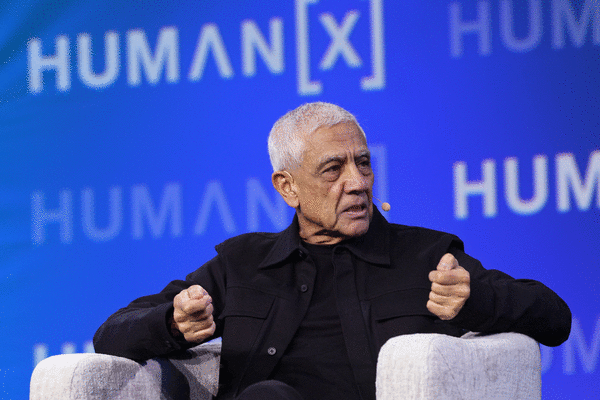
SEATTLE — As the investor in some of the most successful startups in history, Silicon Valley’s Vinod Khosla has proved remarkably prescient in picking winners, including AI wunderkind OpenAI, maker of ChatGPT.
Now, as likely new owners of the Seattle Seahawks, Khosla, his wife Neeru and son Neal, may bring some of that entrepreneurial, disruptive energy to the two-time Super Bowl champs. A group led by the family is reportedly buying the team from the estate of Paul G. Allen for a $9.6 billion, the most ever paid for an NFL franchise.
“Excited to be part of this great franchise,” Khosla, 71, posted on social media Saturday, about the sale, which must still be approved by the NFL. “Also excited to see the money all go to a non-profit.”
News of the transaction has ignited a heated debate over what changes, if any, the Khosla family ownership would mean for the Seahawks, which went on the market in February.
It has also led to speculation over how the purchase might fit into the finances of the Khosla family, which has a reported net worth of nearly $14 billion.
Khosla, who has backed hundreds of startups over his career, declined to comment on the sale, and, true to Silicon Valley form, referred inquiries to his Wikipedia page.
His Menlo Park, Calif.-based business organization, Khosla Ventures, likewise referred to a statement by the Allen estate, which confirmed a sale agreement with “an ownership group led by the Khosla family.”
But details of a more complex ownership picture have emerged since.
Neeru Khosla, 71, an entrepreneur in her own right, will reportedly serve as the team’s “controlling owner," according to a July 11 memorandum from the NFL obtained by ESPN’s Ian Rapoport.
And Neal Khosla, a 2015 Stanford University graduate, “would be expected to have a significant leadership role in the new ownership group,” according to the memo.
Vinod Khosla will also have to sell a 3.1% stake in the San Francisco 49ers he purchased last year, the memo said.
'Don’t need more money'
The purchase of the Seahawks, which is expected to be approved as early as August, caps a remarkable trajectory for the Khosla family.
Born in India, Vinod came to the U.S. in 1976 at age 21 and studied biomedical engineering at Carnegie Mellon University. In 1982, he co-founded Sun Microsystems, a pioneer in computer operating systems and servers. Within six years, the company hit $1 billion in sales.
Khosla’s greater successes have come as a technology investor, including in early internet ventures. Khosla Ventures, launched in 2004, was an early backer of OpenAI, now one of the biggest players in artificial intelligence.
Since 2004, Khosla Ventures has invested in many startups that have become household names, including DoorDash, Instacart and Stripe. It has backed companies aiming to disrupt traditional players in healthcare, clean energy, low-carbon building materials, mass transit, self-driving vehicles and spaceflight.
Khosla, who lives near Palo Alto, Calif., thinks AI will utterly disrupt the U.S. economy and has floated ideas, such as only taxing incomes above $100,000, as a way to soften the blow to human workers.
He’s also rich enough not to care what anyone thinks.
“I can’t be fired,” he told Fortune recently. “I’ve never worried about a career. I don’t need more money at age 71.”
But, apparently, Khosla did need an NFL football team — even if it’s the bitter rival of his own 49ers.
In early May, media outlets reported that a group led by Khosla was preparing an offer for Seahawks. A second offer was in the works by Wyc Grousbeck and Aditya Mittal, currently Alternate Governors of the Boston Celtics.
Neeru Khosla has had a much lower profile than her husband of more than 45 years, but has some experience in the entrepreneurial space.
In 2007, she co-founded the CK12 Foundation, a nonprofit focused on supplying primary and secondary schools with customizable education materials to underserved communities globally.
“Even a single kid going through the system that we don’t take care of — it’s criminal,” she told Forbes in 2015. “To me it’s a deep emotion.”
Neeru’s passion for football is not widely known.
When her husband became part owner of the 49ers last year, the team’s website quoted Neal Khosla as saying that he and his father were huge fans of the team, but doesn’t mention his mother.
“My father and I have been season ticket holders for 30 years, going to games at The Stick starting when I was a child through the last 11 years at Levi’s Stadium,” he said.
When the 49ers announced the purchase last May, the team reported the buyer as “the Khosla family, led by Neal and Vinod Khosla.”
No better investment
That has led to some questions about what Neeru would actually be doing as controlling owner, as well as speculation around Vinod Khosla's motivations for buying the team.
Joe Pompliano, who writes about the finance of professional sports, says one attraction that would have appealed to Vinod is sports’ emerging value in an entertainment world increasingly dominated by AI content.
As AI’s “near-zero production costs lead to an explosion of artificial content across social media and streaming, live sports become one of the last remaining authentic and unpredictable pieces of content,” Pompliano wrote in a recent Substack article.
Pompliano speculates that Vinod was attracted by federal tax provisions that let purchasers of a company’s assets deduct part of the cost from income taxes over 15 years.
The deduction would effectively erase any income the Khosla group is likely to get from the team for 15 years, Pompliano calculates.
A spokesperson for the Khosla Foundation declined to comment on Pompliano’s estimates.
Tax attorney Louis Tuchman, a partner and chair of the tax department at New York-based Herrick, which handles many sports team sales, says so-called cost-recovery deductions aren’t unique to sports teams, but apply to many transactions where actual assets are being purchased.
Tuchman doesn’t know the details of the Khosla purchase or how much the team generates. But as a rough estimate, he said the deduction might allow the Khosla group to deduct a little under 6% of the purchase price each year for 15 years.
“This is a major purchase ... I don't care how wealthy you are,” Tuchman said. “It's fair for someone who's making an investment of this sort to say, ‘OK, how am I recovering my investment?’ ”
Industry experts say the real financial draw of buying a sports team isn’t the annual income anyway, but the likely massive gain the buyer will realize when they sell the team.
As Natalie Welch, the director of Seattle U’s Albers School of Business and Economics’ Sport and Entertainment Management MBA Program, told The Seattle Times this week, “you can’t find a better investment and a better return on investment than an NFL team if you have the opportunity and the funds.”
© 2026 The Seattle Times. Visit www.seattletimes.com. Distributed by Tribune Content Agency, LLC.



Comments