Seattle can host FIFA Men's World Cup. Why can't it host Super Bowl?
Published in Football
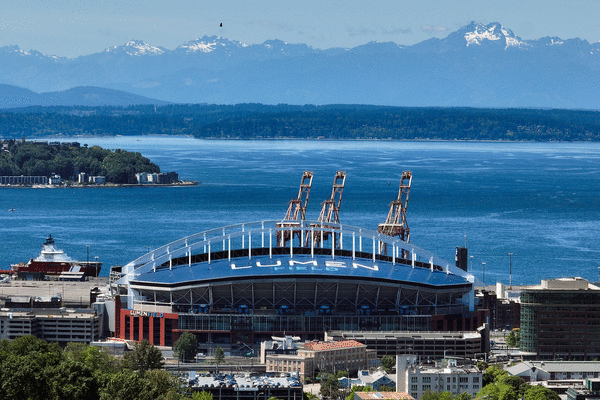
SEATTLE — Seattle serving as a host this summer to what many consider the biggest sporting event on the planet — the World Cup — inevitably raises another question.
Could Seattle someday host a Super Bowl, the biggest annual sporting event in the United States?
The short and unappetizing answer is that the odds may be about as long as Oklahoma City Thunder owner Clay Bennett someday getting a key to the city of Seattle.
That’s based on Seattle’s history of never hosting the game and the league’s recent actions that only lengthen the remote odds.
The longer and more hopeful answer is to say, “Who knows what the future might hold?”
Whether Seattle could ever get a Super Bowl might be contingent on a new or renovated stadium that would add a roof and seats.
Some have theorized that landing a Super Bowl could be motivation for whoever becomes the next owner of the Seahawks to push for a new stadium.
The general view seems to be that the already long odds of Seattle getting a Super Bowl wouldn’t be a major factor — if one at all — in a new stadium effort, assuming a new owner wants one down the road.
But it’s still worth exploring a forgotten history of Seattle’s long-ago efforts to land the Super Bowl and what it takes to get one now.
Seattle’s Super Bowl bid history
The passing of time makes it easy to forget the handful of efforts Seattle made to land a Super Bowl during the first decade or so that the Seahawks existed and were playing to sold-out crowds in the climate-controlled Kingdome.
From the start, those efforts had a low percentage of success given that the league has always preferred warm-weather locations for the obvious reasons of attempting to assure a good setting for gameday and a fun vacation for those attending.
Just six of 60 Super Bowls have been held in what could be considered northern or cold-weather cities — Detroit and Minneapolis two each and Indianapolis and New York/New Jersey one each.
Only one — a game in 2014 that Seahawks fans might remember in New Jersey — has been held in an open-air stadium in a northern city.
Exactly half of the 60 were held in either Florida or California.
Seattle made a serious effort to get the game, notably in 1979, 1982, 1984 and 1988/89.
The 1979 attempt came on the heels of Seattle hosting the Pro Bowl in 1977, back when that was a far bigger deal than it is now.
At an NFL meeting that March, Seattle made a bid for the 1983 game that went to Pasadena, Calif.
At that same meeting, the NFL awarded the first Super Bowl in a cold weather city to Detroit and its new indoor stadium for 1982.
That left Hartly Kruger, who led the Seattle delegation as the head of the Seattle-King County and Visitors Bureau, as being quoted the next day saying he was “very encouraged” that the league was awarding a Super Bowl to a cold-weather city with a domed stadium and that Seattle planned to make another run at the game in a few years.
Bad weather that snarled traffic on gameday and caused the San Francisco 49ers to not arrive until 90 minutes before kickoff didn’t help the league warm to the idea of regularly playing Super Bowls in the north.
Seattle attempted to show how serious it was at landing the game in 1984 by agreeing to add up to 6,500 temporary seats to the Kingdome to try to push capacity past 70,000 (the venue had an official football capacity of 66,000), while also agreeing to give up its allotment of tickets usually given to the host team.
Alas, future Super Bowls were awarded that year to Pasadena and San Diego.
Hope emerged anew in 1985 when the NFL adopted a resolution introduced by then Seahawks managing partner John Nordstrom to commit to picking a northern site for the Super Bowl in either 1991 or 1992.
This, finally, seemed like Seattle’s big shot, with the city feeling some added momentum after having also just shown it could host a successful Final Four at the Kingdome in spring 1984.
A Seattle Times story in March 1988 stated that Seattle was “considered by many the front runner for the 1992 Super Bowl.”
Eddie DeBartolo, then owner of the San Francisco 49ers, was even quoted as saying it was “an open and shut case” that Seattle would get the game, citing in part the desire to reward the Nordstrom family “because they were so popular” within the league.
But when the league held its meetings that month, it decided not to award any future Super Bowls, pushing the decision back a year.
By then, the Seahawks had a new owner — Ken Behring purchased the team from the Nordstrom family in August 1988 — which changed the dynamic.
Seattle was one of four NFL cities with domed stadiums making bids for the 1992 game along with Detroit, Minneapolis and Indianapolis.
Reports stated Seattle finished fourth in the voting, which was won by Minnesota, said to be in part because of Detroit already hosting a Super Bowl and the Vikings (who entered the league in 1961) being in the NFL longer than the other two finalists.
The Seattle Times stated that the Seattle contingent — which included Nordstrom, who attended hoping to still help get the game for the city — was left “bitterly disappointed” and that the effort to get the game was likely to “be the last for many years.”
Said Seattle host committee chairman John Getzelman when asked when the city might try again, “I think it’ll be a very long time.”
Indeed, no more efforts were made during the fraught Behring era, which included an attempted move to Los Angeles.
When Paul Allen mercifully bought the team in 1997, it was with a plan for an open-air stadium to try to replicate the Husky Stadium atmosphere he fondly recalled of his youth.
Given the city’s failed attempts at getting a Super Bowl, there also seemed little reason to try to build a stadium to meet the apparent requirements to get one, and any thoughts of a retractable roof were set aside for cost reasons.
There has been no serious attempt to get the game since.
Could Seattle try again?
Any speculation about the long-term future of the franchise and efforts to lure league events are on hold until the sale from Jody Allen to a new owner is completed.
What’s worth noting is that the old model of cities deciding they want to place bids for the Super Bowl and making presentations to the league is no longer in effect.
In 2017, the league quietly changed its protocol for awarding Super Bowls, which it also uses for the NFL draft.
Now, instead of a bidding process, the league approaches a city or cities about hosting future games (or the draft) — something few if any cities are likely to turn down once it gets to that point — and has them prepare plans to present to owners for approval.
This has led to recent votes becoming one-city slam dunks — in March, Las Vegas was unanimously approved as the host of the 2029 game; and earlier this month, Nashville, Tenn., was unanimously approved for the 2030 game (Los Angeles will host in 2027 and Atlanta in 2028).
Nashville getting a Super Bowl illustrated that the NFL’s requirements for hosting a game can be altered if the league has a desire to go to a certain city.
Nashville’s new indoor stadium, set to open in 2027, is expected to have a fixed capacity of around 60,000, which will be the smallest in the league and far below the long-stated reported requirement for hosting the Super Bowl of a stadium needing to seat 70,000 or more (though Nashville’s stadium will reportedly also have a sizable number of standing-room-only spaces that will bump up attendance for big events).
Awarding the Super Bowl to Nashville appears to show that what the league might care about just as much as what happens on gameday is a city’s ability to handle the entire week of events leading up to the game.
When the announcement was made, the league trumpeted that 600,000 fans attended the NFL draft in Nashville in 2019, as well as its reputation as an event city and that it is expected to add 18,000 hotel rooms by 2030 to increase the city’s total to 80,000.
After the Super Bowl last February in which the Seahawks beat the Patriots, 29-13, the San Francisco host committee’s thank you letter noted that there were “300+ events across the region” held in conjunction with the game and 100,000 hotel rooms booked.
Natalie Welch, who teaches in the Sport and Entertainment MBA program at Seattle University, said Super Bowls are really “becoming more and more” about the events in the week leading up to the game — concerts, block parties, the Super Bowl experience “immersive football festival” and the numerous businesses that hold networking events — than the game itself.
“It’s really more of a corporate event,” she said. “It’s less about stadium capacity and all that and more about is it a good fit for being a sexy marketing event.”
With Vegas and Nashville appearing set to join a Super Bowl rotation of regular host cities that includes Los Angeles, the Bay Area, Tampa Bay, Miami, Atlanta, New Orleans and Phoenix, it’s a club that might only get that much more difficult to break into.
©2026 The Seattle Times. Visit seattletimes.com. Distributed by Tribune Content Agency, LLC.





Comments