Mike Preston: Marvin Lewis knows hurdles facing Ravens' Anthony Weaver
Published in Football
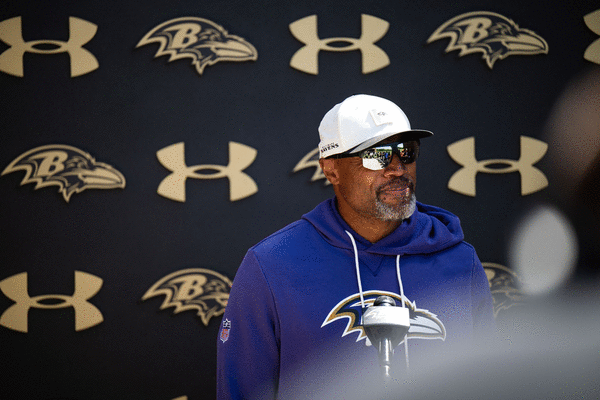
BALTIMORE — Former Ravens assistant coach Marvin Lewis has been in the same position as current defensive coordinator Anthony Weaver.
Lewis became a hot commodity shortly before he turned the Ravens’ defense into one of the greatest ever in 2001, as Baltimore won Super Bowl XXXV. Shortly thereafter, he was interviewed by four teams for head coaching positions.
Now, let’s move forward to 2026.
There were 10 head coaching vacancies this offseason, and not one was filled by a Black man, despite the fact that the majority of both college and pro football players are Black. In the past three seasons, Weaver has done nine interviews with nine franchises.
According to Lewis, Baltimore might be Weaver’s best chance because the 45-year-old coordinator is with Ozzie Newsome, who became the league’s first Black general manager in 2002. Newsome currently serves as the Ravens’ executive vice president of player personnel.
“I think he is probably in a good space,” said Lewis, 67, who served as Cincinnati’s head coach from 2003 through 2018 and compiled a 131-122-3 overall record while being named Associated Press NFL Coach of the Year in 2009. “He is with Ozzie, and that’s another person that can be an advocate for him.”
Lewis, though, wasn’t finished. He acknowledges being basically the “token” interview for years before the Bengals presented him with the opportunity. The NFL’s Rooney Rule, established in 2003, requires teams to interview minority candidates for head coaching vacancies.
Lewis offered Weaver some great advice on breaking through and landing a head coaching position.
“It’s what you do when nobody is watching,” Lewis said. “Secondly, you have to do a good job of presentation all the time. But from the standpoint of what we’re talking about, I think it’s how you interact or operate within the pregame meetings when they are talking with network people. You have to make as many tie-ins as possible.
“You don’t have to kiss anybody’s [butt], but present yourself in the right way. I think being an ex-player has a little bit of an advantage, but I believe he will get the opportunity. You can’t be discouraged, but encouraged.”
Weaver will get his chance to rebuild the Ravens’ defense and make his case for a head coaching position.
A year ago, the Ravens were in disarray. It’s very easy to blame former defensive coordinator Zach Orr, but the Ravens lacked reliable talent. They allowed 247.9 yards passing per game and couldn’t mount consistent pressure without exotic blitzes. They had only 30 sacks.
That’s a lack of talent.
Weaver can rebuild with the recent signings of former Bengals outside linebacker Trey Hendrickson and veteran defensive lineman Calais Campbell. Second-year outside linebacker Mike Green also should be able to provide more pressure after a strong offseason in the weight room.
Even though rookie coach Jesse Minter will be calling the defensive plays this season, he’ll make sure Weaver gets strong consideration for open head coaching positions. Plus, the Ravens get compensatory draft picks if Weaver gets hired away after his second season, and we know how this team loves extra picks.
But there are other problems.
Black assistant coaches have few advocates. They had one in John Wooten, who in 2003 became the Chairman of the Fritz Pollard Alliance, an advocacy group that worked in conjunction with the NFL as far as hiring minority coaches, scouts and front-office personnel. But Wooten retired from the group in 2019, and since then, there hasn’t been a consistent voice.
Sports agent Jimmy Sexton plays a major role in college football hiring cycles, and Trace Armstrong does the same thing in the NFL with his connections with general managers and head coaches. But of the 32 head coaches in the NFL, only three are Black: Houston’s DeMeco Ryans, Tampa Bay’s Todd Bowles and the New York Jets’ Aaron Glenn.
Even after Lewis was let go by Cincinnati, he still received phone calls from teams looking for head coaches, but maybe that was because of the Rooney Rule. Regardless, there are many stories to tell.
Green Bay called him, and so did Detroit. Ditto for Dallas, Jacksonville, Washington and Houston. Even some of the old front-office personnel from his days in Baltimore contacted him about head coaching positions.
“At one point, for about two weeks, [former Washington Commanders owner] Dan Snyder and I were best friends,” Lewis said. “I think on a Monday and Tuesday after Thanksgiving, I go to the Bahamas for an interview, and they later hired Ron Rivera. I had heard Jacksonville was looking for an offensive-minded coach, and then they hire Jack Del Rio.
“In the case of the Cowboys, Stephen Jones calls me and then Jerry spends two hours trying to convince me I can work for him, and they hadn’t even fired Jason Garrett yet. One night, [former Jets executive] Phil Savage calls and tells me I’m at the top of [former Jets GM] Joe Douglas’ list. Joe calls and says, ‘You’re the person that I know, I want you,’ and they hired Robert Saleh, who is now coaching in Tennessee.”
The NFL is a tough world, and an even tougher business. When you talk to current players, the attitude seems to have shifted from years ago, when they wanted a leader who looked like them and came from a similar background, to one where a head coach simply wants to make his team and the individual better.
The NFL has prided itself on wanting diverse players, coaches and front-office executives, but it won’t change. It’s the same, sad story.
Even Lewis acknowledges turning down Weaver years ago when he wanted the job of Bengals defensive line coach. Instead, Lewis hired Jacob Burney, a former Ravens assistant who moved to Baltimore with the Browns in 1996. When the Texans made Weaver their defensive coordinator in 2020, he had no chance of winning with that roster.
The Dolphins improved from start to finish under Weaver, but they still finished with the No. 22 defense overall, allowing 348.8 yards per game. There were some bright spots in linebackers Jordyn Brooks, Tyrel Dodson and Chop Robinson and defensive tackle Zach Sieler.
It should get better in Baltimore.
“I screwed up and didn’t hire him in 2016 to be my coach for 2017,” Lewis said of Weaver. “And he was just breaking into coaching, and I ended up hiring Jacob Burney, who I coached with there at the Ravens because I thought I needed a more experienced coach at the time. I probably should have dug a little deeper, brought Anthony in, and spent some time with him. In the end, I realized that he probably might have been a better fit because I think the players would have taken to him better than what they did with Jacob. Some of them are good with whoever’s there. Others need something that Weaver does; he can put an arm around a kid and move on.
“Anthony had a higher ceiling. I really followed him and watched everything he did and listened to him, make sure every time I got a chance to say hello, I said hello. So I’ve been impressed with what he’s been able to do.”
Apparently, so were the Ravens.
©2026 Baltimore Sun. Visit baltimoresun.com. Distributed by Tribune Content Agency, LLC.





Comments