How the Bears' stadium deal collapsed -- an echo of the 1988 White Sox drama
Published in Football
SPRINGFIELD, Ill. — As the midnight adjournment deadline approached on the final night of Illinois’ 1988 spring legislative session, a sense of pressure gripped the statehouse.
Gov. James R. Thompson and House Speaker Michael Madigan roamed the rows of the House chamber, offering trades — pet projects, promises of political support — in exchange for votes on a taxpayer-funded stadium to keep the Chicago White Sox from bolting to St. Petersburg, Fla.
When the clock hit midnight, an out-of-state TV reporter loudly declared, “That’s it. That’s it. The White Sox are going to Florida.” He didn’t know Illinois politics. The roll call stayed open until the 60th and final vote was secured at 12:03 a.m. — three minutes past the deadline, when it should have required 71 votes to pass. The bill was declared passed anyway, with the official roll call time recorded as 11:59 p.m.
Thirty-seven years later, the final Sunday night and early Monday of the recently adjourned spring legislative session had echoes of that frantic night. This time, lawmakers were scrambling over a stadium plan to keep the Chicago Bears from accepting an offer to move to Hammond, Ind.
The Sox had at one time considered going to west suburban Addison on land the team purchased, but then weighed a Florida move. The Bears purchased the former Arlington International Racecourse site in Arlington Heights for its new stadium complex but were seeking long-term property tax surety to move there. Ultimately, the Sox got a new taxpayer-financed stadium across from the old Comiskey Park. But the Bears’ fate was left unclear — perhaps to be decided only by the team — when state lawmakers adjourned without agreeing on a property-tax relief plan for the team.
The difference in how the Sox stadium deal went down and how the Bears stadium deal didn’t happen underscores some of the radical differences in politics, sports and stadiums.
The Sox vote was met with great urgency as a governor, legislative leaders and a Chicago mayor all united to save the team. But the Bears appeared largely to be a political afterthought, with the House and Senate failing to agree on vastly different stadium plans. Gov. JB Pritzker acknowledged he had not even read the Senate’s last-ditch proposal, and said he doubts that the Hammond offer could ever come to fruition due to environmental site concerns.
Money is also key. The White Sox vote got the team a $150 million taxpayer-paid stadium. The Bears were looking for $855 million alone in publicly paid infrastructure improvements and property tax relief, on top of the $2.5 billion it pledged to privately finance a stadium.
Public attitudes have changed since the Sox deal. Voters now dislike using taxpayer funding to subsidize multibillion-dollar professional sports venues that they often can’t afford to attend. And in an election year, where high property taxes remain a constant voter complaint, giving property tax breaks to a wealthy sports franchise isn’t a popular item for politicians to support.
“I just think the times are different because I think people that loved the Sox then (in 1988) still love the Sox now, but they don’t want us to pay for a stadium for them,” said House Speaker Emanuel “Chris” Welch of Hillside. “You know, since I’ve been speaker, (Sox owner Jerry) Reinsdorf has been down here advocating for a new stadium. The same deal that he got in (1988) … he wouldn’t be able to get that today. It’s just a different political environment.”
Senate President Don Harmon, of Oak Park, told reporters that “the question I don’t think is ‘How this came together last night?’ but that we did anything at all” about the Bears.
“There was an enormous undercurrent in our caucus to not do anything,” he said. “People are worried about neighbors being thrown off of food stamps, people not being able to keep up with inflation because their wages aren’t coming up, losing their healthcare because the hospitals and healthcare providers that serve them are being undercut by Washington. There was no appetite at all to provide public dollars to a $10 billion sports franchise.”
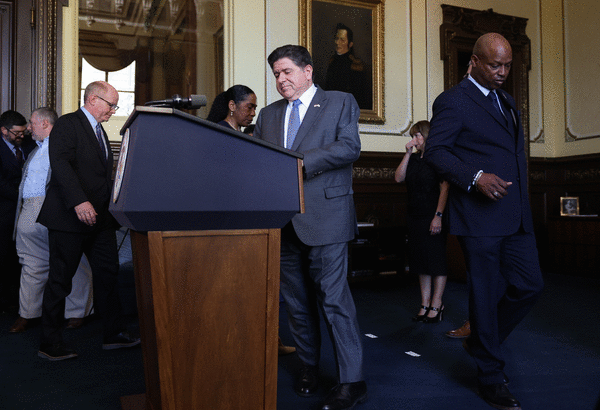
To be sure, during an early morning news conference with Pritzker, Harmon and Welch, the state’s top three Democratic leaders sought to shift from questions about the unresolved stadium issue to budgetary action taken to combat the effects of President Donald Trump’s federal budget cuts and the need to address “kitchen table” issues of concern to voters in an election year.
But even Welch admitted later that “as the (Bears) conversations have continued, as legislation passed the House, as legislation passed the Senate (Monday morning), more and more it comes up at the kitchen table. People are saying, ‘Hey, Speaker Welch, don’t let the Bears leave, but don’t give them any money.' ”
While at first glance it may appear easy to blame statehouse politicians for taking a walk on the Bears, there were several factors outside Springfield that left the stadium issue in Illinois unresolved.
Based on interviews with negotiators, participants cited a factionalized Bears’ leadership structure that was naive to the political game and found itself undercutting any political progress as it sought to leverage more public funding support.
Additionally, the late arrival of Chicago Mayor Brandon Johnson in early May to Springfield created a distraction from negotiating a stadium deal for the Bears in Arlington Heights as Johnson insisted that the city’s previously rejected 2024 lakefront plan, south of the Soldier Field home that the Bears have used since 1971, be reintroduced to the talks.
In 2024, Pritzker recalled, “The mayor of Chicago held a big press conference with the Bears, announcing a $2.5 billion stadium that he had no money to pay for, so that was going to have to get paid for, and that’s not something I was willing to do.”
Notably lacking at that 2024 news conference was anyone with a significant vote or the ability to swing votes for the Bears and the city in Springfield. And there was little discussion at the time of what would have been likely lengthy legal challenges by lakefront preservationists to the site.
But during his early May visit to the statehouse, Johnson told city lawmakers that the Bears — while negotiating for Arlington Heights and Hammond — also had made recent overtures about a stadium based in the city.
Though the Bears and the NFL quickly made statements that the team’s stadium search was limited to Arlington Heights and Hammond to try to quell any negative fallout on progress a stadium bill was making in the legislature, the team’s talks with Chicago’s City Hall provided an impetus for some city lawmakers to staunchly oppose a Bears move from the city to the suburbs and to demand a city stadium option where none had existed.
That’s why Senate Democrats, after weeks of consideration, rejected on Saturday a House-passed “megaprojects” bill aimed at giving the Bears the property tax certainty they desired for the 326-acre Arlington Heights location the team acquired for $197.2 million in 2023. That measure would have allowed the team to have its property tax assessments frozen for 25 to 45 years in exchange for making payments to local taxing bodies in lieu of taxes, known as PILOT.
Progressive Senate Democrats also balked at putting their name behind legislation to grant a major property tax break to a multibillion-dollar professional sports franchise.
In response, a Senate Democratic-passed alternative would have given cities in Cook County with more than 70,000 people the option to create a municipal sports stadium authority to be able to own an arena privately financed by a team, thus making it not subject to property taxes.
With Arlington Heights and Chicago two of the cities that would have qualified for creating a sports authority, the bill was viewed as a way to get Chicago back in the stadium picture while allowing the Bears to select Arlington Heights as its preferred site.
But by the time the measure reached the House, lawmakers decided too many unanswered questions remained about the proposal — including questions about finances and taxation — to ensure its passage. And then the chamber decided to adjourn.
In the aftermath, Pritzker said, “I don’t want the Bears to leave Illinois, and I’ve worked very hard to make sure that they stay. Indeed, my original focus had been keeping them in the city of Chicago. They weren’t able to find a property to make that happen for them in the city of Chicago.”
“As much as an emotional connection as many of us have to the Bears and to keeping them in the city of Chicago or in the state of Illinois, (my) No. 1 principle is we’re not going to put this on the taxpayers of the state of Illinois,” the governor said.
The legislative leaders said they will continue talks on the Bears stadium issue, and Pritzker said they have the power to call a special legislative session if a measure can be agreed upon.
But in what has truly been a yearslong fumble-prone political exercise involving a vaunted 105-year-old charter member of the National Football League, the ball ultimately rests with the Bears.
“We will finalize our evaluation of both Arlington Heights and Hammond, and remain on the late spring/early summer timeline that we have previously communicated,” the team said in a statement Monday morning after the legislative exodus from Springfield began. “We will provide an update when we have a decision to share.”
©2026 Chicago Tribune. Visit chicagotribune.com. Distributed by Tribune Content Agency, LLC.





Comments