Mike Vorel: Should Seahawks draft Washington's Jonah Coleman? Here's the case for it.
Published in Football
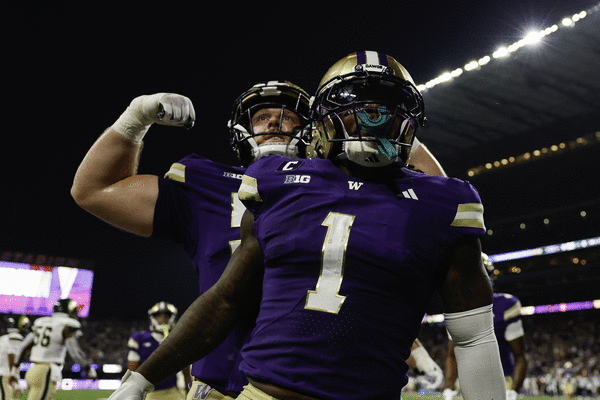
SEATTLE — Call this a homer column.
But the Seahawks should draft Washington running back Jonah Coleman.
Proximity aside, the case for Coleman could not be clearer. The reigning Super Bowl champion Seahawks need a running back, considering Kenneth Walker III signed with Kansas City and Zach Charbonnet will miss multiple months with a torn ACL. That leaves George Holani, Emmanuel Wilson, Kenny McIntosh, Cam Akers and Velus Jones Jr. as available options at an incomplete position.
With the 32nd overall pick in this month’s NFL draft, some are projecting the Seahawks to select Notre Dame running back Jadarian Price. But while the 5-foot-11, 203-pound Price presents an intriguing blend of size and speed, he also wasn’t the best running back on his own roster. That nod goes to top-10 lock Jeremiyah Love, with Price (674 rushing yards, 6.0 yards per carry, 13 total TD in 2025) providing a potent change of pace.
Perhaps that reduced workload will allow the 22-year-old Price fresher legs on the next level. But given that running backs are inherently risky in the opening round, I’d prefer the Seahawks address needs at guard (Oregon’s Emmanuel Pregnon), edge (Texas A&M’s Cashius Howell) or corner (Clemson’s Avieon Terrell) instead. Trading back, for a franchise with just four total picks in 2026, would also be a sensible decision.
Especially when tackle-breaking bowling balls are still available.
“I look at Jonah Coleman, and I watch his run style,” draft analyst Todd McShay said on the Rich Eisen Show. “He’s a bowling ball. He’s got these light feet. He always runs with pad level. He wears you down. He brings this energy to an offense.
“I think in a running back class that’s not like a year ago where you had 26 guys go — six in the first three rounds, 20 on Day 3 — I think he’ll probably fall to the fourth round, and a team’s going to get a starter. I really think he’s going to be that kind of player.”
That’s the player Coleman’s consistently been. The 5-9, 220-pounder combined for 1,811 rushing yards, 5.2 yards per carry and 25 rushing touchdowns in two seasons in Seattle, while adding 531 receiving yards and two more scores. Those were hard yards behind an unconvincing offensive line.
I get that pure production doesn’t always translate. But Coleman’s attributes — the feet of a ballet dancer, the frame of a battering ram, the instilled experience in an NFL offense — should help him provide an instant impact.
Consider the completeness of Coleman’s résumé. Besides his aptitude as a ball-carrier, Coleman is a plus pass protector, surrendering just 10 pressures and one sack during two seasons at UW. He’s relentlessly reliable, with zero fumbles and one total drop in his college career. He appeared in 25 of 26 games the last two seasons, a staple despite the position’s ferocious physical demands. He’s also a proven commodity in pro-style systems.
“I visited the Seattle Seahawks. I met the GM [John Schneider] and that was great,” Coleman noted in an interview with Sports Illustrated. “I had a great conversation with their running backs coach. We saw eye-to-eye on literally everything we were talking about. We ran an identical offense at Washington to many NFL teams. The terminology was very similar.”
Or, as he told The Seattle Times in April 2024: “I can call out the plays if I’m watching an NFL game. It’s kind of crazy. We’ve really got a pro system. If I watch the 49ers play, the Chiefs play, the Rams, it’s the same plays, just different words. When I see guys make plays in the offense that we run, it gets me excited.”
Coleman might be making those same plays for the Seahawks soon.
Plus, Coleman’s completeness transcends tape. He graduated with a UW degree in education studies and a 3.93 GPA. He was one of 16 national finalists for the 2025 William V. Campbell Trophy, college football's foremost scholar-athlete award. A three-time UW dean’s list honoree, he was one of two Husky athletes invited to present to the university’s Board of Regents about the impact of institutional decisions. He earned the program’s academic award, community service award and “Be a P.R.O. Award” at its postseason banquet.
In my two seasons around Coleman, he was always accountable, always available, always professional. He was a steadfast protector of the program. When Kalen DeBoer’s departure and Jedd Fisch’s arrival triggered an unsurprising transfer exodus, Coleman’s message was simple.
“Whoever wants to be here will be here. Whoever don’t … the portal’s open,” he said.
“We don’t want hostages. We want volunteers,” he said.
“Compete,” he said, when asked his pitch for future Huskies. “You’ve got to come in here with a chip on your shoulder, including me. Even though I know the playbook, I’ve still got to compete. Really the biggest thing is, if you want to come here, you’re going to compete and be a pro. That’s what the pro programs are built on: competition.”
Considering his character, toughness, reliability and skill set, Coleman sure sounds like a Seahawk.
And yet, he could slide to the fourth round for a reason. Because this bowling ball doesn’t offer breakaway speed. Because he’s not as athletically dynamic as Love or Price, etc. Because he isn’t built to be a combine king. Because he may not seamlessly translate to some special teams.
Besides, I know this request requires a lot of luck. There’s no guarantee another team won’t cut the line for Coleman, and it’s bad business for the Seahawks to reach for any player. They should only keep Coleman in Seattle if the circumstances fall in their favor. If not, there are other running backs with similarly compelling cases.
But only one bowling ball who broke tackles five miles from Lumen Field.
© 2026 The Seattle Times. Visit www.seattletimes.com. Distributed by Tribune Content Agency, LLC.






Comments