Trevon Brazile's unorthodox path from rural Missouri to Nuggets breakout rookie
Published in Basketball
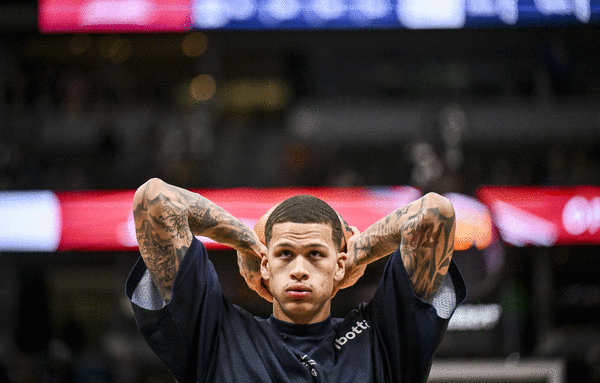
DENVER — Trevon Brazile was 5 years old when his mom’s house burned down in Bolivar, Mo., taking almost all of their belongings with it. Nobody was home when the fire started, but it left an emotional void. Most of Brazile’s early childhood vanished in the flames. “If I could have one thing back, it would be pictures,” his sister, Mariah Griffin, said. “Especially of Trevon. We have very few pictures from when he was little because of that.”
But out of the fire emerged a new prized possession, a picture that didn’t exist yet but came into focus years later. Without a place to live, the family stayed with Brazile’s dad in nearby Springfield until his mom landed on her feet. His parents were separated but still friends, and they both worked long hours to get by — Phil at a construction company, Melissa at various jobs from a group home to a pharmacy. She moved to Springfield permanently, and so Brazile grew up there, splitting time between his parents’ homes and eventually his sister’s. Mariah often looked after him. He followed her everywhere. On Feb. 12, 2012, they were walking to a park when Trevon pointed out a large house in the neighborhood. It towered over them.
“Someday, sissy,” he said off-handedly, “I’m gonna buy us a house that looks like that.” Mariah needled him for the comment — it was a big promise for a 9-year-old to make. But when they returned home, Trevon wanted to show her that he wasn’t messing around. He drew the house, a five-story yellow mansion with green window paneling in his mind’s eye. He signed it to his sister.
He had never been all that interested in coloring as a child, so the drawing struck Mariah as especially meaningful. She kept it in her backpack every day, a reminder of her brother’s resilience. His ambition. Mostly, though, a part of her was just afraid to lose another sentimental token of his youth.
When the Nuggets drafted Brazile with the 35th pick this June, Mariah couldn’t be at his party in Springfield. She was nine months pregnant in North Carolina, where she and her husband live now. They had already decided on the baby boy’s name months earlier: Denver. Pure coincidence. They’ve always enjoyed visiting the Rocky Mountains, and Mariah had even suggested to Brazile that they plan a brother-sister trip to Colorado. She beamed with pride as his name was called, as Denver became his new home. She wished she could be with him. She opened a drawer in her nightstand and pulled out the 14-year-old drawing instead. She texted him a photo of it.
Throw it anywhere
Not even Brazile envisioned this much responsibility for himself on draft day. He was a second-round pick joining a perennial playoff team that was three years removed from winning an NBA championship. He expected his rookie season to demand patience.
“I didn’t know if I was gonna get zero minutes, or get thrown in in the fourth (during garbage time), or at the last two minutes, or what,” he said.
He certainly didn’t anticipate becoming a key cog in the Nuggets’ everyday rotation, sometimes even their first player off the bench. Buried in a loaded draft class, the rookie out of Arkansas has been a small-scale revelation: Heading into Friday's game, he was averaging 6.5 points and 4.9 rebounds in 18.1 minutes per game, ranking seventh on the team in playing time.
More important than the stats is the athleticism he’s added to an aging roster, and the wattage he’s brought to an otherwise tense dynamic at Ball Arena. When he’s not loitering around the rim and waiting for opportunities to go vertical, he’s spacing the floor and knocking down 3s at a respectable 36.7% clip. But primarily, Brazile has been a high-flying lob-catcher, shot-blocker and rebounder.
“I gotta tell them to throw (alley-oop passes) higher,” he said recently. “They think that they’re gonna turn it over. I tell them, like, ‘You’re not gonna turn it over. You can literally throw it anywhere.' ”
His emergence might not have been possible without the hamstring injury that Spencer Jones suffered at training camp. An unheralded success story himself, Jones was locked in as Denver’s backup four. His absence left coach David Adelman to experiment with other options throughout the preseason. Brazile shined. He continued to fill in for Jones as the season tipped off, snatching seven rebounds in the first five minutes of his career at Oklahoma City.
By the time Jones returned from his injury eight games into the regular season, Brazile had been too impactful to be relegated from the rotation. Jones is Denver’s backup three now, making room for another bench forward.
“I could just tell the mistakes (Brazile) made early, his reaction to coaching was so easy. … Personalities are different, how you handle somebody getting on you, pushing you,” Adelman said last weekend in Chicago. “And the guy, it was just an immediate response of, ‘OK, I’ll do it better. I’ll do it better next time.’ There’s no up-and-down, long conversation, conman stuff. He just wants to be better.
“To see Trevon’s growth through 14 games — we made the right choice with the second-round pick.”
From ‘B team’ to NBA
When stubborn determination took over and motivated Brazile to draw that house in 2012, he had no idea how he’d afford it. He wasn’t picturing himself as an NBA star. Basketball hadn’t even come into his life yet. Once, when his sister asked what he wanted to do when he grew up, he shrugged and suggested he could be a barber.
Life in Springfield revolved around the outdoors. Brazile spent his summers hiking and camping in the Ozarks, hanging out on pontoon boats, jug-lining for catfish. Early in the morning, he would attach a fishing line to an empty milk jug and leave the flotation device on the water for hours, the baited hook dangling 10 to 15 feet below the lake’s surface. A couple hours later, he would make the rounds, hoping to find a catfish dancing on the end of the line. Other times, he fished more traditionally. The joy was in the stillness, the relaxation. He was an introvert, the opposite of his sister.
“We had a lot of fun. We just made do with what we had,” Mariah said. “We grew up pretty poor, so we just had to find things to do that were fun and make it seem like it wasn’t so sad all the time. … We weren’t in complete poverty, but we had the very bare minimum of what we needed.”
Brazile grew up playing football almost exclusively. Quarterback. It came naturally to him. Basketball didn’t. He was on the ‘B team’ in both years in middle school. He didn’t even bother trying out for the high school team his freshman year. Mariah is convinced he scored on the wrong team’s basket in one of the first organized games she ever watched.
“He was terrible,” she said, laughing. “Terrible. Oh my gosh. It was so bad.”
“I asked him one day, ‘Hey, what’s the deal? You’re so great in football. What’s going on in basketball?’ ” Phil Brazile remembers. “He said, ‘Well, everybody is just right there.’ ”
Phil had played hoops at Southwest Missouri Baptist. His son was naturally athletic. It didn’t make sense, he thought, that Trevon could be so skilled in one sport and so lost in the other. It had to be psychological on some level. Phil saw a lot of himself in his son.
“The junior-high gym is so small. You’re walking on people’s feet taking the ball out,” he said. “When he was on the football field, everyone’s in the stands. His head’s covered with his head gear. So he felt comfortable. … It wasn’t like he was the worst player out there (in basketball). But it just seemed like for me, being around the sport so long, that he had to come out of his shell and forget those people that are just sitting there watching the game. I think the more personal contact with the fans is what kind of held him back a little bit.”
Phil didn’t want to force anything on his children. But he felt grateful for the inclusivity of the junior-high basketball program. He wonders if Trevon would’ve ever returned to the sport if he had been cut entirely, if he hadn’t been able to play on a B team.
As it was, his son came home from school early in his sophomore year and announced a change of heart.
“I almost fell out of the chair,” Phil said.
Brazile walked away from football. He started going to the gym two or three times a week with his dad to hone the fundamentals of basketball. Phil hoped he could make the JV team that year. “He went to tryouts,” Phil said, “and came home on varsity. It was shocking how fast he adapted to it.”
Brazile came off the bench for most of that season. But he was growing rapidly, both as a player and as an unusually tall person. The summer after his sophomore year, he had severe knee pain and swelling. His dad worried that he might’ve torn a ligament. They went to a doctor for an MRI, which revealed that Brazile’s growth plates were wide open and inflamed. Growing pains, they called it.
“They just told me, like, this kid’s gonna be tall,” Phil said. He estimates that from the end of sophomore year to junior year, Trevon shot up from 6-foot-2 to about 6-8.
He joined an AAU program during that time, run by former Missouri State University player Robert Yanders, who died at 44 in 2023. Yanders had strong relationships with college programs in the state and brought Brazile to Mizzou’s attention. Meanwhile, Phil was working weekends and taking extra hours to help afford the AAU expenses, causing him to miss every summer AAU game Trevon played. It was worth the sacrifice, he told himself, because he could still attend games during the high school season. When Brazile transferred to Kickapoo High School for his senior year, he “exploded onto the scene,” said Chris Hollender, who worked on Missouri’s staff at the time and recruited Brazile.
“Trev’s recruitment was really interesting because he wasn’t really recruited,” Hollender said. “He was kind of an unknown. Not kind of an unknown. He was a total unknown. … We recruited him quietly early and kind of got it done. He was coming off the bench on a small AAU team (at first) and playing behind guys who didn’t even get to play on their high school teams. It’s a really interesting story.”
Brazile’s knee problems resurfaced a few years later. After his freshman year of college, he transferred to Arkansas but tore his ACL in December 2022, a month into what looked like his breakout campaign. He was averaging 11.8 points and 6.0 rebounds, skyrocketing onto draft boards at the time. At the end of his freshman year, Hollender said, “I had one NBA scout telling me he might be the best NBA prospect in the SEC.”
The injury sent Brazile’s draft stock up in flames. He sat out for a year and stayed in college until 2026, gradually reestablishing himself as a potential NBA talent.
He was used to starting over. He had learned it from his mom, from his sister, back when he was too young to fully understand what they had lost. Mariah had watched the fire shape him over the years, in ways he might not even have noticed.
“Trevon is still like this: He doesn’t have a bunch of stuff,” she said. “And I think it probably stems from that. He’s more of a minimalist when it comes to material things. He would rather have less, and if he has enough of it, then that’s great.”
The little house
In Denver, he’s making $1.36 million this season, the NBA rookie minimum salary. It’s still more than he could’ve dreamed of 15 years ago, when a giant house represented his hope and ambition.
Now it’s the smaller things that provide fulfillment, like living in another place with access to mountains — “being out in nature I think is really important to him,” Mariah said — or getting paid a visit by his sister and newborn nephew. Denver was born in July. Brazile’s first opportunity to meet him was in October, when Mariah brought him to Denver for the Nuggets’ home opener.
“It was a very emotional game for me, getting to watch him play, getting to see him meet my son,” she said. “It was a lot.”
And that was before Brazile played the game of his life, stamping himself as one of the Nuggets of the future with 17 points and nine rebounds and two clutch blocks. His performance sparked a 23-point comeback win. His dad, a quiet, stoic supporter since Trevon was young, expected it. Nobody else in the building did — not from a rookie second-rounder.
Mariah teared up in her seat. She felt something supernatural in the air, like her presence had an inspirational effect. “He usually has a good game every time I’m there,” she said. It pained her that she couldn’t be around him every day, for every game.
They’re both parents now. Brazile’s daughter, Taelyn, turned 2 in October. He visits her in St. Louis whenever he can. “Trying to figure out fatherhood and be a basketball player, that was hard,” Mariah said. “The schedule was not easy for that. It still isn’t. But that’s probably made me just as proud, watching him be a dad, as it has been watching him be an NBA player.”
When she pulled the drawing out of her nightstand to text Brazile back in June, she meant it as a “you made it” gesture, but she also realized the humor in how it could come across — as a reminder that he owes her that mansion.
As time passes, though, Mariah finds herself wishing for the opposite. When they fought as children, their mom warned them they would miss each other someday.
Now Mariah yearns for the house that burned down.
“I would give anything to go back to that little house,” she said, “and us just being together.”
©2026 MediaNews Group, Inc. Visit at denverpost.com. Distributed by Tribune Content Agency, LLC.





Comments