Shelby Swanson: This executive is looking to turn Timberwolves and Lynx success into more money
Published in Basketball
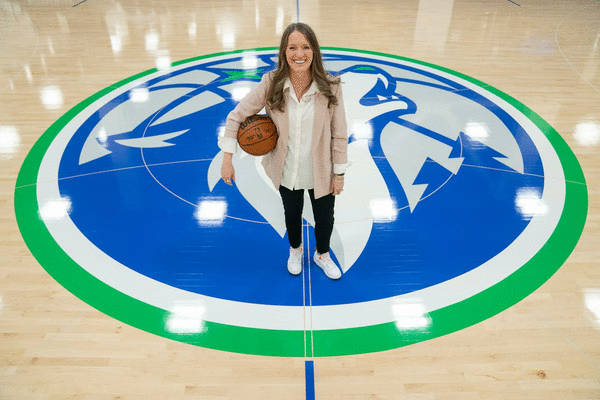
MINNEAPOLIS — Jamie Morningstar is, seemingly, always moving.
An hour before the Timberwolves tip off at Target Center, the franchise’s newest executive starts her pregame rounds mingling at the Lexus Courtside Club, an all-inclusive lounge for some of the arena’s highest-paying customers.
Morningstar could zip to the upper-level suites on the elevator, but she decides to take the long route — climbing the lower-bowl steps to soak in the pregame atmosphere. Once she’s made it to the venue’s swankier lounges, Morningstar checks on concessions and greets clients.
As she walks, she scans. Morningstar is constantly sizing up the 36-year-old Target Center — looking for ways to make the most out of the NBA’s second-oldest arena.
“These are a lot narrower than you would find in a building today,” Morningstar says, snaking her way through a tight upper-level concourse. She stops to point out a vendor squeezed into a once-vacant corner. “So you just have to figure out how to make it work.”
As the Timberwolves and Lynx’s new chief commercial officer, Morningstar was hired to drive revenue at the aging Target Center — and, eventually, its shiny new replacement. It’s a newly created position under new ownership. And CEO Matt Caldwell, who has spent the past year overhauling the franchises’ business operations, is hoping his latest C-suite hire can help turn the organization’s on-court success into a booming business.
Even as championship contenders with plenty of star power, the Timberwolves and Lynx remain “a little bit below” their respective league averages in revenue, said Caldwell.
“Given our performance, I think we can be much higher,” Caldwell said, “so we’re driving, but it takes time. It’s not like you just win and all of a sudden fans show up or partners start sending you checks.”
Morningstar’s mandate is to help close that gap: growing season-ticket sales, attracting more single-game and group customers and expanding corporate partnerships.
A new arena will open even more opportunities. But before that transition, there’s still time for Morningstar to make her mark on Target Center, where she said the Wolves’ 94% attendance rate last year showed room for improvement.
“I think we’ve got a beautiful footprint here,” she said, “but it is about making the most of it.”
From Madison Square Garden to the Minnesota Timberwolves and Lynx
Morningstar’s phone has been buzzing all day.
It’s Nov. 19, the Timberwolves are hosting the Knicks, and her former Madison Square Garden colleagues want to know: roughly a month into her new job in the Twin Cities, where does her allegiance lie?
“I’m cheering for the Timberwolves all the way, no question,” she tells a reporter.
But even with her focus here in Minnesota, Morningstar is constantly pulling from her past stops. And there’s a lot of them: Morningstar worked for six professional basketball franchises in the last 20 years, taking her from Detroit to Seattle, Oklahoma City, New York, Milwaukee and back to New York before arriving in the Twin Cities this fall.
Morningstar had never been to Target Center before taking the job, but the arena immediately felt familiar. Its “upside-down” configuration — 10,000 upper-bowl seats versus 8,000 lower-bowl seats — reminded her of the old Bradley Center in Milwaukee, where she oversaw ticket sales for eight years. Both are holdovers from an earlier era of arena design, before sports franchises prioritized packing more fans in the lower bowls and going heavy on premium seating.
“Not surprising, but different,” said Morningstar. “And when you’re working with a building this age, you’re going to run into stuff like that.”
She learned to work around those limitations in New York, too. Across two stints and more than nine years at Madison Square Garden Sports, Morningstar had to get creative to generate revenue inside the NBA’s oldest arena.
As senior vice president of ticketing at MSG, Morningstar made a playbook with the marketing and analytics departments to target prime dates for sellout games. She concentrated resources on those dates and challenged the organization to look at limited spaces differently. Her former boss at MSG, David Hopkinson, said Morningstar turned a “literal supply closet” into a sold-out suite. Ticketing and premium revenue at MSG increased by $163 million, or 39%, in less than six years under Morningstar’s leadership.
So, underutilized spaces at Target Center, beware: She’s coming.
In a suite, she surveys the dining area and wonders what it may look like as a party room. There are probably a couple spots on the floor level, Morningstar reckons, where storage space could be repurposed. As we approach an upper-level deck overlooking the atrium, Morningstar points to the frenzy below: an interactive fan experience sponsored by Target, where families are collecting prizes and shopping for merchandise.
“When this isn’t here,” Morningstar said, “we put retail here. Because our retail space is very small in the building. So it’s spaces like this. How can we make adjustments that are gonna help the consumer experience be better than it would have been otherwise?”
Growing revenue at Target Center and preparing for a new arena
We stop for a hot chocolate outside the Grant Thornton Chairman’s Club — an upscale, private hospitality suite in the upper bowl. The cocoa could be a bit thicker, Morningstar observes, but is definitely “not bad.”
It’s a small detail, but one of many that can distinguish a premium experience. And at Target Center, which has one of the lowest NBA premium seating capacities, Morningstar will help the organization lean further into food and beverage offerings and hospitality to differentiate fan experience.
Expanding the corporate partnerships sales staff is another focus for Morningstar. She wants added manpower, but is also exploring ways to incorporate AI and other technologies to build efficiencies.
And, of course, there’s the new arena. Any build is years away, but Morningstar is already prepared for the transition — whenever that time comes.
When Morningstar arrived in Milwaukee in 2013, the Bucks ranked last in the NBA in season-ticket sales, with roughly 2,500 accounts. But the franchise had also just drafted a future superstar in Giannis Antetokounmpo. As he blossomed and the Bucks improved, Morningstar helped build the sales operation to capitalize on the growing demand. By the time the team moved into Fiserv Forum in 2018, they boasted more than 10,000 full-season memberships.
She helped transition thousands of existing customers to new seats, prices and premium experiences — a process former Bucks president Peter Feigin described as a “Herculean” undertaking. Feigin credited their high retention rates to Morningstar’s command of data and personalized approach.
“She talks to the fans,” Feigin said, “she understands what the 500 highest-paying fans actually care about ... and inputs that, literally, into the design and the construction of a new arena.”
Caldwell said he’ll be drawing on that experience as the Wolves consider everything from the balance of bowl seating to courtside configurations and premium clubs.
“When you’ve been through those ideation meetings, and you’ve been through the kind of vision boarding and then seeing that through execution, you have experience of what works and what doesn’t,” Caldwell said.
All of this raises an obvious question: What will these revenue-driving efforts mean to the everyday Wolves fan?
Morningstar says she is also focused on improving the experience for the average fan. On Oct. 30, the Wolves launched their “Pack Deals” effort, offering tickets at a special price of $20 for select home games.
“We want everyone to have the opportunity to come in and experience it,” Morningstar said, glancing out at the Target Center court. “I mean, look at it. It’s awesome.”
©2026 The Minnesota Star Tribune. Visit startribune.com. Distributed by Tribune Content Agency, LLC






Comments