Takeaways from a 127-121 Bulls loss to the 76ers, including Nic Claxton's debut at center
Published in Basketball
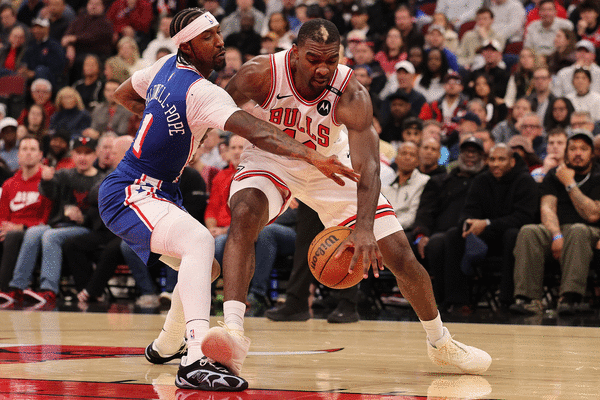
CHICAGO — Somewhere around midcourt, Matas Buzelis decided to go for the kill.
The forward was racing at full speed, angling toward the rim. Barely a minute remained on the clock as the Chicago Bulls trailed the Philadelphia 76ers after spending the better part of the game nipping at the heels of the top-ranked team in the Eastern Conference. Buzelis had the time and the space to land a blow.
This has been a season of second-guessing for Buzelis. Nothing is coming easily — not his 3-point shot, not his drives to the rim, not even the dunks that power his typically aggressive style of play. But in Sunday’s 127-121 loss to the 76ers, Buzelis reset himself through the basics. He hit a trio of 3s and led the Bulls with 19 points. And when a clutch opportunity opened up in the full court, he took it.
Buzelis drove hard toward the right block, baiting Tyrese Maxey to drop low as he sprinted toward his own baseline. The moment Maxey swung around, overcommitting toward Buzelis’ right hip, the Bulls forward countered by pulling himself to the left, side-stepping his defender with a well-mannered two-step before launching headfirst toward the rim. Buzelis took no chances, securing the ball through the rim with both hands, his tongue sticking out in concentration as he cut the lead to three points. One minute, nine seconds left on the clock. The win was so close that Buzelis could almost reach out and touch it.
The final five minutes of clutch time against the 76ers showcased how far the Bulls can go with a bit of antagonism from the youngest members of the roster. With just under four minutes left, Buzelis pinned a layup by Anfernee Simons against the backboard, creating a runway for Caleb Wilson to line up a transition 3-pointer and cut the lead to three. But the Bulls could never carve that lead closer than two points as the 76ers powered their way to a win on the backs of 20+ point performances from their star trio of Maxey, LeBron James and Jaylen Brown.
The weaknesses are still the same. The Bulls gave up an exorbitant 20 offensive boards to the 76ers — which led to 33 second-chance points — entrenching their status as one of the worst defensive rebounding teams in the entire NBA. Despite a higher-scoring game, Josh Giddey turned the ball over with 30 seconds left, bobbling a possession into the hands of LeBron James as the Bulls trailed by only five points to effectively squander their last chance at a comeback. And yet this team suffered less from its errors Sunday.
The Bulls will talk plenty about “good losses” this season. And sure, this team could use a good win, too, particularly amid the stupor of a seven-game losing skid. Yet for the Bulls at this point in their rebuild, this learning experience of this type of loss mitigates the pain of the final buzzer.
“We don’t want moral victories, but I think we did a lot of things right tonight,” center Nic Claxton said. “Obviously we didn’t come up with the win, but our process was right, so we just got to keep building from that.”
Here are four takeaways from the loss:
Claxton makes his debut
After missing the first eight games of the season with a tweaked left hamstring, Claxton made his introduction to Bulls fans in Sunday’s loss.
Claxton will be the starting center when he is released from his minutes restriction, but coach Tiago Splitter brought him off the bench Sunday to accommodate his return-to-play protocol. Splitter said the medical team advised Claxton to stay under 20 minutes in his first game of the season; the center ultimately played 17 minutes and 41 seconds.
“I needed the restriction today,” Claxton said with a laugh after the game. “I was a little tired.”
The introduction of Claxton into the rotation immediately elevated the Bulls’ defense. Splitter opted to pair Claxton often with second-year forward Noa Essengue, who is quickly becoming the best on-ball defender on the Bulls roster. This pairing allowed the Bulls to create a higher level of pressure at the point of attack with a safety blanket of rim protection provided by Claxton. Essengue often picked up ball-handlers full-court, hounding guards like Tyrese Maxey as they attempted to advance the ball.
While Claxton scored only four points, he tallied two blocks in his Bulls debut. He noticeably struggled on the boards, securing only four rebounds in the game while ceding considerable space to Philadelphia bigs like Joel Embiid and Jabari Walker.
“I just got to grab the ball,” Claxton said. “I had my hands on the basketball. I just got to bring down the ball and just make sure I’m hitting, make sure I’m turning and seeing who’s crashing.”
The Bulls have a hard time scoring with a defensive rotation — for instance, Claxton paired with Isaac Okoro, Patrick Williams, Tre Jones and Buzelis — on the court. Conversely, their highest-scoring lineups barely put up any defensive resistance. This lack of balance is one of the weakest traits of this current roster construction. But any improvement in defensive pressure is welcome for a team with the worst-ranked defensive rating in the league before Sunday’s game.
A whole lot of Williams
Williams played nearly 25 minutes — the sixth-most on the roster — in another surprising shift in the lineup from Splitter. In his seventh season with the Bulls, Williams has not been a prominent feature in the rotation. He started the season with a small groin injury and did not play in a game until last week’s loss against the New York Knicks. The Bulls are stuck with his lengthy (and hefty) contract, but the forward’s age (25) and recent struggles were expected to significantly reduce his role this season as the coaching staff focuses on the team’s long-term future.
Not the case. Williams showed plenty of small flashes in the loss, picking off steals and working his way to the rim for dunks and dumping inside passes for necessary assists. He tallied seven points, three assists and a steal. Williams still has plenty of work left to balance out his years of floundering out of the main rotation in Chicago, but his ability to hold down a significant stretch off the bench is impactful for a Bulls team that needs as much depth as possible.
Powell’s absence impacts 3-point shooting
This marked the first game of the season the Chicago Bulls played without veteran Norman Powell, who experienced back spasms Sunday morning that sidelined him against the 76ers. The loss of Powell placed particular focus on Chicago’s 3-point shooting. Powell supplied the second-most attempts (6.9 average) and made shots (2.1) from behind the arc for the Bulls through the first eight games of the season. That volume accounted for more than 15% of the team’s total long-range production.
The Bulls have not been good from 3-point range this season. Nearly every player on the roster is shooting below his average from the 2025-26 season. Before Sunday, the team was shooting at a league-worst 27.2% from behind the arc as a result. But Splitter felt this was an issue of finishing rather than the quality of shots being produced through the actions of the offense.
Without Powell, the Bulls had an obvious deficit to make up in the shooting department. But despite attempts by Wilson (2 for 6) and Buzelis (3 for 7) to make up for that volume, the Bulls still couldn’t break out of their shooting slump and finished 10 for 37 (27%) from behind the arc.
Hawkins earns an early look
Splitter continued to tinker with rotations by digging deep into his bench against the 76ers, which included playing guard Jordan Hawkins early in the first quarter. Hawkins had not played more than seven minutes in a Bulls game so far this season, but nearly tripled that number in Sunday’s loss while tallying nine points off the bench.
Hawkins was a late addition during the preseason who earned the final two-way contract on the Bulls roster. An NCAA champion with Connecticut, he was originally drafted by the New Orleans Pelicans in 2023 during current Bulls general manager Bryson Graham’s tenure as an assistant general manager. The Bulls brought in the 24-year-old guard as another potential development piece on a young roster with plenty of room. Although Hawkins is limited in his potential playing time due to his status as a two-way player, Sunday’s performance suggests a willingness by the Bulls to use him more thoroughly this season.
____
©2026 Chicago Tribune. Visit chicagotribune.com. Distributed by Tribune Content Agency, LLC.






Comments