Zack Cox: Jaylen Brown for Paul George?! Trying to make sense of Celtics' stunning trade.
Published in Basketball
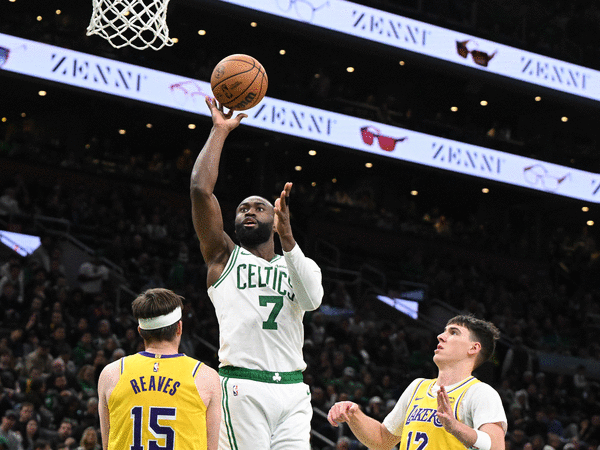
BOSTON — Giannis Antetokounmpo would have been controversial and risky, but understandable.
Paul George and a handful of picks? For a 29-year-old franchise pillar coming off his best season? That’s baffling.
And yet, that’s how the Jaylen Brown saga resolved Wednesday, with the Boston Celtics shipping their longest-tenured player to a division rival in a blockbuster trade that was staggering on several levels.
Boston reportedly will send Brown to the Philadelphia 76ers — the team that embarrassed the Celtics in the playoffs two months ago and had never been rumored as a potential Brown suitor — in exchange for George, first-round draft picks in 2028 and 2031, and second-rounders in ’28 and ’30.
Multiple outlets reported Brown’s market was softer than anticipated after the Celtics’ failed attempt to trade him and two picks for Antetokounmpo. Chatter about his lackluster advanced metrics dominated the NBA discourse for days. But even with that context, the return Boston ultimately received was underwhelming.
George has an impressive resume, sure, as a nine-time All-Star who’s made six All-NBA teams and four All-Defensive teams. He might be a Hall of Famer. These days, though, he’s a good-not-great, 36-year-old wing who struggles to stay on the court with any regularity.
In the seven seasons since his 2019 trade from Oklahoma City to the Los Angeles Clippers, George has appeared in 60-plus games just once. He logged 86 DNPs over his two campaigns with the 76ers (25 of them due to a suspension for violating the NBA’s anti-drug policy) and posted middling numbers when he did play (16.7 points, 5.3 rebounds, 4.0 assists, 1.8 steals in 31.7 minutes per game).
This isn’t a two-time NBA MVP like Antetokounmpo, who, despite his own injury concerns, is a top-five player in the world when healthy and would have filled a clear Celtics need. It’s not even a boatload of unprotected first-round draft picks, like the ones teams gave up for role players Mikal Bridges and Desmond Bane in the previous two offseasons.
This is an oft-injured, past-his-prime player who’s six years older than Brown and similarly expensive ($54.1 million this coming season, $56.6 million player option for 2027-28), plus some potentially valuable draft capital. George’s strong series against Boston this postseason doesn’t change that.
So, why? Why were the Celtics so dead-set on trading Brown that they were willing to accept an offer like this?
Did the relationship between the player and the organization — the deep “frustration” to which Tracy McGrady alluded after the season — deteriorate to the point that moving Brown was the only viable option, even if he did not explicitly request a trade?
Was this financially driven? The trade only saves the Celtics about $3 million this season, but Brown’s remaining contract is one year longer than George’s, and he’ll become eligible for a two-year, big-money extension later this month. Did the call to trade Brown and his hefty salary come down from Bill Chisholm’s ownership group?
Did the Celtics, in this current era of luxury-tax penalties and apron restrictions, not see a path back to true contention with Brown and Jayson Tatum both on supermax contracts? Are they already looking ahead to next summer, when they could attempt to flip George’s expiring deal to build out a stronger supporting cast around Tatum?
Why didn’t Brad Stevens, after seeing the tepid demand for Brown’s services, abandon negotiations and opt to keep one of the NBA’s most successful duos together for at least one more year? Why settle for this return now, when the draft has passed and training camp doesn’t start for another three months?
Does Stevens now regret not offering up Hugo Gonzalez and/or Baylor Scheierman, whom Milwaukee reportedly desired, to try to close the Antetokounmpo deal and avoid the consternation that ensued? And are there more moves to come that will make this stunning shakeup any more palatable for Celtics fans?
Those are all questions that Stevens will face whenever Boston’s president of basketball operations holds his next news conference. Regardless of how he answers, this will go down as an anticlimactic end for an all-time great Celtic.
Booed on draft night in 2016 by fans who wanted Kris Dunn instead, Brown leaves Boston as the 10th-leading scorer in franchise history. He played 10 seasons on Causeway Street, and the Celtics reached the Eastern Conference finals or later in six of them. He experienced seven 50-win seasons, including each of his final five, played in two NBA Finals and helped break the C’s 16-year championship drought in 2024, earning MVP honors in the East finals and NBA Finals that year.
Brown’s No. 7 almost certainly will hang in the TD Garden rafters once he retires, alongside Tatum’s No. 0.
“The one thing I want to make very clear is how valued he’s always been,” Stevens said last week. “He’s been amazing. He’s been an amazing teammate, a great person to be around. And whether that run ends 10 years from now when he retires, or before, there’s a lot to celebrate.”
In what proved to be his swan-song season with the Celtics, Brown was an All-Star for the fifth time, an All-Star starter for the first time, a second-team All-NBA selection and the sixth-place finisher in NBA MVP voting. Only Luka Doncic, Shai Gilgeous-Alexander and Anthony Edwards averaged more points per game than his 28.7.
But that career-best production didn’t deter the Celtics from trading Brown within the Atlantic Division in a move that, on paper, makes their roster worse and Philadelphia’s better.
Once again: why?
____
©2026 MediaNews Group, Inc. Visit at bostonherald.com. Distributed by Tribune Content Agency, LLC.





Comments