Dieter Kurtenbach: Love, loyalty and unfinished business -- why Steve Kerr couldn't walk away from the Warriors' fading dynasty
Published in Basketball
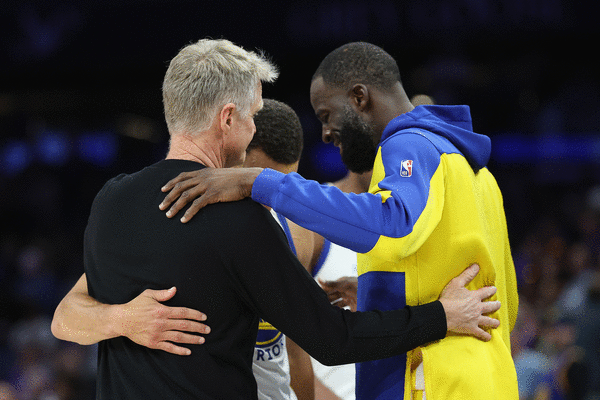
SAN FRANCISCO — Steve Kerr couldn’t quit.
Not yet.
And to hear him tell it, Friday, perhaps not ever.
He might just be a glutton for punishment. If he is, the Warriors are lucky that’s the case.
Because why else would a man with four rings as a coach, a surfboard as pristine as his resume, and a slew of grandkids waiting in the wings return to “fading dynasty” and a 10th-place roster?
The answer is simple: He can’t quit the high.
He won’t let the Golden State Warriors as we knew them — the team that can lay claim to being the greatest basketball squad ever assembled — die an ugly, mediocre death on someone else’s watch.
He’s coming back because the job isn’t done; this era deserves a proper exit; a new era deserves a proper indoctrination; and, let’s face it, retirement is for the birds. He’s hooked on competition.
In his first press conference since inking a two-year deal to remain the spiritual guide of the Bay Area’s favorite traveling circus, Kerr sounded less like a basketball coach and more like a man renewing his wedding vows.
During the 35-minute media affair, he dropped the word “love” 20 times. And you could feel in his voice that he meant it.
It was a real, authentic affection for a franchise whose best days are probably behind it; one that didn’t even make the playoffs this past season.
“If I were tired and burned out, then I would not be doing this, but I love my job,” Kerr said. “I love coaching the Warriors. Being in this city, being in the Bay.”
Of course, that wasn’t going to be enough just a few weeks ago, when retirement seemed the most likely option for the Dubs’ coach.
But his wife, Margot, served up the ultimate reality check: Leave now, and you can come back to the NBA and coach anywhere, but you could never coach the Warriors again.
So, he stayed.
He couldn’t stomach walking away from Steph Curry, Draymond Green and the ghosts of the dynasty they built together.
“We’ve been together for 12 years now, so it goes beyond just coach-players,” Kerr said. “It’s family.”
And such a belief is fully understandable when you contrast his first day in charge of the Dubs with Friday’s presser.
Back in May 2014, Kerr was introduced on a makeshift stage in a cramped practice facility, attached to the downtown Oakland Marriott, standing beneath a lone, dusty championship banner from the Ford administration.
He took over the league’s butt of the joke. The bottom of the NBA barrel, even if things were looking up in the Bay because of that Curry kid.
Friday, he held court in a room atop Chase Center, a gleaming tech-bro Taj Mahal with billion-dollar panorama views of the Bay and the city, financed by the very dynasty he helped birth.
Had Kerr left, the franchise would be in an eons better position than when he found it.
But to walk away after that whimper of a season?
That’s not how the story is supposed to end. This movie is missing its classy, feel-good epilogue.
“I couldn’t imagine walking away from the Warriors,” Kerr said. “I can go down the list. There are people when I walk into that building every day who I love and admire, and who I know share the same values and desire for us to win, and it’s an incredibly exciting and enlivening feeling to have that.”
The Dubs have managed a paltry two playoff series wins since their 2022 title. Curry and Green are in the twilight of their careers, though Curry would surely laugh at that notion (with ice wrapped around his knee). Kerr knows he has to end this era with dignity, while somehow setting up the next era to be worthy of succession.
And he’s right when he says he’s the one who can bridge that gap.
“I think I have a better chance of coaching this team than anybody else,” Kerr said, citing his relationship with Curry and Green, and his “intimate knowledge of our team and our organization.”
Management, to their credit, agreed. But general manager Mike Dunleavy made it crystal clear this isn’t just a nostalgic farewell tour for the boys:
“It’s not just a one-year swan song ‘Last Dance’ type thing, like hey let’s ride out into the sunset,” Dunleavy said. “That is 100 percent not what this is about. Joe [Lacob] would not have been down with that.”
Translation: Ownership isn’t paying exorbitant luxury tax bills for a slow-motion retirement party. They needed a multi-year commitment to get this right.
So, what does getting it right look like?
For one, they want to be a tough out by the end of the 2026-27 campaign. They want to play “meaningful basketball” rather than book early-May tee times.
They need to provide competition in the here and now and create a second timeline, if you will, that actually works.
But mostly, Kerr admitted, he just needs to grab the reins. Amid all the talk of partnership and championships, he acknowledged the grim reality: The vibes were undeniably off last season. Part of that might have been his lame-duck status as coach.
“One of the things I feel really strongly about is I want to get better. I want to lay a stronger foundation for next season that will carry forward,” Kerr said. “I think we got a little away from that. We got a little too loose. I’ve got to be better next year.”
“I’m still pretty young. I got a lot of energy. I love what I do. It made sense to keep going.”
It’s a noble, if stressful, pursuit. One that Kerr, with millions in the bank and even more equity tied to his incredible reputation, could have left for someone else.
But while the dynasty might be fading into the Pacific fog, the architect isn’t ready quite yet to hand over the keys.
The work is not quite done.
©2026 MediaNews Group, Inc. Visit at mercurynews.com. Distributed by Tribune Content Agency, LLC.





Comments