Why the potential return of the Sonics to Seattle has never felt closer
Published in Basketball
SEATTLE — October 25, 2006. April 18, 2008. May 15, 2013.
March 25, 2026?
Those dates on the calendar — three in the past, one still yet to come — represent four seminal moments in the history of NBA franchise stability as it relates to Seattle.
The first three are dates fans of the green and gold would rather forget.
The first was the day Clay Bennett’s purchase of the SuperSonics was approved by NBA owners. The second, the day his relocation request to move the franchise from Seattle to Oklahoma City was given the OK, prior to the lawsuit and subsequent settlement that finally allowed the organization to bolt.
And the last was the day Chris Hansen’s efforts to purchase and relocate the Sacramento Kings were thwarted and voted down by the league.
Three moments that went to define the opinion of the NBA in the minds of many sports fans in the Pacific Northwest.
But that last date — Wednesday — might end up being a date that gets circled and remembered in a different light. The NBA Board of Governors will wrap up two days of meetings in New York on Wednesday with the expectation that the league’s owners will give the green light to start conversations with interested ownership groups who want to bring expansion franchises to Seattle and Las Vegas.
After years of posturing, and fits and starts, the return of the NBA to Seattle has never felt closer. But there are significant questions that remain. Here’s a look at a few of them with Wednesday's meeting on the horizon.
Is this real or just another tease?
It sure seems real.
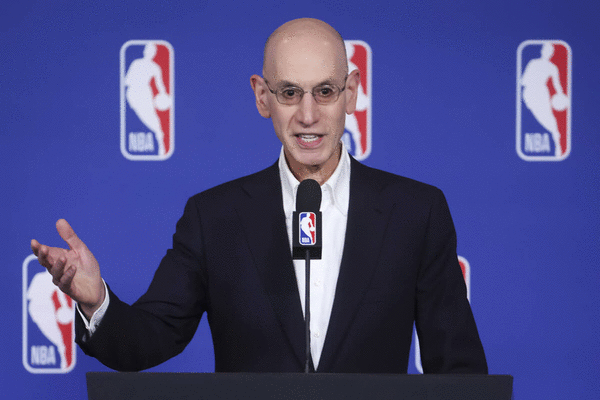
NBA Commissioner Adam Silver set the stage for what seems likely to happen next when he unexpectedly announced at the NBA Cup that expansion was going to be addressed sometime in 2026.
What comes from the meetings Tuesday and Wednesday is expected to be a vote of approval from the league’s owners allowing Silver to start holding substantive talks with potential ownership groups in Seattle and Las Vegas that could lead to a vote for expansion approval later this year. For the initial vote and for the final approval, 23 of the league’s 30 owners must vote in favor for approval.
Industry sources have told the Seattle Times that the buzz during All-Star weekend in Los Angeles last month was momentum quickly growing behind the thought that expansion was going to take place. With word emerging earlier this week of the pending vote, it would seem highly unlikely for that kind of information to leak without an expectation that a vote of approval is coming and would allow Silver to start the real conversations.
Assuming that approval comes, the next few months will be filled with conversations and negotiations, and ultimately a final decision on whether to formally expand or not. The vote for that could come as soon as the NBA Summer League owners’ meeting that’s held in Las Vegas in July. If there are delays or hiccups in the talks, the vote on formal expansion could be pushed to the annual BOG meeting held in September. Either way, as long as the vote is sometime this year and the league gives the thumbs up, the expansion franchise should be able to start in time for the 2028-29 season.
Is this going to become a bidding war?
That is one of the significant unknowns about how many parties are going to get involved in the bidding. To date, the only group locally to express their interest in pursuing expansion once the league gives the green light is the Kraken ownership group. They have decided advantages over any other group as a stakeholder in Climate Pledge Arena and the owner of the primary tenant that uses the facility. But questions remain about who all would be involved in any sort of investment group that would put forth a bid. To date, there have been behind-the-scenes conversations, but reserved public-facing campaigning by the Kraken group in jockeying for the lead position.
That has created a little bit of that uncertainty about whether another group could swoop in and get involved. The NBA likely wouldn’t mind that. The more groups, the more demand. The more demand, the more likely the expansion fee could be pushed upward.
Does the Seahawks sale factor into all of this?
Just like with the question about the bidding war, the fact the Super Bowl champions are for sale and in the same market adds a wrinkle to the situation around the NBA. The primary figures in each situation are likely committed to staying in their lanes — the folks who will be providing most of the money in the pursuit of each franchise likely should not change. But the money that comes in on the fringes could be a little in flux. Ultimately, it's a small piece of the much larger pie.
The higher likelihood is whoever is committed at this point to being financially involved in either potential transaction isn’t changing.
What about the Sonics history?
Should this continue in the direction it seems to be heading, yes, the history of the SuperSonics would return to the expansion franchise. That was part of the settlement agreed to when the team moved to Oklahoma City in 2008 — when a team returned to the market, the 41 years of history that accompanied the Sonics time in Seattle would be reinstated and no longer claimed by the Thunder franchise.
Many of the stars of the past — Gary Payton, Shawn Kemp to name a pair — have stated they did not want their past accomplishments in Seattle recognized by the Thunder franchise.
What’s the Vegas angle to all this?
Nine months ago, the momentum behind Las Vegas wasn’t dead, but it certainly had quieted significantly. There was uncertainty about possible ownership groups, including whether LeBron James’ longstanding want to be involved with a Vegas expansion team was still there. There were major questions about the arena situation and if T-Mobile Arena — home of the NHL’s Golden Knights — would be the home of an NBA team as well or if a new building would be in the offering.
Clearly a couple of those questions have been answered. There appear to be at least two ownership groups positioned to be involved in the bidding, although the most prominent name linked to team ownership there seems to be out. The Athletic first reported and James later confirmed that he and his partners with Fenway Sports Group would not be involved in the bidding process for a Las Vegas franchise.
The other two groups, per reporting from the Las Vegas Review-Journal, are a group that includes Magic Johnson and another that includes Golden Knights owner Bill Foley.
The arena … well that remains perhaps the biggest unknown in Sin City. The NBA has indicated upgrades to T-Mobile Arena might be good enough to satisfy needs. But the building is already home to the Golden Knights, UFC and concerts, and there are valid concerns about congestion and potentially a viable path toward a new building. Whether a building could be ready in two years should the reported 2028-29 timeline be applied to both teams is unknown.
____
© 2026 The Seattle Times. Visit www.seattletimes.com. Distributed by Tribune Content Agency, LLC.




Comments