Abby Schnable: Allen Greene's decision to retain Jeff Capel is defensible -- even if fans hate it
Published in Basketball
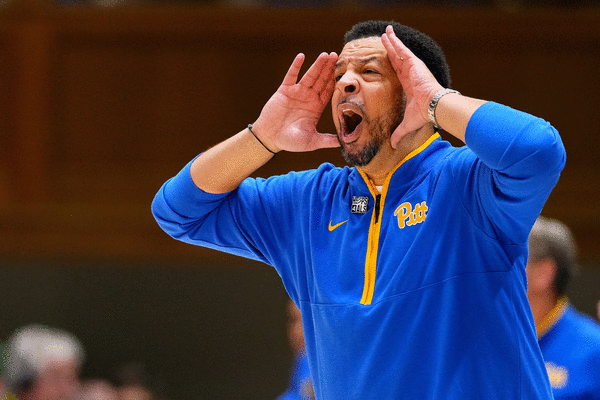
PITTSBURGH — When Pitt athletic director Allen Greene announced Friday afternoon that Jeff Capel would return for a ninth season as Pitt’s men’s basketball coach, the reaction was immediate — and largely surprised.
After a 13-20 season that ended with Pitt fighting just to qualify for the ACC Tournament, many assumed a coaching change was inevitable. Even Capel seemed resigned to that possibility during his postgame press conference after the Panthers lost to NC State in the second round.
Instead, Greene chose continuity.
Whether fans like it or not, the decision is defensible. It may even be the safest move Pitt could make right now.
That doesn’t mean Capel’s tenure to this point has been good enough. In eight seasons, he owns a 127-127 record with just one NCAA Tournament appearance. By any traditional measure, that résumé falls short of expectations for a program that wants to consider itself a national contender.
It’s not as though the opportunities haven’t been there. The 2023-24 roster featured two future NBA players in Bub Carrington and Blake Hinson, along with Zack Austin, who has since landed in the NBA G League. Yet Pitt still fell short of the NCAA Tournament that season.
Greene didn’t shy away from that reality.
“To be blunt, this season fell well short of our expectations,” Greene said in a statement announcing the decision. “Simply fighting to qualify for the ACC Tournament is not good enough.”
Still, Greene believes stability gives Pitt the best path forward.
In the modern landscape of college basketball, that logic carries weight.
Firing a coach is no longer just about moving on. It’s about money — a lot of it. Capel’s buyout reportedly sits in the $10-15 million range. Paying that sum just to make him go away would have come at a cost elsewhere.
That money could instead be invested in the roster — and in today’s NIL and revenue-sharing era, roster investment is often more important than the name on the sideline.
“We already provide our student-athletes with the full amount allowable through revenue sharing,” Greene said. “But the programs that thrive are the ones that bring their entire community together ... to create above-the-cap NIL opportunities for our student-athletes.”
In other words, success in modern college basketball is increasingly tied to how much talent a program can afford to assemble — and Greene is essentially calling for help.
A coaching change might have energized the fan base. Some fans have already threatened to walk away from season tickets after the announcement.
But replacing Capel would also mean paying another coach’s salary — and possibly another buyout — while trying to rebuild a roster in one of the most expensive eras college basketball has ever seen.
That’s a risky equation.
Instead, Greene is betting that the foundation already in place can be improved rather than rebuilt.
There are pieces to work with.
The Panthers could return a young core that includes Roman Siulepa, Nojus Indrusaitis and Omari Witherspoon. The program also signed a strong recruiting class headlined by Anthony Felesi, Chase Foster and Jermal Jones.
And Pitt’s front office structure now includes general manager Jay Kuntz, who has built a reputation as one of the sharper evaluators in the transfer portal.
If the program truly commits resources to roster building, as Greene indicated, Capel will have the opportunity to reshape a team that simply wasn’t good enough this season.
That doesn’t mean the problems are purely financial.
Roster construction was one of the biggest issues in 2025-26, despite having investment that Greene considered NCAA Tournament worthy.
Pitt entered the season with an inexperienced group and little proven depth in key positions. Dishon Jackson missing the season due to pre-existing health issues after being touted as the major portal pickup didn’t help.
Injuries to Brandin Cummings and Papa Kante only compounded the problem, leaving the Panthers leaning heavily on players who were still adjusting to the ACC level.
The result was a roster that often looked overmatched — and exhausted.
Pitt regularly relied on a short rotation, forcing players to log heavy minutes in one of the country’s most physical conferences. Fatigue showed up in sloppy defense and late-game execution.
Some of that came down to roster limitations. Some of it came down to coaching decisions.
Reserves Macari Moore and Kieran Mullen — both originally expected to redshirt before injuries elsewhere forced Pitt to adjust — rarely saw consistent minutes, even as the rotation tightened and starters were pushed toward 40-minute workloads. Development doesn’t always happen in practice — it often comes from game reps.
At a certain point in a difficult season, expanding the rotation may have been worth the risk. The Panthers were already struggling to keep pace in the ACC, and fresh legs could have helped alleviate the fatigue that became increasingly visible as the season wore on.
Capel bears responsibility for that.
Better roster construction, particularly older players at point guard and center, must be the priority moving forward, and Greene said as much.
“In today’s college basketball landscape, teams that win in March are typically anchored by players with maturity and toughness,” Greene said in the statement. “Building a roster with those characteristics will be a central priority moving forward.”
Staff changes could also help. Eight seasons without significant shake-ups is unusual in modern college basketball, and adding stronger voices focused on player development or tactical adjustments could benefit the program.
While Capel may prefer to keep his longtime staff intact, it’s difficult to imagine that decision resting solely with him anymore. As Greene noted in his statement, “Jeff and I will continue to examine every aspect of the program and will make the necessary changes.”
If Pitt is serious about evolving, the coaching staff could be one of the first places where that shows up.
What Capel does next will determine whether Greene’s gamble pays off.
For all the criticism surrounding the season, one thing remained clear: The players never quit. Pitt closed the year fighting, even as the losses mounted.
That speaks to the culture Capel has built. Players believe in him. They play hard for him.
But culture alone isn’t enough.
Results matter, and Pitt needs them soon.
Capel now enters what is unquestionably a prove-it season. If Pitt fails to reach the NCAA Tournament next year, the conversation will likely end differently.
For now, Greene made the calculation that stability — and financial flexibility — offered a better path than starting over.
It may not be the move fans wanted.
But in today’s college basketball landscape, it’s one that makes sense.
© 2026 the Pittsburgh Post-Gazette. Visit www.post-gazette.com. Distributed by Tribune Content Agency, LLC.






Comments