Greg Cote: Late Tommy John known for surgery, not 288 wins. He deserved better.
Published in Baseball
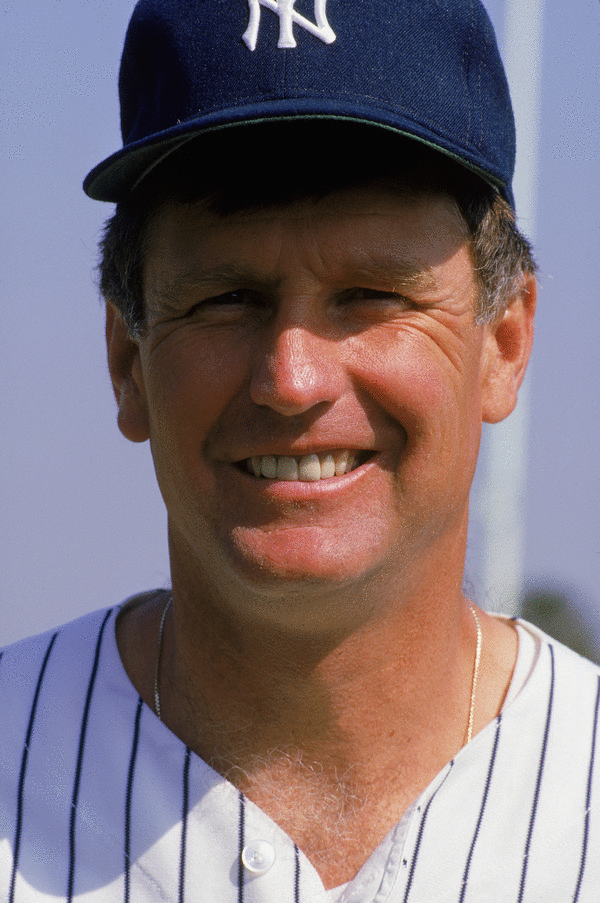
MIAMI — Thomas Edward John Jr. — forever Tommy John, “the Bionic Man” — died quietly Saturday night at 83, his career unrequited, his legend unfulfilled.
He deserved better. Always did. Still does, though now the honor due him if it ever comes at all would be posthumous, with all the bittersweet ache that forever surrounds the word.
Tommy John would die under hospice care outside Bradenton, about 3 1/2 hours northwest of Miami on Florida’s Gulf Coast. He had been fighting bladder cancer and other ailments for years. He had strong local ties including a minor-league stint with the Fort Lauderdale Yankees, and spent much of his life in Fort Lauderdale, raising his family there and in the ‘90s coaching baseball at the city’s Westminster Academy.
That followed a long professional career that from the early 1960s through the ‘80s saw him pitch 26 major-league seasons for seven teams, notably the Yankees, Dodgers and White Sox. The left-hander was exceptional. He won 288 games, had 2,245 strikeouts with 46 shutouts and three 20-game seasons. Yet Cooperstown never called. Across MLB history Roger Clemens, who has only himself and steroids to blame, is the only man to win more games without being in the National Baseball Hall of Fame.
In 15 years on the Hall ballot BBWAA voters inexplicably never gave him more than 31.7% of the votes, less than half of the 75% needed. Five times since, as recently as 2025, the Veterans Committee also has turned its back.
I am a BBWAA member and a Hall voter and proud to be ... but not always. I had no vote the years John was on the main ballot. Meanwhile, I have watched a Veterans Committee ripe with cronyism repeatedly give a Cooperstown pass to players who didn’t come close via the main electorate, such as Harold Baines. That was scandalous. Baines never got more than a negligible 6.1% vote from the main electorate, but was let in by a 16-member that included former White Sox owner Jerry Reinsdorf, manager Tony La Russa and others with close ties to the player.
Now known formally as the Contemporary Baseball Era and Classic Baseball Era committees but still loosely as the Veterans Committee, this group meant to correct oversights continues to let in marginal guys. Just last month, Jeff Kent got in despite topping out at a 46.5% vote from the main electorate.
While Tommy John died, his career was mysteriously denied.
His name lives on, of course, but less for the almost 300 career victories than for the elbow surgery that saved that career.
“Tommy John Surgery” is his legacy. It was not one he wore comfortably.
[Neither was Tommy John thrilled when late in life there arose a Tommy John men’s underwear brand unrelated to the former pitcher in every way. But we digress.]
His name never goes away because of the surgery. It came back when the Marlins’ Sandy Alcantara had the procedure in 2023, and again in ‘25 when Yankees ace Gerrit Cole had it.
In 1974 Tommy John was the first to undergo Dr. Frank Jobe’s pioneering technique of ulnar collateral ligament (UCL) elbow reconstruction, later named for him. Now it has become somewhat routine.
Said Cole upon John’s passing: “The first thing that comes to mind is how much of a trailblazer he was and what great perseverance he had, venturing into the unknown with the surgery and really writing the book, the script for how to push through it and overcome it and ultimately have success afterward.”
The Yankees in a statement called John “a bedrock of our rotation during his time in pinstripes and a longtime favorite of Yankees fans,” adding, “While his incredible longevity and post-surgery achievements changed the fortunes and trajectory of countless athletes around the world, it also overshadowed his excellence as a pitcher.”
John would record 164 of his 288 wins with the new elbow. Alas, Cooperstown stayed forever unimpressed.
And Tommy John himself had misgivings about being the name and face of the surgery.
“My name is now attached to something that affects more children than pro athletes,” he wrote in AARP magazine in 2018. “Today 57% of all Tommy John surgeries are done on kids between 15 and 19. It doesn’t bother me to watch my legacy being upstaged by an operation that has saved plenty of ballplayers’ careers. What does bother me is that my name is now attached to something that affects more children than pro athletes. I was in my 30s and playing major-league ball for nearly a dozen years before needing the operation. Today, most Tommy John surgeries are done on kids. It’s hard seeing so many kids being pushed the way they are today, and getting hurt as a result.”
The wife and three children that survive him include a son, Tommy John III, who is a chiropractor.
“As the father of a son who also shares my name and who works with many injured young athletes, this fight is personal,” John wrote. “My hope, whether I’m around to see it or not, is that the next time you hear ‘Tommy John,’ you’ll remember an athlete who tried to call attention to what may be happening with our grandchildren, instead of a surgery. Any unnecessary injury or procedure — no child should ever suffer in the first place.”
While ‘Tommy John Surgery’ became a legacy not of his choosing, the one he earned across 26 major-league baseball seasons and dearly coveted was the legacy denied. The surgery named for him that has saved countless other pro careers is its own distinction of some merit, but the 288 victories should be enough.
“Posthumous” always means too late, but Cooperstown needs to do right and welcome Tommy John home.
____
©2026 Miami Herald. Visit miamiherald.com. Distributed by Tribune Content Agency, LLC.


Comments