For the Orioles, getting back to fundamentals starts from the ground up
Published in Baseball
The Orioles had reached a breaking point. One that had Mike Elias calling for the organization to take a hard look in the mirror.
Just over 13 months ago, the Orioles decided to make a change. After fizzling out down the stretch in 2024 and getting off to a 15-28 start last season, the team fired manager Brandon Hyde in its biggest shakeup of organizational leadership since Elias hired him during his first offseason as general manager in 2018.
But Elias, who had been promoted to president of baseball operations only months prior, didn’t stop there. Sitting in the visitor’s dugout in Milwaukee, he pointed to the Orioles’ swift downfall from June 2024 when they were “on top of the sport in almost every facet of the sport” and recognized that moving on from Hyde wasn’t the only change they needed.
“I’m in the process of very heavily evaluating everything that we do across the organization that pertains to the front office, analytics department, player development. You name it, we’re looking at it very hard,” Elias said that afternoon.
“Some of it’s just individualistic, being, ‘Hey, let’s do something different with this player.’ Other things, I think, will involve perhaps sweeping changes to the way that we do business in the warehouse. I’m just not ready to go into it all right now.”
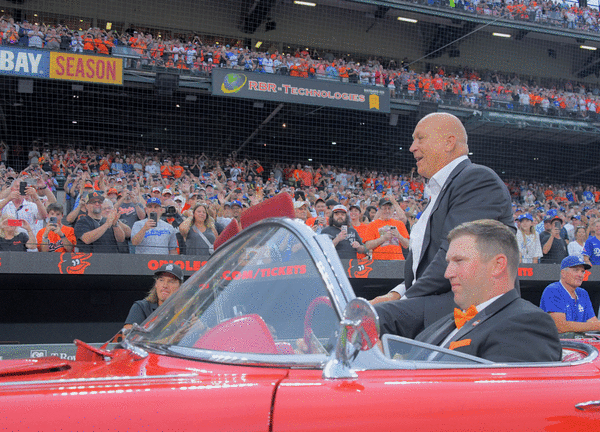
What those changes look like on the player development side is starting to be realized. The Orioles, with the input of Hall of Famer and minority owner Cal Ripken Jr., have shifted their efforts in the minor leagues. Beginning in spring training, the organization started putting a greater emphasis on fundamentals and situational baseball to foster winning habits from the MLB roster all the way down to its Dominican summer league team.
Ripken was involved as early as last offseason, when he called former San Diego Padres and St. Louis Cardinals manager Mike Shildt to help convince him to join their player development staff. Shildt, who was looking to take a step back from the grind of managing, agreed to fill the newly created role of upper-level coordinator of instruction, with which he’s taken on a leading role in establishing a different standard for Orioles baseball.
“We have all these resources, right? You have all these things at the disposal of the industry,” Shildt said on Thursday’s episode of The Baltimore Sun’s “Early Birds” podcast.
“The other side of it is we have a lot of things in the industry, and what does that balancing act look like, what does that sweet spot look like for competition to win games? And so I was pleased to be a part of a group with [lower-level coordinator of instruction Samuel Vega] and organizational philosophy to look towards fundamentally how we’re going to play the game to win the game as a champion might. So, I tip my hat to [Elias] quite a bit of being able to figure out what that looks like and be able to pivot into it.”
Avoidable mistakes have been a consistent theme for the Orioles over the past year and a half, and they still haven’t quite eliminated them at the major league level — as evidenced by the series of miscues that led to their 7-6 loss to the Los Angeles Angels in extra innings Wednesday.
First-year manager Craig Albernaz has taken several steps to cut down on them, but it’s a process that takes time, especially for a team built around a nucleus of players that were all developed a certain way.
“The game in general has gone away from more situational baseball, so the amateur player comes up in more of a skill-developed-based model, so understanding how to play the game, how to see the game, how to play to win the game, because that scoreboard is still real, is where we currently are, and we’re making strides,” Shildt said.
Though Ripken did some on-field instruction during spring, he’s operated more behind the scenes in the months since. Ripken does, however, frequently communicate with Shildt, the front office and other members of the player development staff to share his expertise on the finer points of the game, including breaking down specific plays with minor league coaches and ensuring what’s been communicated with the players involved.
“Just every aspect of the game, whether it’s controlling the run game to PFPs to double-play turns to pop-up priority to first-and-third situations — just the boring stuff people don’t see but wins and loses ballgames,” Double-A Chesapeake manager Roberto Mercado told The Sun on June 18.
“I think those aspects are something we’ve kind of honed in on, and we’re continuing to grow every single day. As the season goes on, we tell the guys, ‘Hey, we’re going to get better as games go, as the series goes, as the season goes.’ And we’re doing that now. It’s really good to see those improvements.”
One example of the Orioles’ implementation of new practices is standardized verbiage. On groundballs to the right side of the infield, Orioles first baseman Pete Alonso always calls “I got it, I got it, I got it,” to signal his pitcher to cover the bag while he fields the ball. Given that Alonso figures to be their starting first baseman for the next half-decade, the Orioles have made “I got it,” the organization-wide call for first basemen on those plays.
The same goes for situational decision-making. Shildt has had extensive conversations with Orioles third base coach Buck Britton about the contact play, when a runner is at third looking to break for home on a ball in play. Britton explained his thought process for those situations and the terminology he uses with players, and Shildt has taken those principles to each affiliate to ensure they’re putting their prospects in a position to seamlessly take in Britton’s instructions when they eventually make it to Baltimore.
“These are the conversations that we have organizationally, and that really creates the ‘Oriole Way,’ and the ‘Oriole Way’ is just doing things together and having people like Cal or other legacy players like Brian Roberts, [who] spoke in minor league camp about stealing third,” Shildt said. “It was elite. … The more we can do these things together and make sure that we’re standardizing to create clarity for our player, because player clarity leads to player confidence, and player confidence leads to championship players.”
The “Oriole Way” used to be the standard that was the envy of the sport, back when Baltimore was one of baseball’s most successful franchises from the early 1960s through the mid-1980s. It was passed between generations of Orioles, from Brooks Robinson to Eddie Murray to Ripken — the latter being perhaps the greatest embodiment of it all with his iron man streak of 2,632 consecutive games played.
After the front office recognized the team had strayed from that path, it changed course. What the “Oriole Way” looks like in 2026 and beyond is still being forged.
From the ground up.
_____
©2026 The Baltimore Sun. Visit at baltimoresun.com. Distributed by Tribune Content Agency, LLC.





Comments