Bill Shaikin: As MLB proposes salary cap, Sacramento pursues team it might not be able to afford
Published in Baseball
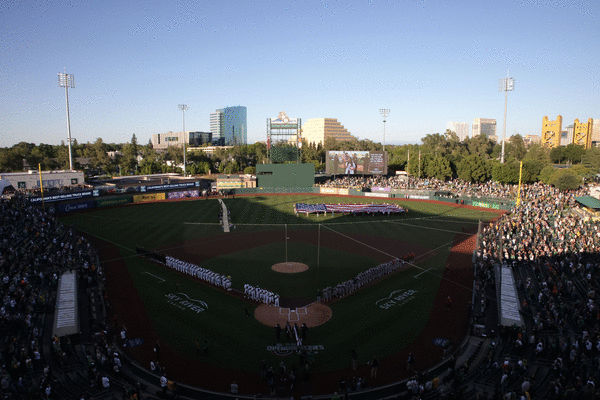
LOS ANGELES — They had balloons, baseball caps and a splashy video. They even had Dusty Baker, because any day with Dusty Baker is a good day.
And, as a campaign called "The Sacramento Pitch" unveiled its plan to lure a Major League Baseball expansion team to the state capital, the mayor made his pitch a blunt one.
"This region has earned its place in the majors," Sacramento Mayor Kevin McCarty said Thursday. "And, frankly, MLB could use Sacramento."
We'll see. But, as McCarty and other dignitaries rallied in Sacramento, a more important gathering was happening in New York, at which MLB owners formally proposed the salary cap players have vowed to resist.
Whether owners can get a cap — either by persuasion through the fall and winter, or more likely by canceling games next spring so players go unpaid — remains to be seen. For Sacramento and the other American and Canadian cities pursuing two expansion teams, the outcome of collective bargaining could determine the fee MLB would charge for each one.
On Thursday, Sacramento unveiled a $4 billion proposal to land a team, build a riverfront ballpark and surround it with an entertainment district. By the time MLB is ready to expand — after collective bargaining, and most likely after new media rights deals in 2028 — baseball insiders suggest the expansion fee itself could be around $4 billion.
Said Barry Broome, president of the Greater Sacramento Economic Council: "If it's a $4 billion fee, I'll be surprised if there are too many people that would pay that."
MLB never has had a salary cap. In 1994, the last time MLB proposed one, the players went on strike, and the World Series was not played.
Now, the league argues, payroll disparities are so great that only a cap can solve them. In its presentation Thursday, MLB noted the Dodgers paid more in luxury taxes last season than 16 teams paid in player salaries and cited a $446 million payroll gap between the Dodgers ($515 million) and the lowest-paying team, the Miami Marlins ($69 million).
The league also said fans in a large market have a 50% chance of seeing their team win the World Series by age 12, while fans in a small market have a 50% chance of seeing their team win by the World Series by age 73.
"Ultimately, the game is about hope and competition, and too many fans in too many markets have too little hope their team has a fair chance to win," MLB spokesman Glen Caplin said in a statement.
The MLB proposal: a cap with a maximum payroll of $235 million and a minimum payroll of $171 million, with those figures including $23 million per team in player benefits. The Dodgers' payroll would be cut roughly in half, although the league and the union would discuss ways to phase in such cuts over time.
Those savings help explain why the Dodgers — at least for now — would support a proposal that includes every team throwing their local television rights into a pool that would be marketed as one national package — one place to see every game, with no blackouts, and with revenue shared equally among teams.
The Dodgers' SportsNet LA deal — $8.35 billion over 25 years — has provided the team with a massive financial edge in funding back-to-back World Series champions.
The MLB Players' Association believes the owners can share all that revenue — from local television and other sources — and thus resolve financial disparities without capping player salaries.
"Billionaire owners are not seeking to cap their profits or asset values, only player salaries," MLBPA executive director Bruce Meyer said in a statement. "This isn't out of generosity or a desire to protect the game's well-being. It's a play to control costs, increase profits and maximize franchise values — all at the expense of players past, present and future."
MLB owners have been distressed as franchise values — ultimately, sale prices — have not appreciated as rapidly as they have in other sports. A salary cap would offer owners the cost certainty — 50% of industry revenue, however that might be defined, would go to players — that limits financial risk in ownership.
In the NBA, which has a salary cap and media deals more lucrative than in MLB, the league reportedly anticipates bids in the range of $7 billion to $10 billion for proposed expansion teams in Las Vegas and Seattle.
In MLB, a prominent official with knowledge of the situation not authorized to speak publicly told me the expansion fee could range from $3 billion to $5 billion — on the lower end without a salary cap, on the higher end with a cap and the greater media revenues that could come with it.
That could leave Sacramento and the other MLB suitors — including Salt Lake City, Montreal, Nashville, Raleigh, Charlotte, Orlando, Vancouver and Portland — scrambling for more funding at a time the surprisingly common thought is an expansion fee would be about $2 billion.
In 2021, when Sportico estimated the average MLB franchise value at $2.2 billion, Commissioner Rob Manfred said that figure could be "where you would start" in evaluating an expansion fee. Sportico this year put the average franchise value at $3.2 billion, and the San Diego Padres sold last month for a league-record $3.9 billion.
In Sacramento, campaign chairman Mark Friedman said his group has lined up $1.8 billion in private and public funding and is in search of a lead investor, with the stadium site and tax rebates already arranged with local governments.
"We've set the table," Friedman said. "All of the guests are in attendance. We're simply waiting for the guest of honor."
Broome said he spoke with representatives from two runners-up in the Padres bidding as well as "a group of billionaires from Texas." It's all tire-kicking for now, he said.
For $4 billion, Friedman said, Sacramento can get a team, put up a stadium and surround it with places to eat, shop and play.
"We're targeting being able to be competitive up to $4 billion," he said. "If it turns out to be more than that, we'll need to look at the numbers again."
In the meantime, Baker was there to tell a few stories and put everyone in his hometown at ease, as he did for decades as one of baseball's most acclaimed managers.
In his remarks, Baker celebrated the dozens of major leaguers who that come out of Sacramento.
"We had some of the baddest dudes in baseball — not only in Sacramento, but in baseball. We were proud of that," Baker said.
"If you weren't hitting — if you were hitting now like some of these guys are hitting now, .217 — man, we'd talk about you. Because, if you were from Sacramento, you gotta ball."
©2026 Los Angeles Times. Visit latimes.com. Distributed by Tribune Content Agency, LLC.





Comments