Paul Sullivan: Another unexplainable Cubs losing streak? Been there, done that.
Published in Baseball
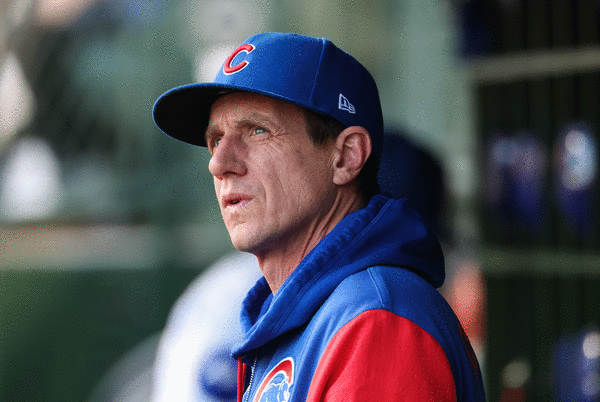
CHICAGO — It might seem like the end of the world for panicky Chicago Cubs fans.
The Cubs take a 10-game losing streak into Wednesday night’s game in Pittsburgh, having erased most of the gains from two earlier 10-game winning streaks and falling from first place in the National League Central to a tie for last.
But as a senior fellow at the Chicago branch of the Institute of Laughable Losing Streaks (ILLS), I can confirm the Cubs have been in more dire straits after similar stretches of bad baseball, many of which I witnessed firsthand.
First of all, there are still four months to recover from the mess the Cubs find themselves in, and two months remaining before the trade deadline, when president Jed Hoyer will have to decide whether to sell or buy. As bad as the Cubs have been since their 20-3 stretch led into this 2-14 slump, the fact that they were 20-3 in the first place indicates the talent is in place for a potential rebound. The 2017 Los Angeles Dodgers won 11 in a row in July and lost 11 straight and 16 of 17 in late August and September, yet made it to the World Series before losing to the drum-beating, signal-stealing Houston Astros.
The first lesson students learn at the ILLS is “(Stuff) happens.”
In May, the Cubs are second to last in MLB with a .203 average and have had five regulars hitting .200 or less: Dansby Swanson (.143), Seiya Suzuki (.159), Ian Happ (.184), Nico Hoerner (.195) and Pete Crow-Armstrong (.200). This lack of inconsistency is unsustainable based on their past numbers, even when accounting for possible aging effects on four of those five players.
If those four revert to their career norms or thereabouts — and Crow-Armstrong reverts to his first half of 2025 status — the Cubs offense should be back above average in due time. If not, Suzuki and Happ, who are in their walk years, could be goners by August.
Cubs fans traditionally take a “Why us?” approach to prolonged team slumps, looking for metaphysical reasons to explain the unexplainable.
In this case, some have pointed to the so-called “Lady in White,” the White Sox fan who harassed Crow-Armstrong at Rate Field on May 17, leading to his vulgar comeback that went viral and put talk radio on high alert for several days. The Cubs have not won since.
Others point to the May 15 death of Billy Goat Tavern owner Sam Sianis, who alternately promoted and removed the Billy Goat curse placed on the team by his uncle in 1945 before it allegedly was broken with the 2016 World Series win. Could Sianis have willed the curse to his heirs? The Cubs won that night, but have not won since.
Another conspiracy theory revolves around the “Magic Wand” used by Sox pitcher Mike Vasil on his team’s hitters that resulted in a five-homer game against Cubs pitching in an 8-3 win on May 16, which started the Cubs’ losing streak. Was it also used to hypnotize Cubs pitchers into submission? They have not won since.
Over the years, many students at the ILLS have written their theses about the strange phenomena surrounding Cubs losing streaks. Blaming the Cubs’ ills on off-the-field issues is entertaining and keeps some sportswriters employed well past their expiration date. But the common denominator of all those slumping Cubs teams appears to be poor pitching, hitting and roster construction, like another Chicago franchise that’s in a rut.
A recent example can be found in 2021, when the Cubs were feeling good about going 19-8 in May only to go on an 11-game losing streak from late June through early July. That led to the Great Summer Sell-off at the trade deadline, an important moment in the team’s history and Hoyer’s career.
“We went through a 12-gamer in 2012 with a 101-loss team,” Hoyer said that July. “Going through a losing streak like that with this much talent is certainly not something we anticipated and obviously is disappointing.”
Asked if another rebuild was in order, he replied: “You’ve got to make labels?”
Thus began the rebuild that couldn’t be labeled a rebuild, as Anthony Rizzo, Kris Bryant, Javier Báez, Craig Kimbrel and others were all shipped elsewhere for a slew of prospects. The Cubs then promptly went on a 12-game losing streak in August that no one blamed on a curse. It was relatively painless since Hoyer had already announced a new era was beginning.
Five years later, only Crow-Armstrong has made any impact from the group of prospects acquired in the Great Summer Sell-Off. Hoyer received a contract extension last summer and the Cubs made the playoffs, igniting anticipation for 2026, which began much like 2021 before the current fade.
Perhaps the most unexpected Cubs losing streak was the 13-gamer in 1985, which came after the memorable 1984 season that snapped a 39-year postseason drought and changed the franchise and Wrigleyville forever. The ‘85 Cubs were 35-19 and four games up in the National League East before a catastrophic turn of events — 13 straight losses.
“Absolutely mind-boggling,” outfielder Keith Moreland said.
Cubs announcer Steve Stone asked Chicago Tribune columnist Bob Verdi: “If it gets to 16, does that mean it splits?”
When the Cubs finally snapped the streak, coach Don Zimmer stuck his head into manager Jim Frey’s office during his postgame press conference.
“Well, did the president call?” Zimmer asked.
President Ronald Reagan, a former Cubs announcer, did not call Frey to congratulate him. The Cubs wound up 77-84 and 23 1/2 games out, and would not make the postseason again until Zimmer was manager in 1989.
The granddaddy of all Cubs losing streaks took place at the outset of 1997 when they lost their first 14 games, a National League record unlikely to be broken. This coincided with my switch from the Tribune’s White Sox beat writer to its Cubs beat writer, an ominous event for Cubs general manager Ed Lynch and president Andy MacPhail, the architects of that team and other disasters after I moved back to the Sox beat.
After the first six losses in 1997, Chicago radio personality David Kaplan, then with WGN-AM 720, said he’d sleep in a van at the Wrigleyville McDonald’s until the Cubs won a game. Kaplan would spend eight cold nights sleeping in a van down by the ballpark, getting sympathy from manager Jim Riggleman, who told him, “We suck,” but none from the players. When I asked Cubs outfielder Dave Clark about the radio stunt, he said of Kaplan: “Get a life. If you want to sit out there and freeze to death, go ahead.”
The McDonald’s was eventually torn down and replaced by a new one. Kaplan went on to bigger things and is still on morning radio at ESPN 1000. Wrigley Field is still Wrigley, despite a massive renovation that caters to wealthy fans while making the owners even wealthier.
Meanwhile, prolonged losing streaks continue to make Cubs fans, no matter the time, players, manager or top executives.
At times like this, it’s best to remember the wise philosophy of Mike Ditka, who declared: “This, too, shall pass.”
____
©2026 Chicago Tribune. Visit chicagotribune.com. Distributed by Tribune Content Agency, LLC.




Comments