Seattle Times picks all-time Mariners team ahead of 50th anniversary season
Published in Baseball

SEATTLE — Vibes are high. Higher, perhaps, than they have ever been at this time of the year around the Seattle Mariners.
And for a franchise with nearly five times as many losing seasons (29) as playoff appearances (six) since its inception in 1977, the Mariners do have much to celebrate as they honor their best and brightest during this 50th anniversary season.
Baseball, better than any other sport, cherishes its past. And this 50th season promises to be a nostalgic one for the Mariners.
Throw in the potential for this 2026 team — with its emerging franchise icons and the momentum built off October’s playoff excitement — and this season could turn into both a recognition of where the Mariners have come from and an appreciation for what they believe they can achieve.
No, the Mariners haven’t often had great teams. But they have just about always had great players.
In that spirit, The Seattle Times has gathered sports writers and editors past and present to select an all-time Mariners team. Our 15 voters had a simple directive: Pick the players who best represented the Mariners during their careers.
Some selections were obvious. No one will be surprised at the unanimous choices of players who have their own statues outside T-Mobile Park and are instantly recognizable by a single name.
Other selections divided our panel. Votes were split between three candidates at second base, and one or two bullpen choices might force even the most knowledgeable baseball student to search Baseball Reference’s site for basic background (Enrique Romo was better than you remember).
Here it is, The Seattle Times’ all-time Mariners team.
…
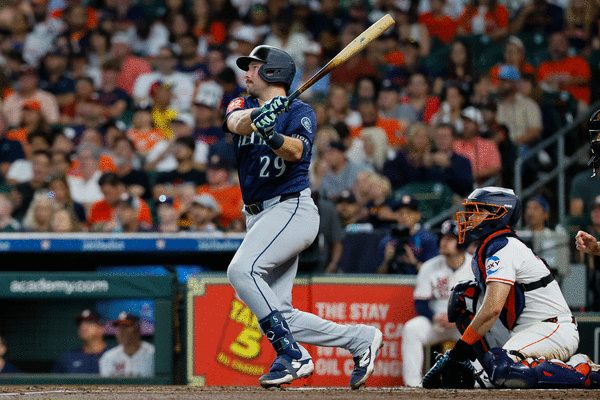
Catcher: Cal Raleigh
This is an easy call after Raleigh’s historic 60-homer season last year, which is in the discussion as the single greatest season by a catcher in MLB history. Raleigh, at 29, is in his prime and he’s signed through 2030. The Big Dumper has big plans for the Mariners.
A nod here to Dan Wilson, who was the franchise’s only All-Star catcher (1997) until Raleigh last season. Wilson caught more innings (10,102) than any catcher in M’s history and is ranked by FranGraphs metrics as the No. 1 most valuable defensive player, at any position, in club history, ahead of shortstop Omar Vizquel and catcher Mike Zunino. Guess who is already No. 4 on that list? It’s Raleigh, who ranks just ahead of Ken Griffey Jr., Ichiro and Adrian Beltré.
First base: Alvin Davis
In 1984, Davis became the franchise’s first homegrown star, posting what is still the best season by a first baseman in club history (6.0 bWAR), earning AL Rookie of the Year honors and soon blossoming into the “Mr. Mariner” moniker he still proudly carries today as a special assistant in the minor leagues. In an era when the Mariners had little success, Davis gave fans reason to show up at the Kingdome. From 1984-90, Davis ranked as the fifth-most valuable first baseman in MLB with a 21.9 bWAR, behind the likes of Don Mattingly (32.7), Eddie Murray (31.0), Kent Hrbek (25.7) and Will Clark (25.2).
The Mariners have had five first basemen earn All-Star selections: Bruce Bochte (1979), Davis (1984), Tino Martinez (1995), John Olerud (2001) and Ty France (2022).
Olerud, the Bellevue native and Washington State product, received one vote in our panel. He was a steadying presence in the early-2000s teams, posting a 17.1 bWAR for the M’s with three Gold Gloves, a .827 OPS and a 121 OPS+.
Second base: Bret Boone
This was our tightest vote at any position, with three worthy candidates splitting the 15 votes. Boone, with seven votes, ultimately is the choice ahead of Robinson Canó (five) and Harold Reynolds (three). Boone had 37 homers and a league-leading 141 RBIs in 2001, finishing third in AL MVP voting behind teammate Ichiro and Oakland’s Jason Giambi. Boone’s 8.8 bWAR in ’01 ranks as the second-best season by a primary second baseman this century (Chase Utley had a 9.0 WAR season in 2008). In seven seasons (across two stints) with the M’s, Boone was an All-Star twice and won three Gold Gloves.
The overall offensive numbers favor Canó, whose a 10-year, $240 million deal remains the largest free-agent contract in club history. In five seasons in Seattle, Canó slashed .296/.353/.472 (. 826 OPS) with a 129 OPS+ and a 23.9 bWAR. His tenure with the Mariners, however, ended in controversy when he was suspended for half the 2018 season after testing positive for PEDs. He was traded to the New York Mets that winter, along with closer Edwin Diaz.
The defensive metrics favor Reynolds, one of the few stars during the Mariners’ dreary daze in the 1980s. Reynolds was named to two All-Star teams and won three straight Gold Gloves. He’s also the answer to a fun trivia question: Who was the only player other than Rickey Henderson to lead the AL in steals in the ’80s? Reynolds finished with 60 steals in 1987, leading to a story Reynolds loves to tell about Henderson, the all-time stolen base king who was injured for much of that year. Henderson called Reynolds after the season: "Sixty stolen bases? You ought to be ashamed. Rickey would have 60 at the break.” Henderson then abruptly hung up.
Third base: Kyle Seager
Based on total contributions to the Mariners, Seager is the clear choice here, and he garnered all but two of the votes from our panel. Those two votes went to Adrian Beltré, a first-ballot Hall of Famer (for the Texas Rangers) who has to be the most talented third baseman the M’s have had. In five seasons in Seattle, Beltré posted a 21.2 bWAR, though he was basically an average hitter (101 OPS+) with the M’s.
Seager probably qualifies as one of the more underappreciated hitters the M’s have had — we’ll nominate Mike Blowers, Bruce Bochte, Ruppert Jones, Tom Paciorek, Ken Phelps and Leon Roberts for that distinction, too. Over his five peak seasons, from 2013-17, Seager averaged 158 games played and a 5.2 bWAR, with 26 homers, 33 doubles, a .792 OPS and a 121 OPS, plus one All-Star appearance and one Gold Glove. Only Ichiro (13,499) and Griffey (12,681) have played more innings than Seager (12,541) in an M’s uniform. His relationship with the club soured by the end of his career in 2021, but Seager deserves a spot in the Mariners Hall of Fame.
Shortstop: Alex Rodriguez
The No. 1 overall pick in the 1993 MLB draft, Rodriguez debuted with the Mariners a year later as (still) the youngest player in franchise history (18 years, 346 days). Two years after that, he won a batting title in his age-20 season in 1996, hitting .358 and leading the league in doubles (54) and runs (141) and finishing second to Juan González for AL MVP in one of the closest votes ever. A-Rod posted a 38.1 bWAR over seven seasons in Seattle, and the best season of his career was his final season with the Mariners in 2000, when he hit 41 homers with 132 RBIs and a 10.4 bWAR. In December 2000, he signed a 10-year, $252 million free-agent deal with the Texas Rangers — the largest contract in pro sports at the time — and instantly become the No. 1 sports villain in Seattle. His relationship with Mariners fans remains complicated, as does his place in baseball history after he confessed to using performance-enhancing drugs during his time with the Rangers in the early 2000s. MLB suspended him for the entire 2014 season. He finished his 22-year career with 696 home runs, fifth all time, though he has not been elected to the National Baseball Hall of Fame.
A-Rod received 14 of 15 votes from our panel, with Omar Vizquel getting the other vote. In a 24-year career, Vizquel spent his first five seasons in Seattle, building his reputation as one of the best defensive shortstops of all time. Our panel also considered J.P. Crawford, who last year surpassed A-Rod for the most games played by a shortstop in club history.
Left field: Raúl Ibañez
Rauuuuuul is one of the Mariners’ most unexpected success stories. Seattle’s 36th-round draft pick in 1992, Ibañez bounced back and forth from the minors to the majors from 1996-2000, never quite finding his footing. He didn’t land a full-time major league job until joining Kansas City in 2001; and of his 305 career home runs, 263 came after his 30th birthday. Ibañez re-signed with the Mariners before the 2004 season and becoming a fan favorite, hitting 113 homers and posting an .831 OPS combined over the next five seasons. He returned for a third stint in Seattle in 2012 and hit 29 homers as a 41-year-old, tying Ted Williams for the most homers by a player 41 or older.
Ibañez received 13 votes from our panel. Phil Bradley (1983-1987) and Mark McLemore (2000-03) each received one. Bradley was the Mariners’ All-Star in 1985, hitting 26 homers with a 4.8 bWAR and 134 OPS+ that season. McLemore was a do-it-all utility player and clubhouse leader on the 2001 team. McLemore and Mike Cameron will be featured as part of a new statue to be unveiled at T-Mobile Park in September.
Center field: Ken Griffey Jr.
It’s Junior. Of course, it’s Junior.
Griffey made his debut at 19 on opening day 1989 and went on to define an era of baseball. The epitome of cool, he was an icon for a generation of young ballplayers who grew up wearing their hats backward and swatting majestic home runs playing whiffle ball in their backyards. Griffey made the Mariners relevant, made Seattle believe in its baseball team, made the dream of a new outdoor stadium a reality. In 10 seasons from 1990-99, Griffey was a 10-time All-Star, won 10 Gold Gloves, hit 382 home runs and lead the AL in homers four times, hitting 56 in back-to-back seasons. He was the Mariners’ first MVP in 1997 and the franchise’s first player in the National Baseball Hall of Fame, a first-ballot selection in 2016. He joined the Mariners ownership group in 2021.
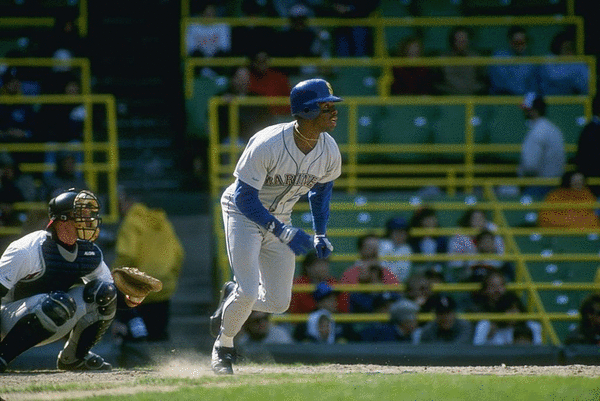
Right field: Ichiro
It’s Ichiro. Of course, it’s Ichiro.
What Griffey was for the Mariners in the ’90s, Ichiro was in the 2000s. The Mariners had lost Randy Johnson, Ken Griffey Jr. and Alex Rodriguez — three all-time greats — in three straight years, and somehow the team reached unprecedented heights in 2001, winning an AL-record 116 games with Ichiro as the catalyst. Twenty-five years later, it’s difficult to capture the sensation that surrounded Ichiro and his arrival as the first full-time position player from Japan. He was a slight-of-build 27-year-old rookie treated like a rock star in Japan but was famously greeted with curiosity and even doubt about his ability to hit major league pitching, most famously from the Mariners’ manager, Lou Piniella. Ichiro quickly put those concerns to bed and mesmerized fans and opponents alike through the 2001 season, and throughout his 19-year big league career. He led the league in hits (242), steals (56) and batting average (.350) in 2001, winning the AL MVP and Rookie of the Year awards. Three years later, he broke the all-time single-season hits record (262) — will anyone ever top that? — and finished with 4,367 hits combined between Japan (1,278) and MLB (3,089), more than any hitter in the history of pro baseball. Last year, he became the third Mariners player elected into the National Baseball Hall of Fame, and the Mariners will unveil his statue outside T-Mobile Park during a ceremony April 10.
Designated hitter: Edgar Martínez
It’s Edgar. Of course, it’s Edgar.
“ … The 0-1 pitch on the way to Edgar Martínez; swung on and lined down the left-field line for a base hit! Here comes Joey! Here is Junior to third base, they're going to wave him in! The throw to the plate will be … late! The Mariners are going to play for the American League championship! I don't believe it! It just continues! My, oh, my! Edgar Martinez with a double ripped down the left-field line, and they are going crazy at the Kingdome!”
Dave Niehaus’ iconic call greeted the most iconic swing in Mariners history, and the importance of Edgar’s double cannot be overstated. It delivered not only an 11th-inning walkoff victory, a dramatic comeback against the New York Yankees and the first playoff series win for the M’s, but the momentum from that moment helped secure public funding for a new ballpark and kept the franchise from moving to Florida. What a swing, indeed. Edgar remains one of the most beloved characters in Seattle sports — now the team’s senior director of hitting — and in 2019 he had his long-awaited moment in Cooperstown for his induction into the Hall of Fame. Over 18 seasons, all with the Mariners, Edgar hit .312 with a .418 on-base percentage and a .515 slugging percentage (. 933 OPS), one of just 14 players in MLB history with a career slash line of .300/.400/.500.
Starting rotation: Félix Hernández, Randy Johnson, Jamie Moyer, Mark Langston, Freddy García
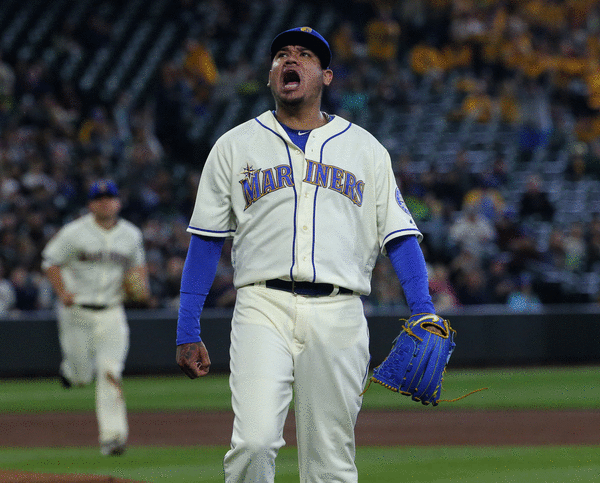
Félix, Randy and Jamie were unanimous choices for the Seattle Times’ all-time team. Félix, hands down, is the best homegrown pitcher the Mariners have ever had. The Venezuelan right-hander made his debut for the Mariners at 19 in 2005. At the peak of his powers, he was as good as any pitcher in the game, culminating in his perfect game Aug. 15, 2012. Félix is now entering his third year on the ballot, and there’s real momentum behind his National Hall of Fame candidacy.
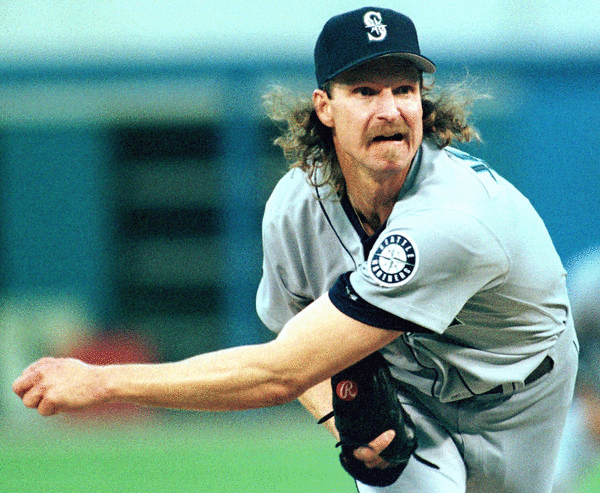
A ferocious 6-foot-10 presence, Randy might be the best left-hander of all time. His best years would come later with the Arizona Diamondbacks — where he won four straight NL Cy Young awards from 1999-2002 — but he found himself with the Mariners in the early ‘90s after arriving via Montreal in a trade for Langston (easily the most valuable trade in club history). Randy won his first Cy Young in 1995, when he went 18-2 with a 2.48 and 294 strikeouts in 214 innings.
Moyer, the ageless wonder, was the model of consistency, making at least 30 starts in nine of his 10 full seasons with the Mariners. The soft-tossing lefty was 145-87 across 323 starts for Seattle, with a 3.97 ERA. He pitched parts of 25 seasons for eight teams, making his final appearance at the age of 49 with the Rockies in 2012.
Langston and García each received 12 of 15 votes from our panel to lock down the final two spots in the all-time rotation. Logan Gilbert received three votes, Hisashi Iwakuma received two and James Paxton one. Langston was the M’s first homegrown ace in the 1980s. He led the AL in strikeouts three times in his first four seasons, and he finished fifth in AL Cy Young voting in 1987, when he went 19-13 with a 3.84 ERA and 262 strikeouts in 272 innings. García, the key return in the 1998 Randy Johnson trade to Houston, was the best pitcher on the Mariners’ 2001 team, winning an ERA title (3.05) and leading the league in innings pitched (238.2) that season.
Bullpen: Andrés Muñoz, Kazuhiro Sasaki, Edwin Diaz, Jeff Nelson, J.J. Putz, Arthur Rhodes
Given the wealth of options, selecting six relief pitchers for the Mariners’ all-time bullpen returned no unanimity among The Times’ 15 voters. Muñoz, Sasaki and Diaz each received 13 votes; Nelson got 12; and Putz and Rhodes 11 each. So in the end, there was a strong consensus, but 13 relievers did at least receive one vote (Mike Jackson and Norm Charlton got six each; Tom Wilhelmsen, Bill Swift, Enrique Romo, Paul Sewald and Rafael Soriano each got one).
Bench: Julio Rodríguez, Jay Buhner, Nelson Cruz, John Olerud, Dan Wilson, Mike Cameron.
Rounding out a complete 28-man playoff roster with some serious pinch-hit pop in Buhner and Cruz, along with elite defense with Julio, Olerud, Wilson and Cameron.
Manager: Lou Piniella
Sweet Lou was a unanimous selection for our panel. The Mariners’ most successful manager, he had seven winnings seasons in his 10 years in Seattle, with a record of 840-711 (.542), four playoff appearances, three trips to the ALCS and the 116-win season in 2001. Piniella was inducted into the Mariners team Hall of Fame in 2014.
© 2026 The Seattle Times. Visit www.seattletimes.com. Distributed by Tribune Content Agency, LLC.






Comments