Hurt in altercations with federal agents, these Minnesotans are still struggling
Published in News & Features
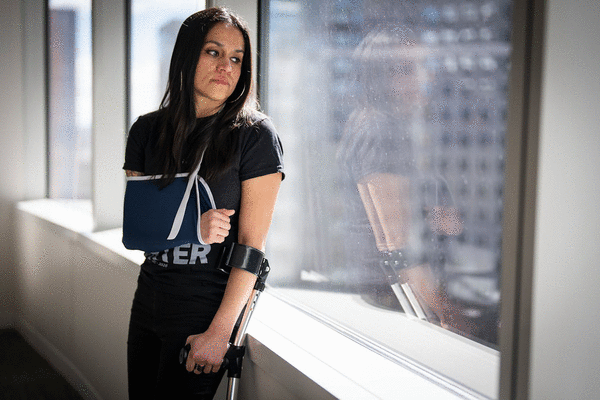
MINNEAPOLIS — Millions of people watched the viral video of federal agents shattering Aliya Rahman’s car window and pulling her into a Minneapolis street in January.
But she doesn’t have to rewatch the clips to churn up the painful memories from that day. The daily reminders are more than enough.
Small things, like a glass shattering in an airport restaurant, bring her mind back to the agents dragging her from her vehicle and tearing her shoulder tendons after she happened upon a chaotic scrum where protesters clashed with federal officers carrying out immigration arrests. What makes it more difficult is she doesn’t know the identities of the federal agents responsible — and worries that they might still be in Minnesota.
“I don’t know who these people were who did this to me,” she said. “I could be sitting next to them having breakfast.”
Thousands of agents have left Minnesota and nationwide attention on the state has dwindled in the last couple of weeks, and some Twin Cities residents have begun to feel a return to normalcy. But Rahman, and those who had similar encounters, continue to deal with symptoms seen in post-traumatic stress disorder, or PTSD, and still feel a sense of unease.
The Department of Homeland Security, or DHS, and Immigration and Customs Enforcement, or ICE, did not return requests for comment sent Wednesday.
While Rahman and other U.S. citizens detained in violent altercations with agents continue to struggle with their own trauma, several emphasized they are more concerned for the well-being of immigrants who have spent days or weeks in the federal jail and are separated from their families.
Wes Powers, a protester and U.S. Navy veteran who is white and was detained in January, said driving past the Whipple Federal Building each day on his commute fills him with dread for the people of color inside.
“It’s the vision of seeing immigrants in overcrowded cells, standing with blank, solemn and terrified expressions,” Powers said. “I’m not scared about what could happen to me. I’m scared, angry and heartbroken for them.”
Rahman, who is autistic and sustained a traumatic brain injury in 2024, was driving Jan. 13 on Park Avenue to her regular appointment at Hennepin Healthcare’s Traumatic Brain Injury Center when she inadvertently came across the chaotic scene where agents were fighting with protesters and fired tear gas and flash-bangs. Agents had closed down part of Park Avenue in south Minneapolis that morning to make an immigration arrest, and were not letting Rahman or anyone else’s car through.
ICE accused Rahman in a Feb. 6 post on X of “impeding or interfering with federal officers” for not driving away from the scene east on 34th Street, though she was never charged. Rahman said she was confused by agents shouting conflicting instructions to get out of the car and to drive away, and afraid for bystanders’ safety.
After a few minutes of yelling, an agent shattered Rahman’s window and cut her seat belt off with a knife before others pulled her out onto the pavement and handcuffed her. Four agents picked Rahman up by each of her limbs to carry her facedown to an unmarked vehicle. The agents pulling on her arms caused the tears in her shoulders that still cause her pain and exacerbated her brain injury, she said.
When she got to the Whipple Building, Rahman began slurring her speech and got blurry vision — symptoms of her traumatic brain injury which doctors have told her become worse during periods of increased stress.
She pleaded for medical attention that was not given, she said, and was forced to walk without a cane which she relies on. Rahman repeatedly pressed a button by her cell door to ask for help, but it either didn’t work or she was ignored, because no one came, she said.
After a while Rahman passed out on the floor of the cell, she said, before coming to in an emergency room at HCMC where she learned she had been released from federal custody.
Later, she would testify about the encounter to Congress. When she was invited by U.S. Rep. Ilhan Omar to attend the State of the Union address, Rahman was arrested again, this time by Capitol police for standing up and refusing to sit down during President Donald Trump’s speech. The federal government ultimately declined to pursue charges against her, according to her attorney.
Rahman said she received numerous threats and hateful messages following her arrests, including rape imagery, messages saying she should be “executed,” and people calling her and breathing loudly without saying anything.
Despite what she went through, Rahman said she will continue to speak out about her opposition to ICE’s presence in Minnesota.
“When my head hurts, I think about the event. When my shoulder hurts, I think about what these people are doing in our city,” Rahman said.
John Abernathy, a 62-year-old freelance photographer, gained nationwide attention when photojournalist Pierre Lavie took a viral photo of Abernathy’s detainment by federal agents outside the Whipple Building as he tossed his camera away to keep it out of the hands of officers.
Abernathy said agents wrongly accused him of shooting pepper spray at others earlier in the protest on Jan. 15, before tackling him to the ground.
Soon after an agent pepper sprayed Abernathy directly in the eye, he said, the agents walked him into the building and released him with a citation for “obstructing” access to the building.
A doctor later found an injury to the back of Abernathy’s eye. Since that day he has had increased eye floaters, he said, and sees a “white flash” when he turns his eyes to look to the right.
While he hasn’t been formally diagnosed with PTSD, Abernathy said he’s noticed symptoms of it, like sleeplessness and shivering — even though he has the heat turned up higher than normal in his house. He still covers protests, but some, like the scene on Nicollet Avenue where Alex Pretti was killed by federal agents, triggered uneasiness.
“As far as fear, anxiety, there’s something there,” he said. “I’m not exactly sure what it is.”
Michael Curtis, a professor of family social science at the University of Minnesota, said that he’s concerned not only for the people directly subjected to the tactics of federal agents, but for the community as a whole who bore witness to Operation Metro Surge.
“In addition to caring for the actual victims, I’m also looking at, systemically, how is this going to reshape the Twin Cities as a community and a culture?” Curtis said.
Powers, a Navy veteran who was detained while protesting at the Whipple Building on Jan. 8, said his physical injuries have healed, but the memories of what he endured and the sights inside Whipple still bother him.
It’s especially hard to move on given that his Fort Snelling apartment has a view of the Whipple Building, he said.
On the day of his arrest, another protester on the ground nearby asked Powers to reach into his pocket to take his phone so agents couldn’t get to it.
Before he could reach the man, the agents grabbed Powers’ wrist and tackled him as well, he said.
As he was led into the Whipple Building, his leg continued to sting from the pepper balls that hit him and covered him in chemical irritants. The sights from inside Whipple, where immigrant men had looks of dread and uncertainty on their faces, left an impact on him, Powers said.
In the days immediately after his detainment, Powers said he noticed unknown vehicles with tinted windows outside his apartment. He worried that agents were watching him. When driving he worries an agent is following him if he sees an out-of-state license plate behind him.
“I don’t know if it’s justified paranoia or if it’s not — my friends say it is justified," Powers said. “I’m thinking I’m just going crazy sometimes and I’m being over-dramatic. It’s hard to settle.”
Powers said he still struggles to get sleep since his release, and has struggled to eat normally at home alone when he’s not out with friends.
His fears are furthered by the fact that his therapy services are offered through the Department of Veterans Affairs, making him worried that other federal agencies could access his information. During a recent visit, Powers said his care team at the VA did not guarantee him that the federal government would respect his medical privacy rights.
Asked about Powers’ concerns, a VA spokesman said in an email that the department “can’t discuss our veterans or even if they get VA care” unless the veteran fills out a signed privacy release form.
Powers still goes back into the Whipple Building occasionally to assist people with immigration court hearings who feel scared to go inside. He said he recently went in to help get the passport and other documents for someone who was released without their identification.
While he’s been able to overcome his anxieties associated with Whipple and continues to assist detainees and immigrants going to court, he said he’s concerned the full extent of the trauma could catch up to him in the future.
“Eventually this is going to catch up to a lot of us,” he said. “The body can only take so much of this, and the brain can only take so much anxiety.”
(Susan Du of the Minnesota Star Tribune contributed to this story.)
©2026 The Minnesota Star Tribune. Visit startribune.com. Distributed by Tribune Content Agency, LLC





Comments