Rain triggers flooding, erosion concerns across Southern California. Could it stomp out fire season?
Published in Weather News
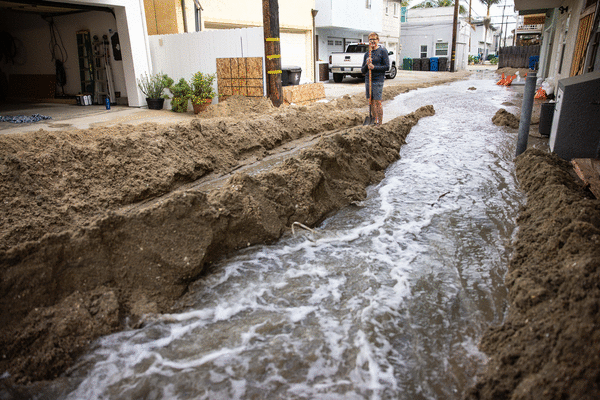
LOS ANGELES — The string of El Niño-fueled storms that have closed roads, crumbled boardwalks and eroded beaches in Southern California in the summer and fall may have also brought a silver lining: a potential end in sight to the region's fire season, experts say.
Just a week after a 570-acre fire spread to hillside communities in Orange County, rains that arrived Wednesday could help extinguish what chance remained of another large, destructive blaze taking off in Southern California anytime soon, said Matt Shameson, a meteorologist with the U.S. Forest Service.
This week's storm brought localized flooding to several freeways by Thursday morning, including parts of Highway 101 in Los Angeles and Ventura counties and Highway 1 in San Luis Obispo County, according to the National Weather Service. Boulders blocked a road near Agua Dulce and a rock slide blocked a section of Highway 41 in the Central Coast.
More rain is expected across the Southland on Thursday, which could bring debris flows to local burn scars, the weather service said. There's also the possibility of thunderstorms and a small chance a tornado could form in Ventura or L.A. county, according to Thursday morning's forecast. The weather should dry out by the weekend, the weather service said.
Across much of the Inland Empire and San Diego and Orange counties, where 1 to 3 inches of rain already fell from the remnants of Tropical Storm Rachel this month, this week's storms will probably quell the risk of large fires for the remainder of the fall, he said.
But in Los Angeles and Ventura counties, most of which got less than a tenth of an inch from Rachel, it will take another round of rains to put an end to the risk for the rest of the season, he said. Light vegetation including grass and brush can cure and turn to fire-ready tinder in short order under the right conditions, particularly during hot, dry Santa Ana winds, but that's unlikely to happen before another rain event, Shameson said. To boot, Santa Ana winds forecast for Friday into Saturday aren't expected to be very strong or widespread, he added.
Southern California's fire season typically peaks in July and August, when each day averages a roughly 22% chance of significant fire, Shameson said. By October, that drops to a roughly 5% chance.
"Basically, once you get to the middle of September, you need a Santa Ana wind event to get large fire activity," he said.
Recent history shows what happens when Santa Ana winds mix with a late-season fire. There was the Norte fire last week that destroyed seven structures in Orange County. In 2025, there was the L.A. firestorm. And months before that, the Mountain fire in Ventura County.
The strongest Santa Ana winds typically arrive in the winter. If those winds are preceded by sufficient rains, the risk of large fires is dampened. It typically takes two widespread rounds of moderate to significant rains to achieve this effect, Shameson said. There's the potential for another storm late next week, though it's too early to tell for certain, Shameson said.
Regardless, areas that haven't received much steady precipitation could still remain vulnerable, cautioned David Acuña, a battalion chief with the California Department of Forestry and Fire Protection in Sacramento.
"I hate to be a negative person," he said. "It's just a matter of I don't want people to let their guard down."
A historically strong El Niño increases the odds that Southern California will receive above-normal rainfall come winter, both by raising the chances that more storms will occur and ensuring they're warmer storms that carry more precipitation, Shameson said.
Due to anomalously high sea surface temperatures resulting from El Niño combined with a marine heat wave and climate change-induced warming, the region has also seen more remnants of hurricanes and tropical storms than normal this year. In addition to Rachel, Hurricane Marie brought rain to the area last month.
In fact, Shameson said, remnants of hurricanes and tropical storms have reached Southern California the last three or four years in a row, compared with a normal pace of every five to 10 years. These storms have helped to increase the amount of moisture in plants and soils and to alleviate drought conditions, a cumulative effect that has also lessened fire risk, he said.
California received 22.61 inches of precipitation during the 2025-26 water year ending Sept. 30, about 95% of the historical average, according to the state Department of Water Resources. That was preceded by near-average water years in 2023-24 and 2024-25 — the longest run of near-average years since the 1990s, wrote Jay Lund, vice director of UC Davis' Center for Watershed Sciences, in a post for the California Waterblog. (Still, the state's snowpack, which also plays an important role in mitigating large fires, remained well below average.)
With the rain falling this week, plus the prospect of a wet winter, some are now bracing for a different variety of wildfire threat: the possibility of flooding and debris flows in burn scar areas.
Wildfires can make soils become hydrophobic, with vaporized organic matter forming a waxy crust that repels water. When it rains, water runs off the surface instead of being absorbed.
As the state sees more El Niño storms, which are expected to kick into high gear starting in December, "we're definitely concerned whether that water will be able to move off safely or if we're going to get so much water all at once that it creates hazards," Acuña said.
To prepare for this week's storms, the Los Angeles Fire Department has augmented resources to help with swift-water rescues and mud and debris flows, with a specific focus on burn scar areas, according to a news release from Mayor Karen Bass.
City crews have also been clearing more than 31,000 catch basins and drainage systems and inspecting and reinforcing vulnerable hillsides and burn areas, including Pacific Palisades, Bass said in a statement.
©2026 Los Angeles Times. Visit at latimes.com. Distributed by Tribune Content Agency, LLC.






Comments