California may be in path of a 'super' El Niño. It could bring rain, floods, coastal erosion
Published in Weather News


LOS ANGELES — You're going to hear a lot about El Niño this year.
The term refers to warmer-than-average waters along the equatorial Pacific that can influence weather across the globe, raising the odds of searing drought in some regions and torrential rain in others. Indicators increasingly suggest such an event will develop later this summer, and it's possible it could be the strongest of the century to affect Southern California.
The prospect has been lighting up meteorology forums and bubbled into the mainstream consciousness this week with the release of an outlook by the European Center for Medium-Range Weather Forecasts indicating that sea surface temperatures could exceed the seasonal average by 2 degrees Celsius. A subsequent forecast released Thursday by the National Oceanic and Atmospheric Administration puts the odds of that happening by late fall at 1 in 4.
Some call El Niños that pass this threshold of warming super El Niños — relatively rare occurrences that are more likely to generate wide-ranging effects. "It's essentially the upper echelon of El Niño events," said Jonathan O'Brien, meteorologist with the U.S. Forest Service.
El Niño is one phase in a recurring global cycle known as the El Niño-Southern Oscillation, with its counterpart being La Niña. This cycle occurs when changes in tropical wind patterns — or trade winds — allow a massive reservoir of sun-baked seawater to slosh east across the Pacific and up against the Americas.
This unusually warm water typically releases heat into the air, spiking global temperatures already climbing due to climate change from burning fossil fuels. It can also alter polar and tropical jet streams, sending storms on a path through Southern California and the southern United States, experts say.
The amount of warm water available for this year's event exceeds that in 1997-98, which was among the strongest El Niño events of the century, said Paul Roundy, professor of atmospheric science at the University of Albany.
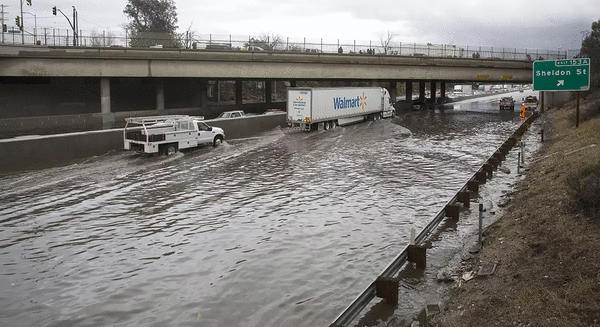
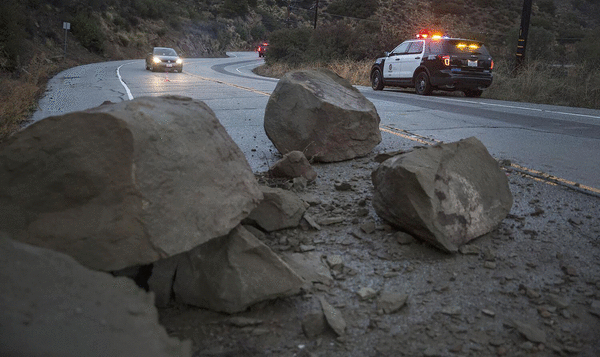
That winter, a relentless string of storms caused flooding and debris flows in California, destroying homes, washing away roads and killing 17 people. Worldwide, a hurricane killed hundreds in Acapulco and Indonesia recorded one of its worst droughts on record.
"If the signal continues to evolve as it currently is, it's possible that we achieve an event stronger than 1997," said Roundy, who predicts there's a roughly 20% chance that this year's El Niño is stronger than any other since the late 1870s, when an estimated 30 million to 40 million people died from droughts in India, China and Israel.
The latest NOAA outlook, released Thursday, forecasts a more than 90% chance that an El Niño will develop by fall and a 50% chance that it will be at least a strong event, said Nathaniel Johnson, a meteorologist at NOAA's Geophysical Fluid Dynamics Lab and a member of its El Niño-Southern Oscillation seasonal forecast team.
The transition could take place rapidly, he said, adding that some research suggests climate change is contributing to more frequent, extreme swings from La Niña to El Niño.
But even when strong El Niños do develop, they don't always translate into the weather conditions people have come to expect.
In 2015-16, a super El Niño was predicted — which some forecasters dubbed a Godzilla El Niño — but California's yearly rainfall totals ended up being about average, said state climatologist Michael Anderson.
But in 1982-83, when another super El Niño occurred, storms destroyed multiple piers and ripped away a 400-foot section of the Santa Monica Pier. The state's rainfall at the end of the year will be determined by more factors, such as the frequency and strength of atmospheric rivers, than whether it's technically an El Niño year, he said.
In Southern California, strong El Niños increase the likelihood of wet winters that replenish water supplies and tamp down wildfire risk but can also unleash flooding, debris flows and coastal erosion. Still, the exact effects are impossible to predict.
El Niños typically strengthen the subtropical jet stream, meaning more of California's weather in the fall and winter months tends to come in from the south, as opposed to the north, bringing in warmer air that carries more moisture, said O'Brien, the U.S. Forest Service meteorologist.
This could help limit Southern California's wildfire potential in the fall and winter, which is typically shaped by the presence of Santa Ana winds. El Niño tilts the odds toward the early arrival of the winter rainfall that could dampen the risk of those winds fanning flames, O'Brien said.
"We are cautiously optimistic that we will get rain in the fall that kind of preempts the Santa Ana winds and limits our potential heading into the fall and winter months of next year," he said.
Still, much uncertainty remains.
The climate system in the tropical Pacific is naturally less predictable in March and April, and even the most advanced models can struggle to capture how conditions will evolve, Tim Stockdale, principal scientist at the European Center for Medium-Range Weather Forecasts, wrote in an email. The picture typically becomes more clear between late May and June, he said.
But it's not just creatures on land that have to keep an eye on El Niño.
The pattern, which can decrease the nutritional quality of plankton, is believed to have intensified the effects of an unusually warm blob of seawater along the California coast that persisted from 2013 through 2016, resulting in a mass die-off of sea lion pups whose starving mothers weren't able to produce enough milk to sustain them.
The sea lion breeding and pupping season is fast approaching at main rookeries such as the Channel Islands, according to Giancarlo Rulli, associate director of public relations for the Marine Mammal Center. "Experts are eyeing current oceanography reports with a healthy level of concern," he wrote in an email.
----------
—Times Deputy Managing Editor Monte Morin contributed to this report.
©2026 Los Angeles Times. Visit at latimes.com. Distributed by Tribune Content Agency, LLC.






Comments