Federal wildlife officers killed 28,000 animals in California in 2025, data shows
Published in Science & Technology News

Federal wildlife managers euthanized 28,000 animals in California in 2025 and dispersed about 1 million more as part of a nationwide program meant to control invasive species and minimize danger to people, pets and livestock, new data shows.
The removals by a division of the U.S. Department of Agriculture — which nationwide involved killing 2.8 million animals and dispersing another 25 million — are the latest examples of the difficulties faced by state and federal conservation officials struggling to limit damage from invasive species and manage the populations of such predators as wolves, bears, mountain lions and coyotes.
“It’s a very large number of lives that have been lost,” said Nadia Steinzor, carnivore conservation director for Project Coyote, which advocates for the predator canines. “It is a very large number of animals.”
The federal program’s data release came days after California Gov. Gavin Newsom signed a bill re-establishing the state’s long-dormant program aimed at limiting human-wildlife conflict, prompted by growing concern over safety issues posed by California’s resurgent populations of wolves and other protected predators.
It also comes amid a renewed effort by the Trump administration to reduce protections for wolves, which cannot be killed or intensely harassed in much of the country under the federal Endangered Species Act. In California, wolves are also protected under state environmental law.
“Wildlife are one of America’s most valued public resources,” the USDA said in releasing the data last week. “Yet wildlife also can have negative impacts on agriculture, human health and safety, property, and natural resources.”
In California, USDA wildlife managers euthanized 1,743 feral swine, 3,285 coyotes, 6,903 squirrels, 14 mountain lions and 18 black bears in 2025, the data shows. Nationwide, the agency euthanized 329 wolves, none of them in California, according to the data.
Across the country, the species most frequently euthanized were feral swine, with about 132,000 deaths, and coyotes, with about 61,000, the data showed. Birds, including Canadian geese, several types of hawks, mynas and larks were also killed in the thousands.
By comparison, in 2015, federal wildlife officers killed about 69,000 coyotes and 42,000 feral swine.
Snares, cyanide and guns
The USDA report also details the types of lethal methods used to kill the animals.
Of the coyotes, for example, 15,000 nationwide were killed by neck snares, 5,500 with foothold traps and 182 with cyanide capsules. About 17,000 were killed from fixed-wing aircraft, and 11,000 from helicopters. In California, 387 were killed with neck snares, 44 with foothold traps and 2,200 shot with firearms. Cyanide was not used, according to the data.
Overall, the number of animals killed in the program last year was down slightly from 10 years ago, when 3.2 million were euthanized and 21 million dispersed. But conservationists still question the volume — and methods — of death.
“Is this really where taxpayers want their money going?” asked Steinzor. “Firearms, shooting from helicopters or an airplane — all of these really cruel and unethical methods that the taxpayers are funding.”
In California, wolves, bears and mountain lions are protected by state law. But coyotes, with their abundant numbers and reputation as nuisances, are not. A move to limit killing or hunting them in the state was tabled last year amid fierce opposition by ranchers, farmers and many city-dwellers, who said the animals kill livestock and pets, and their populations are thriving.
But Steinzor said coyotes contribute to ecosystems by controlling rodents and help some bird populations by eating animals that would otherwise consume their eggs. Killing coyotes can be counterproductive, she said, because disrupting the mating pair of a pack can cause an increase in reproduction, leading to more of the canines rather than fewer.
“We would like to see federal money, state money, local money moving away from lethal methods to non-lethal methods,” she said. “We would like for ... the ecosystem contributions of coyotes and other carnivores to be recognized.”
The USDA says the actions by its Animal and Plant Health Inspection Service were made in response to requests from government agencies, farmers, ranchers and individuals seeking help with predation and other concerns related to wildlife.
“Birds can cause extensive damage to food crops, such as rice and other grains, and predators can cause significant losses to sheep, lambs, and other livestock,” the agency said on its website. “Bird and other wildlife strikes with aircraft cost hundreds of millions of dollars in damage, delay flights, and threaten human health and safety.”
Chasing California wolves with drones
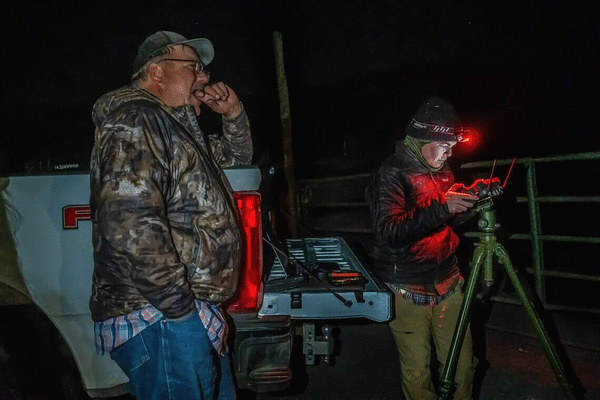
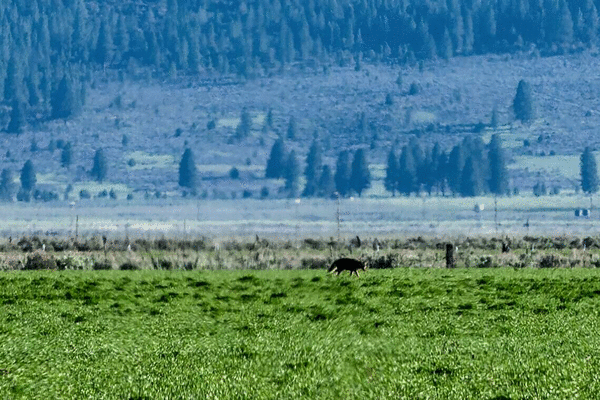
Although USDA wildlife managers did not kill any wolves in California last year, they did assist state game wardens after a Sierra County wolf pack killed nearly 100 calves in a seven-month period, flying drones to scare the apex predators away at night. But the efforts did not deter the pack, and last October state wildlife managers euthanized four of them, one accidentally.
The ongoing attacks on cattle highlighted California’s struggle to manage its resurgent populations of protected predators, and drew national attention to the particularly knotty problem of how to protect wolves, once locally extinct in the Golden State, while also safeguarding people and livestock.
Last month, President Donald Trump directed Secretary of the Interior Doug Burgum to re-evaluate the status of wolves and, if warranted, begin the process of removing their federal protections.
In January, California Natural Resources Secretary Wade Crowfoot called the state’s difficulty managing wolves and other predators “a crisis,” and called for funding and reinstatement of the Wildlife Coexistence Program later enshrined in the bill signed by Newsom last week.
The revived California initiative is meant to reduce euthanization by teaching people how to avoid interactions with wild animals, whether by instructing city dwellers not to feed bears while on a camping trip or training ranchers in nonlethal methods for limiting wolf attacks on cattle, said state Sen. Catherine Blakespear, D-Encinas, the bill’s author. In announcing that Newsom had signed the bill, she referenced The Sacramento Bee’s reporting on the issue.
“They habituate to eating human food, and then they end up needing to be euthanized,” she said. “And we don’t want that.”
Her bill, set to go into effect Jan. 1, re-establishes the program but does not automatically fund it, Blakespear said. In the last budget cycle, lawmakers asked for $48 million for the program and received about $5 million, she said.
But she said her bill allows the department to formally budget the program and request funding. Once established, nonlethal methods of controlling predators including wolves should reduce the need for killing them, she said.
“We want to keep the wild wild,” Blakespear said. “That’s the whole point.”
_____
©2026 The Sacramento Bee. Visit sacbee.com. Distributed by Tribune Content Agency, LLC.






Comments