Joshua tree preservation projects scrapped after Trump administration blocks funding
Published in Science & Technology News
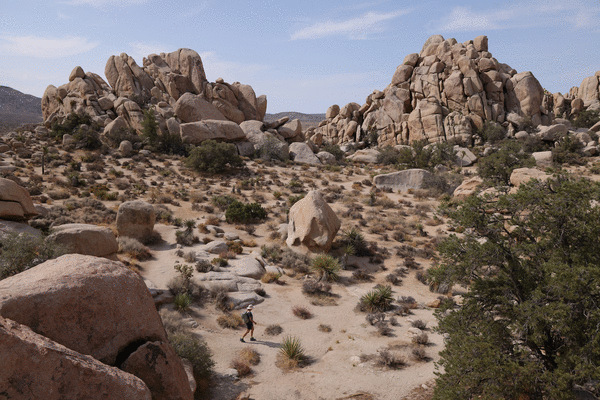
LOS ANGELES — A slate of projects aimed at preserving the future of the iconic Joshua tree has been scrapped after the Trump administration blocked more than $25 million in funding for national parks this year.
The funding already had been secured for more than 130 agreements with outside partners that would have supported projects in national parks across the country, including Joshua Tree. But the Interior Department, upon reviewing the agreements, “disapproved” them, according to The Washington Post.
The Interior Department, which did not respond to a request for comment Friday, told the Post it blocked the agreements because they were with groups that work against administration priorities.
Joshua Tree National Park was among the hardest hit, with the Interior Department blocking 10 agreements worth nearly $1.2 million that would have supported the hiring of at least 16 people, according to the Center for Western Priorities, which created an interactive map of the agreements using National Park Service records. All of the Joshua Tree agreements were with the Great Basin Institute, a nonprofit based in Reno, Nevada.
“These are the partnerships that keep our national parks running,” said Aaron Weiss, executive director of the Center for Western Priorities. “In the case of Joshua Tree, in particular, this is fire recovery, vegetation management — you have to do it at some point and the longer you wait to do it, the more damage that occurs and the more it costs later to get it done. So none of these suspended agreements make any sense.”
The Joshua Tree funding included nearly $41,000 for a fire preparedness vegetation specialist to provide data and support to fire managers facing critical emergency situations; more than $339,000 for vegetation technicians to collect and plant native seeds, reduce invasive plants and repair damage to burned areas; nearly $108,000 for a youth conservation crew to restore areas damaged by wildfire, and more than $83,000 for youth biological technicians to ensure that road and construction projects protect desert plants and wildlife.
The projects would have helped conserve the imperiled spiky succulents that draw millions of visitors to Joshua Tree each year and play a key role as a linchpin of the Mojave Desert ecosystem. Development and wildfires have destroyed swaths of the plants’ habitat, while climate change is threatening to make much of what remains inhospitable.
Joshua Tree is home to multiple climate refugia: higher-elevation areas that are expected to remain cool enough to support Joshua trees even as much of their range becomes too hot and dry. But wildfires have burned several of these areas in recent years, including dense woodlands near Covington Flats and Black Rock Campground.
“These agreements are preserving ecosystems, they are providing veterans, youth and retirees the opportunity to engage in parks, and they are supplementing resources work to help protect and prevent damage to ecosystems that are iconic and make these national parks what they are,” said Chance Wilcox, California desert associate director for the National Parks Conservation Association.
Outside partnerships are especially important because of staffing reductions to the National Park Service and attendant low morale, he said. The association estimates that the agency has lost nearly a quarter of its workforce to buyouts, early retirements and other departures since the Trump administration took office last year.
The blocked agreements affecting Joshua Tree also included support for projects to improve mapping technology, address pest infestations at Keys Ranch and bolster the archaeology program.
In all, the Interior Department denied 78 financial assistance requests from the Great Basin Institute totaling more than $12.7 million, according to a letter from Chief Executive Peter Woodruff appealing the denials.
“GBI’s standards remain staunchly nonpartisan through six presidential administrations, with a mission of supporting public lands management and the agencies charged with that mission,” he wrote.
The Center for Western Priorities also created a map of about 1,500 projects, many of which already had been approved, that the National Park Service shifted to a new “low priority” list this year.
They include four projects at Joshua Tree, including an effort to paint the headquarters shade structure and the Susan Luckie Reilly House and to purchase 150 new firepits and 60 new picnic tables to install in campsites. Another project would involve replacing 17 wayside exhibits at backcountry trailheads and three in the Cottonwood Spring area and adding three new interpretive wayside exhibits on the Mastodon Peak Loop. The fourth was to retrofit mobile storage systems in the park’s museum storage facility.
The Center for Western Priorities has been told that many of the projects were put on the list because there weren’t enough Park Service employees to execute the contracts and hire contractors and support staff to get the work done, Weiss said.
“All of this is part of the attempt to bleed all of our public lands dry and then claim, ‘Oh, we don’t have the resources to manage them,’ which is nonsense,” Weiss said. “Congress provides that ability. But blocking partnerships like this and deprioritizing projects like we’re seeing all across the country, that is intentionally draining our parks to create a false justification to sell off our public lands.”
©2026 Los Angeles Times. Visit at latimes.com. Distributed by Tribune Content Agency, LLC.






Comments