SpaceX Falcon Heavy tops double launch day with midnight sonic booms
Published in Science & Technology News
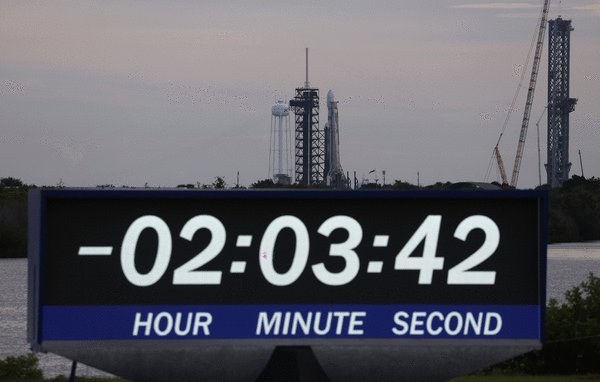
KENNEDY SPACE CENTER — The Space Coast saw only one launch in all of September, but weather held Thursday and SpaceX knocked out two in just one day.
Under a half moon and skeins of streaking clouds over the launch site, a SpaceX Falcon Heavy lifted off from KSC’s Launch Complex 39-A following the flight earlier in the day of the Crew-13 mission to the International Space Station from Cape Canaveral Space Force Station.
SpaceX’s powerhouse rocket launched the NROL-97 mission at 11:53 p.m. carrying a classified payload for the National Reconnaissance Office.
It marked the 58th launch from all providers on the Space Coast this year, only the 14th ever for Falcon Heavy, but the third so far in 2026. Essentially three Falcon 9 rockets strapped together, it produces 5.1 million pounds of thrust at liftoff.
About eight minutes after launch, the two side boosters made a successful return to Canaveral’s Landing Zones 1 and 2 lighting up the clouds with orange and red glows as they followed one another down after having broken off from the main core stage.
The signature double-punch of each rocket’s sonic booms hammered the press site at KSC creating an eerie whistling sound off the side of the massive Vehicle Assembly Building.
Ahead of the mission SpaceX had issued a sonic boom advisory for the boosters’ returns.
“There is the possibility that residents of Brevard, Orange, Osceola, Indian River, Seminole, Volusia, Polk, St. Lucie and Okeechobee counties may hear one or more sonic booms during the landing, but what residents experience will depend on weather and other conditions,” SpaceX warned in its media advisory.
Their return actually marked the second and third sonic booms of the day after Crew-13’s booster made a return to Landing Zone 40. It’s the first time all three landing zones have been tapped for use at the same time.
The Falcon Heavy boosters made their second and fourth trips to space, both of which most recently flew on Aug. 30 on NASA’s Nancy Grace Roman Space Telescope launch.
SpaceX has limited its use of KSC’s Launch Complex 39-A to just Falcon Heavy launches this year having shifted all of Florida’s Falcon 9 launches to Canaveral’s Space Launch Complex 40.
That has allowed SpaceX to focus on completing work on the Starship and Super Heavy launch tower adjacent the Falcon Heavy launch pad. SpaceX is also building two more towers at Canaveral’s Space Launch Complex 37.
During the post-launch news conference for Crew-13 earlier Thursday, Juliana Scheiman, SpaceX’s director of Dragon Human Spaceflight, said Florida’s first Starship launch from KSC could still come before the end of the year.
“We intend to do at least one more launch from Starbase before our next launch out of the Cape, and we always look at flight data and look at how the mission went to inform our next steps, and so that’s what we’ll be doing before we make a plan for coming to the Cape,” she said.
The heavy-lift rocket is more than three times as powerful as Falcon Heavy producing nearly 17 million pounds of thrust at liftoff. It so far has made 14 launch attempts including the most recent this past Monday during which it made it to orbit for the first time.
“We have a lot of work that we need to go execute on Starship,” Scheiman said. “We need to continue to demonstrate reusability on Starship, recovering the ship, recovering the booster, and reusing those.”
She said preparation is going very well at 39-A.
“We’ve essentially done a lot of the initial build of the structures and the systems needed for launching Starship, and we’re beginning to step into the sort of acceptance testing and operational testing prior to activation, so we’re kind of through the main construction and going into the proofing, testing, and activation testing,” she said.
Lori Glaze, associate administrator of NASA’s Human Spaceflight Mission Directorate said the agency has been preparing for that moment as well, as NASA is counting on Starship to launch as part of next year’s Artemis III mission as one of three rockets to fly concurrently alongside NASA’s Space Launch System rocket and Blue Origin’s New Glenn.
“We’re also working with SpaceX and on our side as well to help support and make sure that we’re ready as well when they’re ready to bring Starship here,” she said. “We want to be able to do thumbs up and say, ‘Yeah, we’re all ready to go together on Starship.'”
©2026 Orlando Sentinel. Visit orlandosentinel.com. Distributed by Tribune Content Agency, LLC.






Comments