Anthropic faces court setback on US supply chain risk label
Published in Science & Technology News
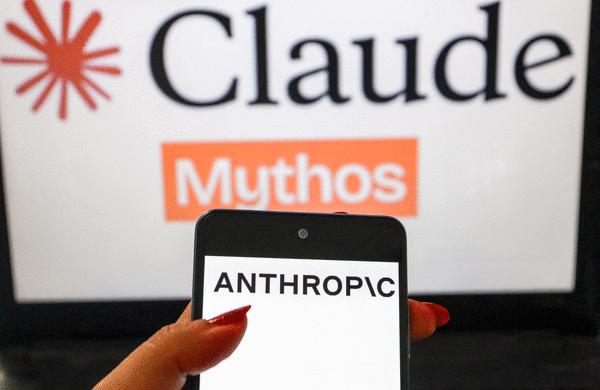
A federal appeals court in Washington rejected Anthropic PBC’s challenge to a Trump administration designation of the artificial intelligence company as a supply-chain risk to U.S. national security, but an earlier ruling by a judge in California that lifted a government ban appears to remain in place for now.
The 2-1 decision on Friday from the U.S. Court of Appeals for the DC Circuit is a victory for the administration, which has been locked in a high-stakes dispute with Anthropic since contract negotiations over the use of the Claude chatbot maker’s AI technology by the military fell apart earlier this year.
Anthropic “refused to relax contractual prohibitions on the use of Claude for lethal autonomous warfare or domestic surveillance,” Justice Karen LeCraft Henderson wrote for the majority. The Department of Defense “had ample support for its conclusion that the continued integration of Claude into the department’s information systems, by the department or its contractors, presented a statutorily covered national-security risk.”
However, an August order against the government by a federal judge in San Francisco in a separate but related lawsuit filed by Anthropic is still in effect. In that case, the judge concluded a ban on government use of the company’s technology wasn’t adequately justified under a law that narrowly defined a supply chain risk as an adversary that may sabotage or maliciously subvert government systems.
Henderson said the DC Circuit had “no quarrel” with that decision because the company hadn’t acted with a “bad motive” in its dealings with the department. But “no such bad motive is required to support” the designation under a broader definition of supply chain risk in a different statute, she wrote.
In a statement, Anthropic said it “respectfully disagrees” with the decision. “Another federal court has already held the government’s parallel designation unlawful,” the company said. “We remain confident in our position and are considering all options, including further review.”
The U.S. Justice Department and the Defense Department didn’t immediately respond to a request for comment.
The government’s restriction on Anthropic has collided with a race among U.S. artificial intelligence developers to deliver the most advanced AI models and prove to their investors that the technology can turn a profit.
In February, Anthropic sought assurances from the government that its technology would not be used for mass surveillance of Americans or autonomous weapons deployment. But the government wanted to use Claude without any restrictions imposed by the company.
Following the disagreement, the Pentagon notified Anthropic that the company and its products had been declared a risk to the U.S. supply chain, requiring all federal agencies to withdraw directives related to the firm. Such risk designations are typically reserved for companies from countries that the U.S. views as adversaries.
Anthropic then sued the Pentagon in California and in Washington, accusing the government of unlawfully retaliating against the company after the failed negotiations.
The Washington suit focuses on the security risk designation, while the California case addresses a broader ban on the use of Anthropic’s technology in government contracts.
The case is Anthropic v. U.S. Department of War, 26-01049, U.S. Court of Appeals, District of Columbia Circuit (Washington).
(Updates with details from the ruling, Anthropic statement, background on dispute.)
©2026 Bloomberg L.P. Visit bloomberg.com. Distributed by Tribune Content Agency, LLC.





Comments