Tech industry's warning as Maryland counties block data centers
Published in Science & Technology News
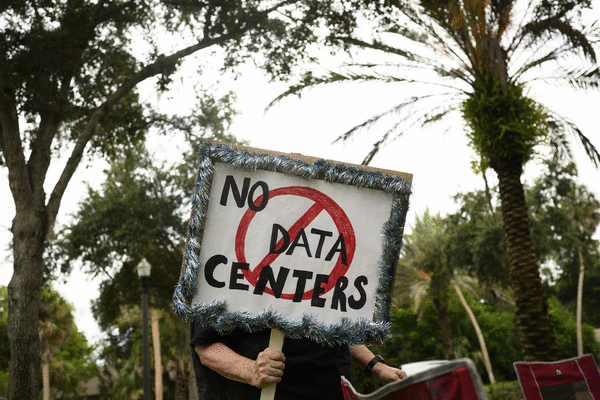
Charles Degliomini worries Maryland is racing toward a wall of its own making. The executive vice president at Rekor Systems — a Columbia-based technology firm that uses AI for roadway intelligence — says Baltimore-area jurisdictions’ fight against data centers is cutting off the very infrastructure artificial intelligence needs to keep up with demand.
As AI becomes more embedded in daily life, data center bans will create processing bottlenecks and slower response times, Degliomini said. The more people rely on AI, he said, the more processing power it takes to keep up with demand.
“Whether you’re Rekor Systems or whether you’re a person sitting at home using ChatGPT to plan their next trip, [processing constraints are] going to happen because of the frictions,” Degliomini said. “They’re going to hit a wall, and there’s going to be not enough compute power to power up. The use is growing exponentially, and then the ability for hyper-scalers to build data centers is being decreased.”
Amazon Web Services had planned to build one of its newest data centers in Lusby, on a stretch of land near the Calvert Cliffs Nuclear Power Plant. But the company walked away from the project earlier this month without publicly explaining why — and Maryland’s tech industry is holding it up as a warning of what’s to come.
The retreat comes amid a widening standoff between Maryland’s counties and one of the fastest-growing industries in the country. Howard, Prince George’s, Carroll and Baltimore City have all imposed temporary moratoriums on data center construction; Harford County has banned the facilities outright; and Anne Arundel County lawmakers are weighing further restrictions of their own.
Moratoriums’ impact
For companies like Rekor Systems, the impact of moratoriums and restrictions may not be felt immediately, but businesses could see operational effects in two to four years, Degliomini said.
The restrictions will likely push the industry outside the state, Maryland Tech Council CEO Kelly Schulz said.
Joseph Dominguez, chairman, president and CEO of Baltimore-based Constellation Energy, said the public’s reaction to data centers has been strong and undeniable, but concerns are “far from unsolvable,” during the company’s Aug. 6 earnings call.
“We can certainly earn the public support to build a 21st century data economy in our communities. It comes down to the trust we earn with the right business values focused on making our communities better and stronger,” he said.
Constellation pointed to a study from Lawrence Berkeley National Laboratory that found data centers may have a stabilizing effect on electricity costs rather than driving them up. In Virginia, home to one of the world’s largest concentrations of data centers, the study found electricity prices have stayed largely flat over the past six years, adjusted for inflation — a trend researchers attributed to data centers helping spread the fixed costs of maintaining the grid across a larger base of customers.
Schulz said hostility toward data facilities will have a negative fiscal impact, pointing to Lusby as an example.
“That was a very big deal to happen to the state; that could have been a great project,” Schulz said. “We’re seeing that more and more frequently. That’s my concern with some of these smaller projects that are being proposed in some of the local jurisdictions. Those end users aren’t going to wait for an extended amount of time. They do have opportunities to go to other states that are more welcoming.”
Darius Irani, an economist at Towson University, said Maryland’s fiscal challenges are closely tied to its reliance on the federal government, which has left the state in a “rough patch” during periods of uncertainty last year. While lawmakers were able to close this year’s deficit through “some accounting” and spending cuts, he said the underlying problem hasn’t gone away.
“Every year it’s got to come to the table and say, how do we cover the hole that seems to be getting bigger each and every year,” he told The Sun, pointing to next year’s projected $3.3 billion deficit.
Virginia has already capitalized on the data center boom, an “economic and fiscal” opportunity Maryland will miss out on unless it establishes itself as data center friendly, according to a policy report from the Maryland Tech Council.
As of 2022, Virginia’s 51 million square feet of data centers supported $640 million in annual state-level tax revenue and $1 billion in local tax revenue. The state also saw 80,000 jobs and more than $30 billion in annual economic activity, the report said.
‘The people won’t let it happen’
Impact Analytics CEO Prashant Agrawal said it does not matter to him where data centers are placed because his Linthicum Heights AI company uses cloud space. He believes it is up to the industry to figure out a way to evolve and expand without taking a toll on communities and the environment. Unless a solution is found, “the people won’t let it happen.”
“We existed without AI (and) hopefully, we exist with AI,” Agrawal said. “It is OK to slow this down and make sure that we’re doing it right. And I don’t think it’s a balance. I think it is environment first and making sure that clean water and all of the good things that are needed are done right.”
Hillary Gonzalez, a member of The People’s Green Liberation Coalition and a Remington resident, does not think the potential financial upside outweighs the health risks to nearby communities. She doesn’t see a future where data center growth and community acceptance can coexist.
Air pollution is a prominent concern with data centers, due to diesel-powered backup generators, according to a May 2025 article in the journal Eco-Environment & Health. Fossil-fuel power plants and the backup generators that power data centers emit pollutants such as nitrogen oxides and fine particles, which the article said can contribute to respiratory and cardiovascular disease and increased cancer risks in nearby communities.
A proposed data center in Frederick County has been met with intense opposition from residents.
Water use is among their top concerns. A medium-sized data center can consume up to about 110 million gallons of water each year to cool its computer chips and servers, according to the Environmental and Energy Study Institute. That’s about as much water as roughly 1,000 households would use. Larger data centers can consume up to 5 million gallons every day, or the amount used by a small town of between 10,000 and 50,000 people.
Alongside those concerns comes an economic reality — the data center campus near Adamstown in Frederick County, if fully built out, would generate about $215 million annually for the county, starting in 2036, according to an October 2025 study by consulting firm HR&A Analysis.
Harford County Executive Bob Cassilly, whose county has placed an indefinite ban on data center development, said that while data centers may generate tax revenue, they also place demands on energy and other infrastructure. He said Harford County is taking a “responsible approach” by focusing on businesses that create meaningful jobs rather than data centers.
“Our residents and existing business community should not be burdened with higher energy costs to support the growing demands of data centers,” Cassilly said in a statement. “Protecting our quality of life, our communities, our rural character, and our open space must come first.”
©2026 The Baltimore Sun. Visit at baltimoresun.com. Distributed by Tribune Content Agency, LLC.






Comments