NC's rarest salamander was hanging on by a thread. Then Helene hit
Published in Science & Technology News
JJ Apodaca sent the drone up over the ridge because he had to see for himself.
It had been a month since the remnants of Hurricane Helene brought torrential rain to the mountains of Western North Carolina, and the only road into Hickory Nut Gorge was gone.
Apodaca climbed the next mountain over, launched the drone, and watched the screen as it crossed the valley toward one of his best sites, a rock face holding roughly 10 percent of the known population of a salamander found only in this gorge, 20 miles south of Asheville.
The canopy was gone. A tornado had followed the storm, snapping trees in half, and landslides had stripped the slope bare. The rocks the salamanders depended on — cool, shaded, humid — lay exposed to direct sun.
“That’s when I realized,” Apodaca said. “It was completely wiped out.”
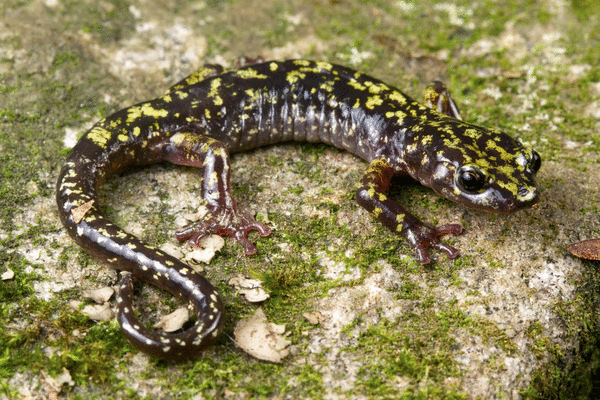
The Hickory Nut Gorge Salamander lives in cracks in rock outcrops in a single 14-mile gorge in the Blue Ridge Mountains. It’s been there for an estimated 10 million to 12 million years — when megalodons roamed the seas and before the Grand Canyon existed — but was only described as a new species in 2019.
It was already running out of room. Second homes and golf courses had been fragmenting habitat for decades, Apodaca said. By the time Helene hit, biologists estimated only 300 to 500 individuals remained in the wild, scattered across a handful of populations, all of them in trouble.
A daring rescue mission
Once Apodaca, executive director of the Amphibian Reptile Conservancy, saw the devastation in the gorge, he immediately called Dustin Smith, curator of reptiles and amphibians at the North Carolina Zoo. By spring, the two had permits to rescue some of the salamanders — HNGs, as Apodaca and Smith call them — from the wild.
The only bridge into the site was gone. To guide them into the gorge, Apodaca and Smith turned to Brian Parr, land steward for The Nature Conservancy, which owns the preserve. Parr had never seen the gorge like this but was responsible for getting everyone out alive.
“I felt a pretty heavy burden both professionally and personally,” Parr said. “It was stressful to say the least. We had to rappel down one of these large, probably 40- or 50-foot slopes.”
Then came the river.
“One section was about 40 to 50 feet wide that came up to your waist, maybe chest high, and we still had to carry all our gear across above our heads. It just added to my stress levels because you just can’t predict that.”
On the very first trip in, their rescue expert nearly stepped on a rattlesnake.
But the crossing was successful, and so was the search.
“We got two adults out, and that just immediately gave me hope that we could keep pressing on,” Apodaca said.
Over 10 trips that spring and summer, the team collected 25 Hickory Nut Gorge green salamanders, all of which now live at the North Carolina Zoo in Asheboro.
Open-heart surgery
Captive breeding is a desperate last resort, reserved for species whose short-term survival looks grim. This population, Apodaca said, is caught in an extinction vortex: as inbreeding rises, offspring survival drops, and each disaster hits harder, shrinking the population faster with each generation.
For Smith, the need to intervene was obvious.
“If you just had a heart attack, you’re also going to need surgery,” Smith said. “If you don’t have the emergency procedure, then you’re not going to get to the point where you can do the exercise to recover.”
For HNGs, making babies is no simple feat. Most of what biologists know comes from their closest cousins, green salamanders. A female develops unfertilized eggs internally, finds a male guarding a crevice, and the two perform a salamander slow dance. If it goes well, the male lays a packet of sperm on the ground, which the female scoops up, fertilizing the eggs inside her. Only then can they be laid, hatch and, with luck, grow into adults.
Behind locked gates, the HNGs live in a tucked-away facility at the zoo in enclosures built with painstaking detail, from solar tubes for natural light to bark and rocks gathered from the gorge and baked to kill off pathogens.
Last year, several females developed unfertilized eggs, but none of them successfully reproduced, likely because of the stress of relocation, Smith said. Now, five females are paired with hopeful suitors, and the zoo is ultrasounding them to check for eggs.
Smith is hopeful but cautious, as sometimes couples just don’t have the right chemistry.
“Don’t assume just because we put them together that they’re gonna breed,” he said. “They’re not always compatible.”
Racing against extinction
Hope can be hard to come by for North Carolina’s rarest salamander, especially when biologists still know so little about it, Apodaca said.
“You feel helpless a little bit, because we work with a lot of other things where we know exactly what to do,” he said. “But with Hickory Nut Gorge green salamanders, it’s different. We can’t really fix their habitat quickly.”
Yet the desperation has only sharpened his resolve.
“It just really relit the fire,” Apodaca said. “We need to be doing very active conservation to protect these things, or we’re going to watch them go extinct in our lifetime.”
The salamander is currently under review for endangered status under the U.S. Endangered Species Act. The decision is already overdue, but Apodaca expects it to pass.
On Aug. 4, the HNG received a boost when it became a target of the Phoenix Species Project, the largest philanthropic initiative in history designed to save 100 of the world’s most endangered species.
For many, pouring this much time and money into saving these salamanders might be hard to justify, but Smith emphatically rejected that framing.
“Sometimes I’m tired of having to justify their existence,” Smith said. “Why does a species that’s been here before humans have to help humans?”
Apodaca took a different tone, noting pride in a salamander that belongs to North Carolina.
“I see this as a real baby of mine,” Apodaca said. “Barbara Kingsolver has a great quote that salamanders should be on the flag of Appalachia. They represent what it is. They represent our place and what it means to live in Southern Appalachia and to love these ecosystems.”
Ben Prater, Southeast program director of Defenders of Wildlife, a nonprofit pushing for federal protection, holds onto that same hope.
“These are global treasures right here in the backyard of many North Carolinians, so losing it means we lose a piece of ourselves, we lose a piece of our natural heritage,” Prater said. “This is a story that has elements of tragedy, but it’s not over.”
©2026 The News & Observer. Visit at newsobserver.com. Distributed at Tribune Content Agency, LLC.






Comments