USDA denies $32 million request to fight California glassy-winged sharpshooter
Published in Science & Technology News
SACRAMENTO, Calif. — U.S. Sens. Alex Padilla and Adam Schiff’s request for $32 million in emergency funding from the U.S. Department of Agriculture to combat California’s growing glassy-winged sharpshooter problem has been rejected.
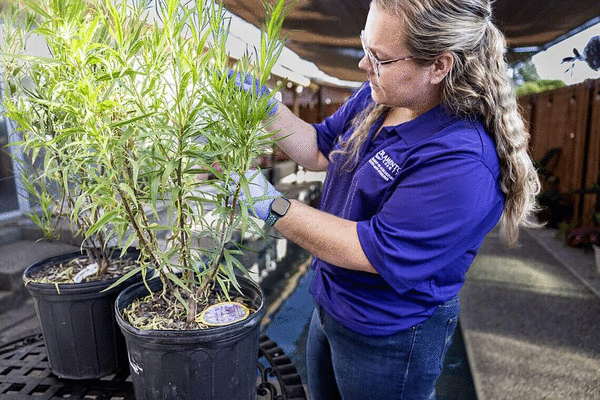
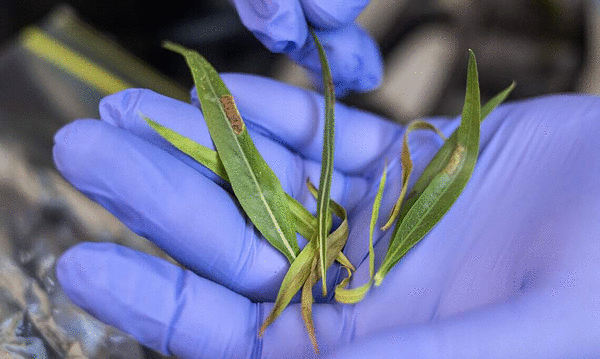
Glassy-winged sharpshooters were found on grapevines and ornamental plants sold at Costco stores in dozens of counties throughout the state earlier this summer. Thousands of plants were sold and are still unaccounted for. The pests can spread Pierce’s disease, which kills grapevines and makes its home in numerous other fruits. Glassy-winged sharpshooters are not a risk to humans or animals.
California Senate Democrats and 12 U.S. House members who requested the money received a letter on July 22 from the USDA under secretary for marketing and regulatory programs, Dudley Hoskins, that said the California Department of Food and Agriculture and county agricultural commissioners would be supported with existing federal funds. The additional funds that were requested would have gone toward tracing, surveying and trapping response programs for the next three years.
The majority of the pest detections have been of immature life stages of the invasive pest, such as egg masses. But recently, more adult insects have been found throughout the state, according to CDFA. The agency said it is not clear yet if all new detections are connected to the Costco incidents.
“We will continue to carefully monitor the glassy-winged sharpshooter detections in California and evaluate if additional resources, such as emergency funding, are needed to supplement the current funds and resources that (USDA’s Animal and Plant Health Inspection Service) is providing,” Hoskins wrote in the letter, a copy of which was obtained by The Sacramento Bee. “... USDA remains committed to mitigating this destructive insect through our strong cooperative efforts.”
The state agriculture agency said it is currently working with $15 million in federal funds, an amount that “cannot support urban eradication when new infestations are detected.”
The leaf-hopping insect destroyed more than 1,000 acres of grapevines in Northern California from 1994 to 2008, causing $30 million in damage, according to California’s agriculture department. Pierce’s disease, in a year when it infects grapevines, can cost California grape growers tens of millions of dollars.
With wine consumption at historic lows, the wine industry is already facing significant challenges. Some grape growers and winemakers are closing because they can’t afford to be in business anymore.
The wine and grape industries are billion-dollar enterprises in California. The state produces 99% of all table grapes and around 80% of all wine in the U.S., according to industry groups. The wine industry supports more than 422,000 jobs statewide, generating about $73 billion in annual economic activity, according to CDFA. Lawmakers said in their USDA funding request that if unaddressed, the glassy-winged sharpshooter could cost the state $104 million annually.
Hundreds of millions of combined public and private dollars have been spent on the pest control programs since their inception. Yet, since 1999, when the pest control programs started, state funding has trended downward, state figures show. While those dollars declined or remained flat, the state agriculture industry’s worth grew and pest control and prevention costs went up. Concurrently, industry and federal investment in the programs increased.
USDA responded to a request for comment with a copy of the letter Hoskins sent to Padilla.
In a joint statement issued Wednesday evening, Padilla and Schiff said, “While we appreciate USDA’s past collaboration to mitigate these risks, our farmers and California’s wine industry need additional federal resources. We will continue pushing USDA to work with us to deliver needed support and keep fighting to protect California’s agricultural industries.”
As the wine and grape industries and some of their allies see limited success in begging for additional support from state and federal agencies, CDFA emailed the agriculture community Monday saying that glassy-winged sharpshooters have been found in “several additional counties,” including Santa Clara, Stanislaus and Santa Barbara, according to a copy of the email obtained by The Sacramento Bee.
Fourteen adult pests have been found in 10 counties, with Stanislaus County joining that tally this week, according to a Wednesday CDFA call to update wine and grape professionals on glassy-winged sharpshooter infestations. This year’s hotter temperatures have led to ideal breeding conditions for the destructive pests.
Sacramento County declared a new glassy-winged sharpshooter infestation after finding 20 adults in Folsom, said Michelle Pham, a manager in the state agriculture department’s Pierce’s Disease Control Program, on the Wednesday call. Containment efforts such as trapping and visual surveys are underway, Pham said, with the new problem area near an infestation in El Dorado Hills that began in 2024.
In Shasta County, three adult glassy-winged sharpshooters were found in the same location in North Redding in a three-week period earlier this summer, said John Ingram, the county’s agricultural commissioner.
“I haven’t been an ag commissioner for that long, but I’ve been with the department for 18 years, and nothing of this magnitude has happened,” Ingram said. “It is an onslaught on grape growers.”
CDFA is continuing to gather information as a part of its ongoing investigation into the two Costco shipment incidents, including by subpoenaing the retailer and the trucking companies involved, staff members said on the Wednesday call.
Wine and agriculture industry associations are asking legislative leaders for $35 million in emergency funds for the state agriculture department in the 2026-27 fiscal year budget. The dollar amount of the request keeps rising as more pests are found in the state.
That emergency funding would help address the fallout from the Costco incidents and ongoing glassy-winged sharpshooter eradication efforts in five counties that had infestations prior to the latest outbreaks. Money would filter down to county agricultural commissioners and staff who are the boots on the ground for pest containment efforts. The industry groups will hear by the end of the month, when the legislative session ends, if their funding request is approved.
CDFA has not made a request to Gov. Gavin Newsom or the Legislature for additional glassy-winged sharpshooter prevention funding, the agency said in a previous statement to the Bee this week. The state agency said it is still awaiting a decision from USDA on its $8.2 million one-time funding request for the Costco incidents.
CDFA’s Pierce’s Disease and Glassy-Winged Sharpshooter Board announced Tuesday it has committed an additional $820,000 to the ongoing emergency response. That money comes from industry assessment fees paid to the state.
“California’s winegrape industry is facing some of the hardest economic times in a generation, but we recognize what is at stake if this destructive pest becomes established in Northern California,” said Trey Irwin, the Pierce’s disease board chair in a news release. “Putting $820,000 from the Board’s limited reserves toward this effort is a major commitment for our industry and shows how seriously we’re taking this threat.”
A 2026 report from the California Agricultural Commissioners and Sealers Association and the state agriculture department warned that the state pest prevention system is “under increasing strain” and, as a result, “falling behind growing threats.” The report identified more than $90 million in “immediate one-time funding needs” and $25 million in annual investments to strengthen the pest control programs. These dollars, the report said, do not account for the long-term investment required to maintain the system’s effectiveness.
The association said the state spends 10 to 15 times more on emergency funding than it would if it systematically invested in pest control programs.
The presence of invasive insects is rising overall as growing season lengths and temperatures shift due to climate change.
Josh Polich has seen firsthand the destruction that Pierce’s disease causes.
A couple of decades ago, the Kern County farm manager and pest control board member and adviser pulled out about 400 acres of table grapes due to a Pierce’s disease outbreak. He said many other farmers in the area did the same and replanted with citrus groves. Keeping the table grapes wasn’t worth the risk of spreading the disease, he said.
He still farms about 3,000 acres of table grapes and has seen an increased glassy-winged sharpshooter presence, both in agricultural and municipal areas. The pest is moving north to places where it has not previously been present, he said.
Polich and other board members from his pest control district met with members of Congress, including Padilla and Schiff, in Washington early this year — before the Costco incidents — to discuss the escalating glassy-winged sharpshooter problem.
His group noted the pest’s increasing presence as the growing number of abandoned vineyards and improperly fallowed fields have become prime destinations for the bug.
“This program used to work, and then they started pulling funding from it and trapping and overwintering sprays didn’t happen,” said Polich, who spoke in his capacity as a member of the Consolidated Table Grape Pest and Disease Control Board. “By not putting funding into a problem that is blowing up and continues to rise ... it is just going to get worse.”
_____
©2026 The Sacramento Bee. Visit sacbee.com. Distributed by Tribune Content Agency, LLC.






Comments