AI is driving computer prices sky high. Here's how
Published in Science & Technology News
It’s hard to remember a worse time than now to purchase a computer.
Computer hardware prices have spiked globally over the past year, and experts say they won’t get cheaper anytime soon. From companies purchasing desktop workstations and students buying back-to-school laptops or a new phone, consumers in Tampa Bay after a new machine may have to opt for the used market or pay a premium.
The reason why is the artificial intelligence industry.
Data centers, which are necessary to run AI platforms like ChatGPT or Google Gemini, require large amounts of a component called dynamic random access memory, or RAM. That type of memory is also used in computers, phones, tablets, gaming consoles and other devices.
As AI companies drive a surge in demand for memory, everyday electronics are seeing price increases. That’s because corporations are buying memory faster than manufacturers can make, leading to what industry leaders are calling a “memory crisis.”
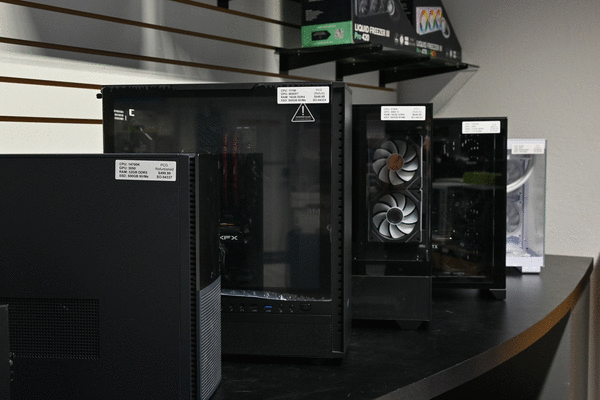
“You used to be able to build an entry‑level (computer) for a grand to like $1,300 — that minimum for new parts now is over $2,000,” said Jack Comiskey, manager of Performance Computer Group in Tampa, Florida, which builds custom systems for gaming and professional work.
Comiskey, 25, said memory kits that sold for $80 to $100 last year have tripled in price and are still creeping up.
Beyond memory, storage drives and graphics cards are also more expensive due to AI-driven demand, pushing more electronics prices up. Companies like Apple, Dell, HP, Lenovo and Framework have all raised prices this year.
While some lower-end machines haven’t been hit as hard just yet, analysts at industry firm TrendForce say an average $900 laptop could become up to nearly 40% more expensive as component costs rise.
Apple CEO Tim Cook told the Wall Street Journal in June that, despite trying to “shield customers” from price increases, the company will have to mark up products due to memory costs. Apple’s laptop and iPad lineups took the first hit, with the recently released MacBook Neo facing a $100 markup from its $700 starting price, despite a successful March launch.
“This is a hundred-year flood,” Cook said. “I’ve never seen anything like it in any area in over 40 years.”
Garret Watson, an information technology and cybersecurity college student from St. Petersburg, said he needs a new computer for school, but prices are making everything unaffordable. Watson, 32, tried to wait out the “memory crisis,” but prices have yet to improve.
‘I’m just at the point where I’m just gonna pull the trigger,” he said. “I mean I need one.”
When Watson built a computer himself three years ago, the memory modules only set him back about $60. Walking into a Best Buy now and seeing the price more than doubled, he said, is a hard pill to swallow.
Bob Morgan, owner of Morgan Business Advisors in St. Pete, saw the price increases coming, but said he needs a new laptop for his company regardless. Morgan accounts for the elevated expenses through his business’ pricing.
“I adapt. I don’t complain,” said Morgan, 61. “If I don’t have control over it, I got bigger fish to fry.”
Everyone wanting their own AI has led to an oversaturated market and too many data centers, said St. Pete resident Dmitri Meana, 25. Meana said he wanted to upgrade his gaming computer with new memory, among other parts, but prices have turned him off.
“It’s now more expensive than ever to actually build your own computer,” Meana said.
Local Tampa Bay businesses that sell, build or repair computers have been grappling with soaring prices for months.
Troy Zapeda, owner of Computer Solutions Tampa, which builds and repairs computers, said since everything is so expensive, he’s noticed a big drop in people wanting to build their own. Although about 40% of his revenue used to come from custom builds, Zapeda said he’s focusing on repairs for now.
He said customers who aren’t in the loop with the memory crisis are often shocked when he gives them a quote.
“It’s really been detrimental to our business,” Zapeda said. “We don’t feel like we should bump up our (building) prices and swallow or push on that extra charge to the customers.”
Comiskey said Performance Computer Group is in a similar position.
“We’ve had to lean pretty heavy into refurbished systems; a lot of people are buying systems that are last gen,” he said. “And then leaning heavily into labor — repairs and diagnostics and those kinds of things when the new (computer) business is slow.”
AI companies need memory chips to store information at data centers. When someone sends an AI a question, that information is directed to large racks of computers inside a data center. The memory chip temporarily stores the question while the AI processes an answer. It can also store data long term, for when people return to conversations with an AI days later.
Industry experts predict memory prices will continue to rise and remain expensive for several years. The only way to bring prices down would be a change in supply and demand, said David Arnold, director of the Florida Semiconductor Institute at the University of Florida.
But demand is outpacing manufacturing speeds.
“Every device that you have that has a chip in it normally has some memory,” he said. “The world as a whole only has so many factories to make these memory chips.”
Building a memory factory is a multibillion-dollar endeavor that usually takes five to seven years, so it will take time for the industry to settle, said Volker Sorger, deputy director of strategic initiatives at the Florida Semiconductor Institute.
Most memory is manufactured by just three international companies: Samsung, Micron and SK hynix. Currently, those manufacturers prioritize business with AI companies, which is typically more lucrative than selling to the consumer market.
In December, Micron shut down Crucial, a brand the company owned that sold memory to consumers for building or upgrading computers.
Sumit Sadana, Micron executive vice president and chief business officer, said in a statement that the decision is aimed at improving supply and support for “larger, strategic customers in faster-growing segments.”
Arnold said there used to be more manufacturers, but only the companies that could make the most memory at the lowest price stayed in business.
With only three major manufacturers at play, Comiskey said the memory industry is known for corruption. All three manufacturers were accused of anticompetitive behavior in a June class-action lawsuit filed by consumers and small businesses.
“It’s not going to go down anytime soon, if it goes down at all, because these companies are going to be like, ‘Well, if people are willing to pay this price, why should we drop the price?’” Zapeda said.
©2026 Tampa Bay Times. Visit at tampabay.com. Distributed by Tribune Content Agency, LLC.






Comments