Despite extremely low survival rate, state will move more deer to Kenai Peninsula this fall
Published in Science & Technology News
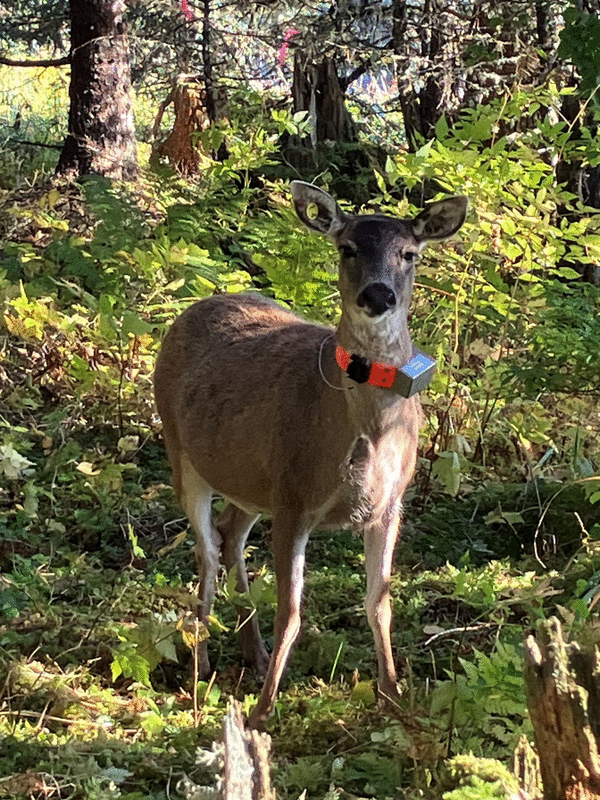
Last fall, the Alaska Department of Fish and Game brought 19 Sitka black-tailed deer from an island near Kodiak to the bottom of the Kenai Peninsula as part of an effort to see how the animals would fare.
Not well, it turned out.
At least 13 of the deer died. Another one slipped out of its GPS collar, and the department isn't sure if it survived. Of the original stock, just five — two does and three bucks — are known to still be alive, according to an update on the program published Tuesday.
It is the state of Alaska's first attempt in 40 years to relocate deer to establish a new population, according to Cynthia Wardlow, Southcentral regional supervisor for the Division of Wildlife Conservation, and it's the first such effort in the southern Kenai Peninsula.
Despite the grim mortality rate, the state intends to try again, and is "planning to move an additional 15-20 deer this fall, primarily does, to supplement the remaining animals," according to Fish and Game's announcement.
"The goal of this is to provide hunting opportunity and food security for Alaskans," Fish and Game Commissioner Doug Vincent-Lang said in the Tuesday update.
Critics say the program is a waste of public money, particularly given how few animals survived their first winter after the relocation, which cost hundreds of thousands of dollars. If the animals are ever made available for hunting, it will be in limited numbers decades in the future, critics argue.
"We don't support this project and think there are far better ways for the state to be supporting food security," said Cooper Freeman, Alaska director for the Center for Biological Diversity, an environmental advocacy group.
His group obtained internal department documents about the program several months ago through a Public Records Act request that showed the true mortality rate among the deer was higher than reported. Even before 19 deer were released near Port Chatham last fall, four of them died in the transportation process from Sitkinak Island.
"The deaths were attributed to prolonged sedation time," according to a mortality report submitted by Department of Fish and Game staff last October and shared with the Daily News by the Center for Biological Diversity, and confirmed by Fish and Game.
According to the department's August update, the animals that did make it to the Kenai Peninsula died from several causes: drownings, coyote attack, disease, hypothermia. One of the does "swam to a nearby island and lived there for almost two months according to collar data," Fish and Game said in the update.
Throughout its materials on the program, Fish and Game says the habitat overall is a good fit, with adequate food for the deer. Their determination is that the high mortality was driven by the severity of last winter, which included abnormally cold weather and deep snow in the southern Kenai Peninsula.
"The (deer) we recovered that were deceased were in good condition, they weren't experiencing malnutrition," Wardlow said in an interview last week.
Though the majority of the original animals died within a year of being captured and moved, Fish and Game will repeat the relocation effort in the coming weeks.
Mixed record on relocations
Moving animals around in the hopes of establishing self-sustaining populations of prey species like deer in new places has a long history in Alaska. Among the efforts tried by territorial and state officials — some successful, others not — were bringing Sitka black-tailed deer to Prince William Sound, Kodiak, Yakutat, Skagway and the Homer Spit.
The prospect of transporting deer to the southern Kenai Peninsula to establish a huntable population goes back to at least the 1970s, according to a 2023 scoping report produced ahead of Fish and Game's inaugural attempt last year.
"The primary benefits of the transplant are to increase hunting opportunities and wildlife viewing. If the transplant is successful, then based on prior transplants of (Sitka black-tailed deer) it would likely be two or more decades before a harvestable surplus exists," according to the document.
The document states that Fish and Game staff developed the scoping report in response to a request from Gov. Mike Dunleavy that came down through Vincent-Lang. Dunleavy's administration considered a similar deer relocation concept for the Matanuska-Susitna Borough, but it did not advance to implementation.
There's never been a large, permanent deer population in the area, despite having environmental and climatological conditions similar to other parts of coastal Alaska, where the animals have done well. As the scoping report notes, the deer fare poorly in exceptionally cold and snowy winters, but thrive and expand their range after milder ones.
Wardlow said that was starting to happen after the 19 animals were relocated to a central release area by helicopter over a few days last fall.
"The deer have traveled in different directions from the point that we dropped them off," she said.
The habitat appears to suit the species, she said. But the department could not have anticipated or prevented the exceptionally cold winter, she said, which likely killed other deer populations across coastal Alaska at comparable rates. Unlike those other populations, though, these 19 were tracked with GPS collars, so there's data from them available to researchers.
She said the Department of Fish and Game is optimistic that by adding more animals to the ongoing effort, it will result in a deer population that breeds enough to sustain itself, provided the approaching winter is not as harsh as last year's.
Deer mortality report
To Freeman at the Center for Biological Diversity, deer relocation is a waste of money at a time when Fish and Game, like many other segments of state government, doesn't have sufficient resources to carry out its basic work.
He said the project fits a pattern under the Dunleavy administration of spending money on wildlife management programs aimed at increasing limited hunting opportunities for small groups of users, which has included aggressive predator control efforts to boost caribou and moose numbers in other parts of Alaska. His organization, Freeman said, is not uniformly against game relocation efforts, pointing to state programs reintroducing musk oxen and wood bison to native ranges in Western Alaska as worthwhile. But the center does not support trying to build a new population of animals in places where there's scant record of them previously living just to meet human desires for hunting or wildlife viewing.
"Our focus is on protecting imperiled species and wildlife and the habitat they need to survive and thrive," Freeman said by phone Tuesday from his house in Homer, across Kachemak Bay from the mountainous tail of the peninsula where the deer were released.
At a purely fiscal level, Freeman said, the program is a bad use of resources.
According to the 2023 scoping report, the estimate for introducing enough Sitka black-tailed deer from Kodiak to the Kenai Peninsula to establish a permanent population will cost $2 million to $3 million. Wardlow, with Fish and Game, said that was based on high-end projections, and the department has been able to reduce expenses. As of last week, the project has cost $460,000, Wardlow said, with the upcoming season expected to cost "similar to slightly less" in part because the department will be reusing equipment like radio collars that it salvaged from the dead pilot animals.
Reflecting total project expenses so far, each of the five surviving deer cost $92,000 in public money to capture, relocate and monitor for a year.
And, Freeman pointed out, four of the 23 deer captured last fall did not survive transportation, let alone release into the wild.
According to a four-page mortality report received from Fish and Game as part of the center's public records request, field teams rushing to transport the animals lacked supplies of azaperone, a tranquilizer favored in veterinary care for large animals. Instead, they used a combination of medications described as "not previously piloted" that caused four deer to remain sedated so long that they ultimately died.
"The veterinarians had requested to start with only a few deer at first to ensure that the proposed drug protocol was safe for the animals. The request was denied and the team was directed to immediately fill the helicopter with five animals. The proposed drug dose turned out to be too high," states the report, which was submitted by Wardlow and a member of the department's veterinary staff last October.
Despite the four deaths, the department continued with the relocation effort under modified veterinary and logistical protocols.
"It was incredibly disappointing for all of us involved to lose animals during capture operations. Our revised protocols allowed us to move the other 19 animals safely and will provide a framework for any biologists working a project that includes sedating or transporting deer in the future," Wardlow wrote in an email Friday.
Still, as the mortality report documents, a majority of the 19 animals that survived the helicopter transports experienced health problems like bloating, overheating, severe stress and poor oxygenation. Several were treated onboard with ketamine, bags of ice to cool them or puncture of the rumen with a needle to deflate "pressure from gas build up."
There's no evidence the deer reproduced over the last year. When Fish and Game surveyed the surviving three does from planes this June and July, it did not observe any fawns with them, though it admitted the juveniles can be difficult to spot amid heavy vegetation.
"The introduction of even a small number of deer can be the start of a large population," the department noted in its announcement this month.
The Kodiak Island population of black-tailed deer that is feeding the current relocation effort was first established with transplants back in 1935. It was 18 years later, in 1953, that a regulated deer hunt on the island was authorized.
"While it may be decades before the Kenai Peninsula deer population is robust enough to be harvested, progress is being made toward that goal," the department stated in its August update.
©2026 Anchorage Daily News. Visit at adn.com. Distributed by Tribune Content Agency, LLC.






Comments