EPA to force the removal of leaking acids from deteriorating Washington pulp mill
Published in Science & Technology News
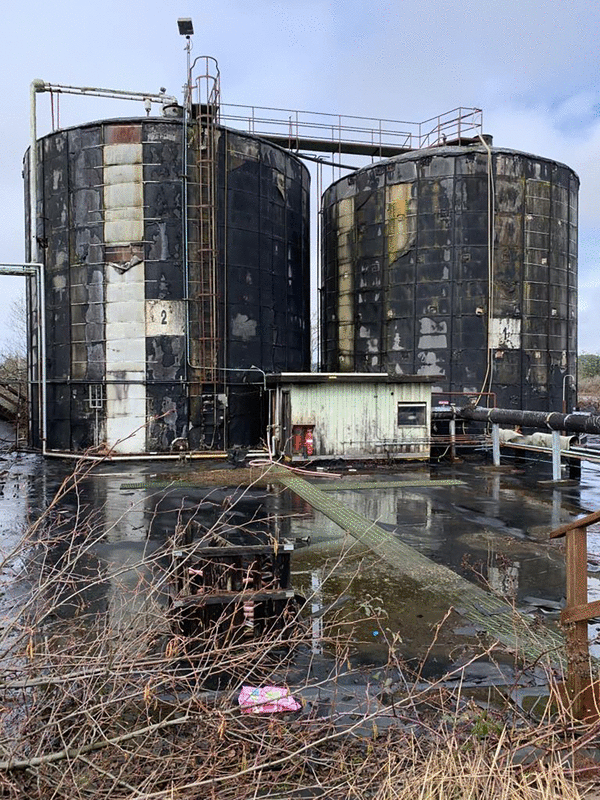
SEATTLE — Federal regulators will force the removal of toxic, highly corrosive chemicals from a defunct and leaking pulp mill along the Chehalis River, officials confirmed this week.
Either Richard Bassett, the U.K. businessman who owns Cosmo Specialty Fibers, must start removing vast quantities of these chemicals from the site this month or the Environmental Protection Agency will step in and take over.
The mill, which sits about 100 miles southwest of Seattle, has been leaking hazardous chemicals for years now, Bassett defiant in the face of fines and demands from environmental regulators. State and EPA officials have been building their case to force a cleanup for quite some time, all the while warning of a potentially “catastrophic release” at the site.
The long-struggling pulp and paper industry had dipped from the public and regulatory spotlight for years. But after a massive chemical tank ruptured at a Longview mill in late May, killing 11 workers and injuring eight, people in and outside of the industry have demanded accountability.
The decision to remove hundreds of thousands of gallons of acid and other chemicals at Cosmo Specialty Fibers is not only the strongest regulatory maneuver at the mill in years, perhaps ever, but it also might kill any hopes of reviving the facility, which once made up the backbone of its hometown, Cosmopolis, in Grays Harbor County.
Once, Cosmo Specialty Fibers employed hundreds in its small town of about 1,700 people, bringing in the vast majority of the community’s tax revenue. People who still live there remember those days; many of them worked there and want the place to reopen. They could use the jobs, the economic stimulus.
The place has a massive footprint on the edge of town with multiple buildings, huge tanks and an expansive parking lot. Now it all sits empty and rusts, like a sort of industrial ghost.
Weeks ago, EPA officials issued Bassett what’s called a “time-critical removal action,” a spokesperson for the federal agency confirmed. In essence the order lays out a series of deadlines for him to clean the site. By the end of the month he must begin removing some of the more than 700,000 gallons of hazardous chemicals at the mill, which the agency now describes as “abandoned.”
“Failure to meet any of the following milestones will result in EPA mobilizing shortly thereafter to conduct the removal work,” agency spokesperson Matt Vanourek said in an emailed statement.
While few additional details about the process are immediately available, officials with Washington’s Department of Ecology confirmed they will also help with the cleanup.
Bassett did not answer questions seeking further insight into the EPA's order or his plans moving forward, offering only a short text message instead.
Maybe they are all bluffing? he said.
Red liquor
Not all that long ago, Cosmo Specialty Fibers served as the largest employer and source of tax revenue for Cosmopolis. The site sputtered to a close after the COVID-19 pandemic, and Bassett has struggled to secure investment to repair and restart the mill.
State and federal regulators have slapped millions in fines on the property for numerous clean air and water violations since the plant was shuttered in 2022. Bassett has fought the citations and resisted the long-overdue fixes that his degrading mill needs. He has even failed to provide water or electricity to the mill, or to pay his security guards, a February analysis from the EPA noted.
Dozens of tanks on the site hold huge quantities of acid; at least eight of them are leaking. One is pouring as much as 45 gallons of chemicals a day, EPA officials wrote in an analysis earlier this year. Most of the tanks’ contents — some 1.7 million gallons worth — remain a mystery, though inspectors have identified around 727,000 gallons of the chemicals.
Many of the chemical tanks are full of sulfite liquor, which is acidic enough to eat away flesh and muscle. In at least one case, someone broke into the mill and poured out a large quantity of this acid, suffering chemical burns in the process.
Cosmo used the sulfite liquor to break down wood chips and produce cellulose, which is essential for the production of everyday products like aspirin, phone and computer screens, fabrics and cosmetics. Once the chemical is used, it takes on a reddish hue and people in the industry call it “red liquor.”
While these liquors are on the opposite end of the pH scale from the chemicals that poured out of the Nippon Dynawave Packaging Co. in Longview during May’s fatal disaster, they’re similarly dangerous at any stage of the milling process.
The leaking Cosmopolis mill sits close to the Chehalis River, increasing the risk of damage to the environment and wildlife, including salmon runs. The 42-inch-wide wooden pipeline running for 2.5 miles between the site and a series of sludge ponds near the river is also leaking in at least 16 locations, including in residential neighborhoods.
Removal
Because of their corrosive nature, the many gallons of chemicals sitting at Cosmo Specialty Fibers can’t be moved easily. The project will require specialized equipment and staff.
Details on the removal were not available. The EPA required Bassett to submit a work plan, though the document is not yet available to the public.
A number of other chemicals must also be drained from the mill. Andy Wineke, a spokesperson for the Ecology Department, said in an email that the state agency plans to help the process by removing oils and other fluids from the site.
The department, which fined Bassett $2.3 million last year for water, waste and air quality violations, will also push for further cleanup of additional contamination at the mill, Wineke said. Bassett has not yet paid that fine, Wineke confirmed.
Given budget and staffing cuts at the EPA since President Donald Trump took office a second time, not to mention the agency's strong push away from environmental regulations, this new federal order is more notable than it otherwise might be, said Marissa Baker, an associate professor of occupational health at the University of Washington. Not only does it likely connote how badly conditions have degraded at the mill in recent years, but also how much the spotlight has turned onto the industry since the deadly Longview disaster.
Still, ordering the removal of the chemicals at Cosmo and actually having them taken away are two different things, Baker said.
Bassett might not hand over the chemicals all that easily. Not only has he fought, appealed and refused to pay fines leveled against him, but he needs the acids, oils and other compounds to start the mill up again. They’re expensive to buy and he’s long argued against their removal, underscoring that they are his property.
The plan, according to Bassett, has always been to restart the mill, perhaps even expand it, once more becoming a major employer and source of tax revenue for the community.
Should the sulfite and red liquors be removed, the result will be a substantial hurdle in the way of reopening. He’s struggled for years to lure outside investors with the cash he needs to repair and jump-start the place. So losing vast quantities of crucial chemicals would amount to a major step in the wrong direction.
Even if the chemicals are removed, Baker noted that broader contamination at the mill must still be cleaned, another challenging proposition given the likely scope of the work and the attitude of the owner.
“If he just walks away and says it’s too much work, is someone still going to hold him and/or the company accountable?” she said.
© 2026 The Seattle Times. Visit www.seattletimes.com. Distributed by Tribune Content Agency, LLC.






Comments