All-male NASA Artemis crew creates backlash as priorities shift
Published in Science & Technology News
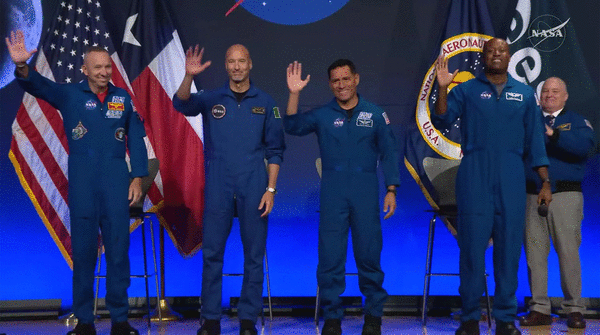
When NASA unveiled the four-person crew of its Artemis III mission last week, it didn’t take long for the general public to notice a common feature of the group: all four astronauts were men.
NASA said the selection was not political. But it triggered a wave of disappointment from former NASA officials, space industry insiders and enthusiasts invested in the agency’s effort to put U.S. astronauts back on the moon for the first time in more than half a century — and their hope that one of them will be a woman.
“Do I think this was chosen maliciously? Obviously no,” Emily Calandrelli, a science author who flew to space with Blue Origin, wrote on Instagram. “Do I think those in the selection process had a bias and ultimately when there were four men selected no one in the room thought it was a ‘big enough’ issue to try to correct? Yes.”
Whether deliberate or by coincidence, the irony of the omission was immediately glaring.
The Artemis program got its name after the goddess of Greek mythology — the twin of Apollo whose name adorned the history-making U.S. initiative that put the first men on the moon. The name “Artemis” was a nod to the agency’s original vow with the program: this time when NASA went back to the moon, it would send the first woman to walk there.
NASA Administrator Jared Isaacman defended the decision last week in a series of posts on social media.
He said he’d personally been to space twice “with 50 percent female crews” and that his closest advisers “and some of the smartest engineers I know are women.” He said NASA technically assigned only women to the SpaceX Crew-10 mission in 2025, though two men were also on the mission from partnering countries.
A representative for NASA referred to Issacman’s social media statements.
Either way, there’s no lack of potentially suitable candidates. There are 37 active NASA astronauts available for flight assignments at the moment, and 15 of them are women, or roughly 42%. Critics have pointed out that, statistically, one should have been selected.
“To not select a single woman for this mission (when there’s a pretty significant number of highly qualified women astronauts right now) feels very intentional in the context of the current political climate,” Camille Bergin, the chief marketing officer at aerospace startup Star Catcher Industries Inc., said in an Instagram post.
While more and more women have joined the ranks of NASA’s astronaut corps over the years, roughly 120 of the almost 800 people who have been to space have been women, either as government astronauts or commercial flyers. And NASA has yet to fly a mission with an entirely female crew on board, including astronauts from the agency and other partners.
Other missions have sought to make a point, such as Blue Origin’s all-female spaceflight crew in 2025, featuring singer Katy Perry, CBS News anchor Gayle King and Jeff Bezos’ wife Lauren Sánchez Bezos. However, that flight prompted a public backlash as a hollow display that favored celebrity and wealth.
Isaacman also suggested that many of the women in the astronaut corps could not be selected for Artemis III as they were training for other potential assignments, such as going to the International Space Station or perhaps future Artemis missions that actually go to the moon. Artemis III will only go to Earth orbit to test lunar landers.
The Artemis missions, by contrast, have drawn huge global attention — more so than commercial trips or recent flights to the ISS — inspiring the imagination of space fans and casual observers alike. In April’s record-setting Artemis II mission, Christina Koch became the first woman to fly around the moon.
“All you have to do is look at the followers of Christina Koch versus any female commander who has recently commanded a mission to the ISS to understand the value that these missions have on girls and women around the world,” Calandrelli said.
At first glance, the make-up of the the next Artemis crew could be perceived as coinciding with efforts by President Donald Trump to walk back diversity, equity and inclusion programs, which prompted NASA and other agencies to remove long-held initiatives and DEI-related language.
Artemis was actually minted under Trump’s first term and NASA’s administrator at the time, Jim Bridenstine, made the pledge that the program would send the first woman to walk on the moon. But during Trump’s second term, NASA has downplayed that original promise, removing the wording from its website.
Isaacman’s primary rebuttal has been that the astronaut selection process is not political and is simply about assigning the best people to the mission based on the requirements of the trip. The crew includes two veteran NASA flyers Randy Bresnik and Frank Rubio, veteran Italian astronaut Luca Parmitano, and Black astronaut Andre Douglas, making his first spaceflight after being selected to be an astronaut in 2021.
“In a world with so much controversy, I hope this can be a moment where we celebrate the astronauts selected, respect the integrity of the process, and recognize the extraordinary depth of talent across the entire corps,” Isaacman said.
Just how NASA selects its astronaut crews remains opaque. The agency does not provide a detailed breakdown of how the decisions are made. And in the past, that decision has often been at the discretion of one person, done in consultation with others.
George Abbey, the director of flight operations and so-called “Astronaut Maker,” was primarily responsible for selecting all of the crews in the early years of the Space Shuttle program. He picked Sally Ride and Guion Bluford to become the first American woman and the first Black astronaut to fly to space, respectively, knowing the weight of those decisions.
Now, the chief of the astronaut office typically makes the decisions, along with a handful of officials at NASA’s Johnson Space Center. Not only do the flight requirements matter, but crew selection is also influenced by the idea that certain astronauts are owed their time to fly, as well as unknown medical issues that may take people out of consideration temporarily, according to a former NASA astronaut familiar with the selection process.
Being intentional about representation has been something that NASA officials have done before.
As former NASA deputy administrator Lori Garver wrote in her book, "Escaping Gravity," former administrator Dan Goldin helped to ensure that of the 65 Space Shuttle missions he oversaw, only five consisted of all-while male crews. Garver said she also made a personal plea that the final Shuttle flight should not be all white and male.
For Garver, the Artemis III decision was also a disappointment.
“I’m not saying the decision was overtly political or partisan or that the assigned crew isn’t qualified or deserves to be celebrated,” Garver said. “But I’ve observed the selection of dozens of crews from inside the agency and know that parsing skills and experience among the extremely qualified astronaut corps is as much art as science.”
©2026 Bloomberg L.P. Visit bloomberg.com. Distributed by Tribune Content Agency, LLC.






Comments