After loss on Blue Origin flight, SpaceX sends company's satellites to orbit
Published in Science & Technology News
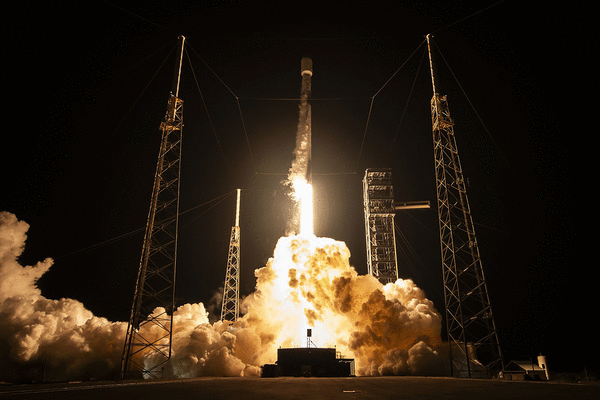
A Texas-based satellite company had a much better day with SpaceX early Wednesday than it did the last time it tried to get a payload to space with Blue Origin.
A SpaceX Falcon 9 launched at 2:39 a.m. from Cape Canaveral Space Force Station’s Space Launch Complex 40 carrying three satellites for AST SpaceMobile, which were all deployed successfully in low-Earth orbit.
The Midland, Texas-based company had in April attempted to fly on Blue Origin’s New Glenn on the NG-3 mission, which ultimately was labeled a mishap by the Federal Aviation Administration after that rocket’s upper stage failed to put AST SpaceMobile’s satellite into the proper orbit, and it had to be brought back down to burn up in Earth’s atmosphere.
But Wednesday’s launch proved successful for the company’s BlueBird 8, 9 and 10 satellites, which are part of an expansion of its direct-to-device broadband internet constellation of satellites.
For SpaceX, it marked the 29th flight for its first-stage booster, which made another recovery landing downrange on the droneship A Shortfall of Gravitas stationed in the Atlantic.
For the Space Coast, it marked the 41st launch of the year with all but six coming from SpaceX.
United Launch Alliance has handled four, including one Vulcan and three Atlas V missions, while Blue Origin’s NG-3 was Jeff Bezos’ company’s lone rocket launch before it suffered a massive explosion on during a static fire test in May. The other launch this year was NASA’s Space Launch System rocket on the Artemis II mission.
SLS won’t fly again until at least mid 2027 on Artemis III, the crew of which was announced last week.
Blue Origin meanwhile is working with NASA and the Space Force to try and get a working launch pad up and running before the end of the year as New Glenn is needed to launch the company’s Blue Moon lander as part of the Artemis III mission.
ULA has one more Atlas V launch on the calendar, a July 3 attempt on what would be the rocket’s final mission to support the Amazon Leo constellation. The remaining six Atlas V rockets after that launch are set aside for Boeing Starliner missions, although that spacecraft’s next flight is on an indefinite hold.
ULA has dozens more launches for Amazon, though, but they’re to fly on its new Vulcan rocket, which suffered its own issues on its lone flight this year when one of its solid rocket boosters had its nozzle burned off during launch. Despite getting its national security payload to space, the Space Force said after that flight it would not fly again on Vulcan until the booster issue was resolved.
While not grounded by the FAA, ULA has delayed any further launches of Vulcan and instead knocked out its remaining stable of Atlas V rockets.
SpaceX, meanwhile, continues to knock out Falcon 9 missions, but also has more Falcon Heavy launches on tap this year. It already flew once, the lone launch from Kennedy Space Center’s Launch Pad 39-A. Its next launch is on the clock for late August to fly NASA’s Nancy Grace Roman Space Telescope. It then has a launch for Astrobotic Technology’s Griffin lunar lander aiming to fly before the end of the year.
Combined, the Space Coast has seen six different rocket types launch this year, including a record five within one month in April.
----------
©2026 Orlando Sentinel. Visit at orlandosentinel.com. Distributed by Tribune Content Agency, LLC.






Comments