San Diego County launches 2 studies to measure toll of Tijuana River pollution
Published in Science & Technology News
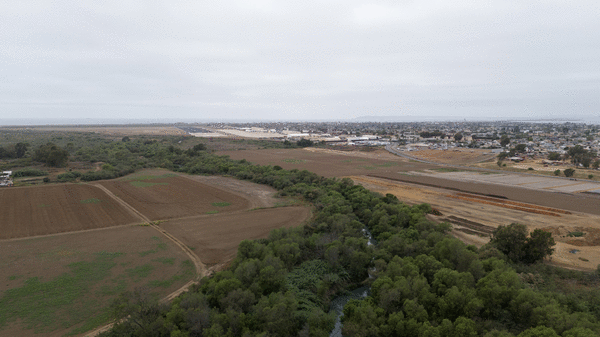
SAN DIEGO — San Diego County is moving forward with two major research efforts to document the health and economic impacts of the Tijuana River Valley pollution crisis, partnering with the University of California, San Diego on an air quality study while simultaneously launching a public survey to measure the crisis’s financial toll on South Bay communities.
The county awarded a $250,000 contract to ECOnorthwest, an independent economic research and policy consulting firm, to conduct the economic impact survey, which targets residents, business owners, visitors and community organizations near the Tijuana River Valley.
The survey asks participants about lost work, school absences, hospital visits, property values and business disruption. Results will be compiled into a report expected in fall 2026.
Matthew Parr, the county’s director of economic development and government affairs, said the survey is designed to produce evidence the county can take directly to state and federal officials.
“We want to take this study to our state and federal officials to demonstrate that this crisis is a crisis,” Parr said. “Hopefully, that unlocks some federal funding for us.”
Earlier county research also documented the economic toll on local businesses. A 2023 survey of 63 South County businesses found more than 70% reported being affected, with two-thirds citing revenue losses from beach closures — including Coronado Brewing Company, which shut down and attributed its closure directly to the sewage crisis.
Parr encouraged broad participation, noting the survey is open to anyone affected by the pollution — not only business owners — and is available in Spanish. He said it is too early to project how many people will respond but emphasized that higher participation will strengthen the study’s findings.
Separately, the county has contracted with UC San Diego to conduct an Exposure Characterization Study examining what airborne chemicals communities in Imperial Beach, San Ysidro and Nestor are being exposed to, and at what levels. The study, led by Kimberly Prather of Scripps Institution of Oceanography, will use a mobile monitoring van to collect air samples across neighborhoods rather than relying solely on fixed monitoring stations.
Researchers also plan to extend measurements into adjacent areas, potentially including Coronado. The exposure characterization study is funded at up to $249,948 and is expected to be completed within one year.
County Public Health Officer Sayone Thihalolipavan said the study will go beyond what existing monitoring provides, seeking to understand how chemical exposure levels vary across neighborhoods where people live — not just at fixed monitoring stations — and whether residents face exposure to any additional compounds beyond hydrogen sulfide.
“It’s still kind of shocking that this many decades into the Tijuana River crisis and emergency that there’s still so much we don’t know, so much we’re still learning,” he said.
The exposure data is intended to feed into a separate, board-approved retrospective health study that will compare historical hospital, patient and death records against exposure levels to look for associations between pollution and health outcomes such as asthma.
A 2024 Community Assessment for Public Health Response (CASPER) survey led by the Centers for Disease Control and Prevention found 70% of households near the Tijuana River Valley reported pollution-related symptoms, while a follow-up Assessment of Chemical Exposures (ACE) study carried out by the federal Agency for Toxic Substances and Disease Registry found 65% said their mental health had been significantly impacted.
County Supervisor Paloma Aguirre, whose District 1 includes the most affected communities, said the earlier studies were self-reported surveys — useful for validating community experiences, but limited. The new studies, she said, are built around hard data.
“Without hard data, we’re unable to make an even stronger case to the state and federal administrations to show them how severe and how much this is harming our communities,” Aguirre said.
Aguirre said the county’s investment in the new studies marks a deliberate shift in approach, and one she intends to press further.
“When people say, ‘Well, why do we need all this data?’ It’s because data is important,” Aguirre said. “And just like a pilot collects weather data so that he can better fly a plane and not put people at risk, we do exactly the same.”
©2026 The San Diego Union-Tribune. Visit sandiegouniontribune.com. Distributed by Tribune Content Agency, LLC.






Comments