NASA refines Artemis III flight details for next year
Published in Science & Technology News
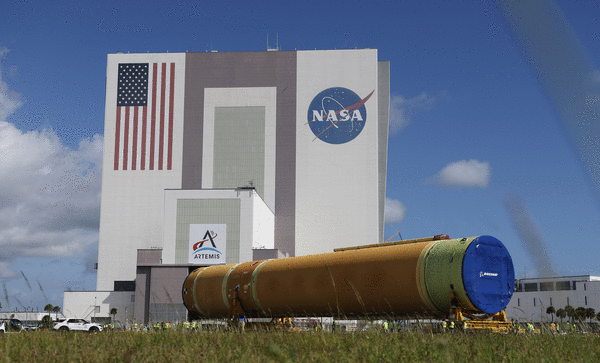
NASA announced it would forgo using the same upper stage used on the first two Artemis flights for next year’s Artemis III mission since it won’t be heading to the moon.
The mission will be headed for a low-Earth orbit and won’t need the interim cryogenic propulsion stage (ICPS) built by United Launch Alliance that helped propel the uncrewed Artemis I flight in 2022 and this year’s Artemis II mission that took four astronauts on a lunar flyby.
Instead, NASA is manufacturing a placeholder it dubbed a “spacer” to mimic the size and weight of the ICPS and maintain the height of the Space Launch System rocket topped with the Orion spacecraft when they head to the pad at Kennedy Space Center.
The spacer’s design and fabrication is taking place now at NASA’s Marshall Space Flight Center in Huntsville, Alabama.
The ICPS was relied on to get Orion to about 70,000 miles orbital altitude before the crew relied on the European-built service module to perform a trans-lunar injection burn to send it on its way to the moon.
With low-Earth orbit that could be more in the 200-500 miles altitude range, NASA will just rely on the service module for all the propulsion needed once the SLS sends Orion into space after launch.
NASA can now hang onto the ICPS for Artemis IV in 2028, a mission that seeks to return humans to the lunar surface for the first time since Apollo 17 in 1972.
Artemis III will still feature four crew who have yet to be named. They just won’t be flying near the moon.
Their main goal is to test out Orion’s ability to rendezvous with one or both of the two lunar landers being developed by SpaceX and Blue Origin.
Use of the ICPS, which is the last NASA has available as the ULA production line that made it has since been retired, would have been mostly wasted staying so close to Earth. The ICPS was based on ULA’s Delta IV class of rockets, which stopped flying in 2024 as the company shifted its production to the new Vulcan rocket.
Both ULA’s Vulcan and remaining Atlas V rockets use a Centaur upper stage, and NASA had already announced a version of Centaur would be used on the SLS rockets for Artemis missions once it ran out of the ICPS supply.
For now, NASA has only committed to SLS through Artemis V as it seeks to shift its heavy-lift needs to commercially available alternatives such as Blue Origin’s New Glenn and SpaceX’s Starship once they mature.
For now, though, SLS is the only rocket powerful enough and certified to fly Orion to the moon.
Artemis III, though, could see up to three rocket launches to satisfy the goals, with a pathfinder version of Blue Origin’s Blue Moon MK2 lander launching on New Glenn from Cape Canaveral Space Force Station’s Launch Complex 36 and a pathfinder version of SpaceX’s Starship launching from potentially the in-development launch tower at Kennedy Space Center’s Launch Complex 39-A.
The SLS with Orion will launch from KSC’s Launch Pad 39-B, just like the two previous Artemis missions, atop mobile launcher 1. Just how close together they would be remains to be determined.
“While this is a mission to Earth orbit, it is an important stepping stone to successfully landing on the moon with Artemis IV. Artemis III is one of the most highly complex missions NASA has undertaken,” said Jeremy Parsons, Moon to Mars acting assistant deputy administrator in NASA’s Exploration Systems Development Mission Directorate. “For the first time, NASA will coordinate a launch campaign involving multiple spacecraft integrating new capabilities into Artemis operations.”
Keeping the mission close to Earth opens up more options to get all three rockets into space at the same time. Communications, though, is something NASA needs to nail down as Orion had been outfitted to use NASA’s Deep Space Network, but will instead need to rely on an alternative for low-Earth orbit operations.
NASA said the Orion crew will remain in space longer than the 10 days of Artemis II and the mission profile, which is still being nailed down and relies on progress of Blue Origin and SpaceX, could have astronauts enter at least one of the two moon landers after they dock in orbit.
Orion’s return trip will also test out a more robust heat shield developed by Lockheed Martin. The heat shield’s protective coating on Artemis I suffered unexpected damage that led to NASA opting for an alternative return trajectory for Artemis II, but kept the heat shield that had been installed on that Orion spacecraft. The heat shield of Orion on Artemis III has been adjusted for what teams hope will allow for “more flexible and robust reentry profiles for future missions,” NASA stated.
One part of the mission that remains up in the air is whether or not a version of the lunar spacesuits being developed by Axiom Space will be ready for a test run in space. NASA needs to evaluate how the AxEMU (Axiom Extravehicular Mobility Unit) spacesuit lander interfaces work ahead of Artemis IV.
NASA also will announce secondary science goals for the mission in the future, and is gauging interest from U.S. and international groups on ridealong opportunities such as CubeSats that might be deployed during flight.
“We’re integrating more partners and interrelated operations into this mission by design, which will help us learn how Orion, the crew, and ground teams all interact together with hardware and teams from both providers before we send astronauts to the moon’s surface and build a moon base there,” Parsons said.
---------------
©2026 Orlando Sentinel. Visit at orlandosentinel.com. Distributed by Tribune Content Agency, LLC.






Comments