Tesla boosts spending plan to $25 billion in AI, robotics push
Published in Science & Technology News
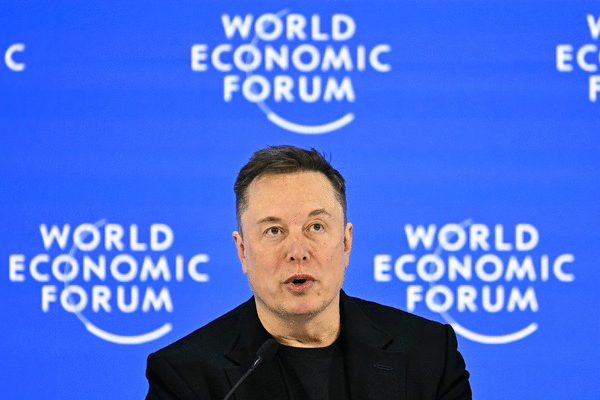
Tesla Inc. anticipates billions of dollars in additional spending this year to support Elon Musk’s ambitions to transform the electric-vehicle pioneer into an AI and robotics company.
Capital expenditures this year will exceed $25 billion, the company revealed Wednesday, roughly three times last year’s outlay. The planned investment is up from a prior forecast of around $20 billion.
“You should expect to see a very significant increase in capital expenditure,” Musk said on a conference call after Tesla released first-quarter results.
The investments will be put toward a dramatic expansion of factory operations, including production of its Optimus humanoid robot, artificial intelligence initiatives and the Cybercab autonomous car. Tesla’s traditional automotive business has declined for the past two years, putting greater pressure on the planned pivot to those futuristic initiatives.
The revised spending plan shows the heavy cost for Tesla to achieve its goals, said Dec Mullarkey, managing director at SLC Management. It’s “sobering up the assessment of free cash flow potential for the year.”
Tesla shares were little changed in late trading, erasing an earlier gain after executives announced the higher spending estimate. Through Wednesday’s close, the stock declined about 21% since touching a record high in mid-December.
In the first quarter, adjusted earnings rose to 41 cents a share, Tesla said, beating the 34-cent average of analyst estimates compiled by Bloomberg. That marked the second straight quarter of better-than-expected results.
The report included promising signs for its core automotive business. Tesla said it “saw continued growth in demand for our vehicles” in parts of Asia and South America, along with a rebound in North America and the Europe-Middle East region.
The surprisingly optimistic comments came several weeks after the automaker reported lower-than-expected vehicle sales to start the year. The first quarter was the second-worst for auto deliveries since mid-2022, trailing only a year earlier when Tesla paused production of its Model Y and dealt with widespread backlash to Musk’s political activities.
The report “confirms that while the legacy EV business is no longer growing rapidly, it’s stable enough to fund Tesla’s heavy investments in robotics and self-driving technology,” Andrew Rocco, a Zacks Investment Research analyst, said in a note.
Tesla pointed to rising gas prices as a boon for its business, driving increased customer interest.
“We have seen a slight growth in terms of quarter-over-quarter deliveries on the order backlog front,” Chief Financial Officer Vaibhav Taneja said on the conference call.
Tesla will be boosting vehicle output as part of its capital expenditure plan, Musk said. The company is “laying the groundwork for what we expect to be a significant increase in vehicle production in the future,” the chief executive officer said on the call.
For the first three months of 2026, however, Tesla spent less than $2.5 billion — well below the outlay the company will need to average per quarter to reach its expenditure forecast for the year. This contributed to Tesla posting $1.4 billion in positive free cash flow for the quarter, far better than analysts’ expectation that the carmaker would burn through almost $1.9 billion.
The company’s energy and storage division reported revenue of $2.4 billion in the first quarter, a 12% drop from a year earlier. While the company didn’t provide details as to why growth stalled at the unit, which had been a bright spot for the last several years, Taneja said “the energy storage business is inherently lumpy.” Tesla still expects energy deployments this year to be up from 2025.
The EV maker reiterated plans for its nascent ride-hailing business it calls Robotaxi, saying the business is on track to expand to Phoenix, Miami, Orlando, Tampa and Las Vegas in the first half of this year. Robotaxi, which was originally envisioned as a driverless service, began in Austin last year and has slowly expanded since then. This month it also launched in Houston and Dallas.
While the company hasn’t provided details about fleet sizes, or disclosed how many vehicles operate without a safety monitor on board, the ramp remains slow, and Musk said it will likely not see material revenue until at least 2027. Tesla also offers rideshare service under the same app in the San Francisco Bay Area, but it’s more akin to Uber and Lyft.
Tesla said it remains on track to start making key products including Cybercab, Semi and an updated version of its Megapack battery storage system.
The spending needed to support production “increases near‑term cash burn and execution risk but can be a long‑term positive for the stock,” said Ivan Feinseth, chief investment officer at Tigress Financial Partners. “Investors may increasingly view it as an AI compute and robotics infrastructure platform rather than just an automaker.”
(With assistance from Andrea Chang.)
©2026 Bloomberg L.P. Visit bloomberg.com. Distributed by Tribune Content Agency, LLC.




Comments