Artemis II 'closeout crew' ready to be astronauts' final contact before launch
Published in Science & Technology News
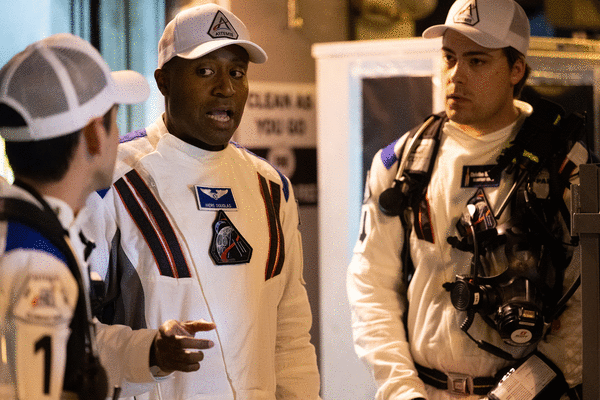
CAPE CANAVERAL, Fla. — Nine people will take the ride to the top of the launch tower for the Artemis II moon mission, but only five will ride back down.
That’s if NASA’s plans to launch four astronauts on board the Orion spacecraft atop the Space Launch System rocket go as planned. Targeting liftoff as early as next Wednesday, the quartet will strap into the spacecraft safe and sound thanks to the five people that are part of the closeout crew.
One of those five will be NASA astronaut Andre Douglas, a backup astronaut for the mission. The other four are contract employees for Amentum, the company with a hand in nearly all the logistic at Kennedy Space Center.
Douglas will be sporting a big No. 2 on the back of his white uniform, while No. 1 goes to Taylor Hose, the closeout crew team lead.
They have been practicing for the big day with the astronauts for years, but Hose said the closeout crew felt a shift as they performed a test run this past February after the SLS and Orion rolled out for the first time to Launch Pad 39-B.
“You could see the vapor coming from the engines and from the top. We’ve driven up to the pad 1,000 times, but seeing the rocket actually look alive — it was really surreal,” Hose said. “We all took a moment. We’re like, ‘Whoa. This is really happening.'”
Now they could be less than a week from the actual launch.
NASA astronauts Reid Wiseman, Victor Glover and Christina Koch along with Canadian Space Agency astronaut Jeremy Hansen will be the first crewed flight of Orion, headed for a 10-day lunar fly-by mission to prove out Orion’s capability to support human spaceflight and set up future Artemis missions including a moon landing as soon as 2028. Launch opportunities run between April 1-6.
The last people the astronauts will see before launch are the five members of the closeout crew who will leave the launch tower about 40 minutes before launch. Before that, they will help the crew put on their helmets before entering Orion.
The last breath of fresh air on Earth will happen in the White Room within the crew access arm at the top of the launcher. If all goes well, they won’t get their next fresh breath until they splash down back on Earth in the Pacific Ocean.
“We’re reaching out into the solar system, and to be able to be a part of that, to strap these astronauts in and know that they’re furthering humanity, it’s pretty incredible,” Hose said.
Hose and closeout crew teammate Christian Warriner, an Orion technician, know their job signifies the final inches before a 600,000-mile journey. That includes a checklist of 157 individual items.
“Our goal is genuinely to make sure everything on that hatch is good to go and that they are safe and sound,” Warriner said. “Until that’s done, we’ve just got to keep rolling and getting the job done.”
Both members were involved in the 2022 launch of Artemis I, Hose said. Training for the responsibility of the closeout crew takes at least 1 1/2 years.
“It’s definitely a big responsibility knowing that the equipment we deal with and how we close that hatch has a direct correlation to the crew,” he said. “So that’s why it takes so long to be trained and certified to do what we do, because everything has to be perfect. We don’t have a choice.”
One of the biggest headaches any launch with a hatch deals with is known as FOD, or foreign-object debris, which could be as small as a piece of hair trapped in the seal where the hatch closes. Their tools include a powerful vacuum and even tape.
“Basically, any type of little thing that we think is either going to become FOD or does seem like it is FOD, we’re going to basically take it and get it as far away from the vehicle and get it in a secure place,” Warriner said.
They also had to train on something new since Artemis II has humans, and that’s the emergency egress system. Four escape baskets that can allow all four astronauts and five closeout crew members a zipline escape away from the launch tower.
“If everybody’s ambulatory, there’s just something wrong, we just have to get out of there," Hose said.
As far as readiness goes, with multiple test runs at the pad under their belts, Hose said they’re prepared.
“I don’t foresee any difficulties. But that being said, it’s a very complex system, so that’s why we have redundancies and spares of everything,” he said. “In case something needs to be repaired, we need to swap out a hand pump, we have spares of everything. Just to be sure.”
It may not be long before they have to start preparing for the next launch. The recently updated plan puts Artemis III on the schedule for mid-2027, with launches as quick as every 10 months thereafter.
“I definitely think it will be a challenge, but I don’t think it’s something we won’t be able to do,” Hose said. “I honestly am looking forward to it.”
_____
©2026 Orlando Sentinel. Visit at orlandosentinel.com. Distributed by Tribune Content Agency, LLC.






Comments