EPA's end to endangerment finding eases rules for carmakers
Published in Science & Technology News
WASHINGTON — The EPA’s decision last week to repeal the 2009 endangerment finding establishing that greenhouse gas emissions are air pollutants harmful to public health will have immediate impacts on vehicle tailpipe emissions limits and start-stop technology incentives.
That finding, which required the agency to regulate the emissions as air pollutants posing a public health threat under its Clean Air Act authority, later became the basis for subsequent tailpipe emissions standards.
The EPA also said the rollback would benefit auto manufacturers in ways that consumers don’t necessarily see. Greenhouse gas testing and measurement; reporting and certification; and banking and trading provisions specific to greenhouse gas emissions would go away.
President Donald Trump and EPA Administrator Lee Zeldin said at a Feb. 12 White House event that the move would save “over $1.3 trillion” overall and could take $2,400 off the cost of a new vehicle. An EPA fact sheet said the savings would accrue over nearly 30 years and would largely come from lower vehicle prices as well as “avoided costs” associated with electric vehicle chargers and related equipment.
Trump called the endangerment finding “a disastrous Obama-era policy that severely damaged the American auto industry and massively drove up prices for American consumers.”
The administration’s repeal releases auto manufacturers from federal regulations that were designed to bring about a nearly 50% reduction in fleet-wide emissions by 2032 compared with 2026. The Biden administration set those ambitious standards for light- and medium-duty vehicles for model years 2027-2032.
The Trump administration likened the standards to an “EV mandate.”
It’s unclear what effect the reversal will have on vehicle fuel-economy standards. The EPA said its decision wouldn’t affect those standards. The National Highway Traffic Safety Administration sets fuel-efficiency standards under a 1975 law.
But Transportation Secretary Sean Duffy, whose department includes NHTSA, suggested those standards may also be in play.
“This Administration is taking a whole-of-government approach to make cars more affordable again,” Duffy said in a statement. “Whether it’s resetting mileage standards or abolishing an idiotic start-stop requirement that every driver hates, President Trump’s auto dream team is working overtime to lower costs and revitalize American manufacturing.”
Automaker support
The EPA distributed statements from auto sector representatives last week supporting the change.
Alliance for Automotive Innovation President and CEO John Bozzella called the Biden regulations’ standards “unachievable.” Bozzella attended the Biden administration’s event announcing the standards in March 2024, saying at the time that the goals were a “stretch” due to the pace of reductions but that U.S. automakers were “committed to the EV transition.”
“I’ve said it before: Automotive emissions regulations finalized in the previous administration are extremely challenging for automakers to achieve given the current marketplace demand for EVs,” Bozzella was quoted as saying in the EPA statement. “The auto industry in America remains focused on preserving vehicle choice for consumers, keeping the industry competitive, and staying on a long-term path of emissions reductions and cleaner vehicles.”
Will Otero, a representative for Stellantis NV, Chrysler’s parent company, said the decision “enables us to continue offering Americans a broad range of cars, trucks, and SUVs … that they want, need and can afford.”
Zeldin singled out the start-stop technology for attention, announcing the EPA would eliminate an emissions credit for vehicles with start-stop features, which he called a “stupid feature” that “countless Americans” pushed for him to end. The EPA said start-stop credits allowed manufacturers to meet some emissions standards “on paper” while in reality offering “questionable emission reductions.”
The start-stop feature automatically shuts off a vehicle’s engine when it reaches a complete stop, such as at a traffic light, and allows the vehicle to immediately restart when the accelerator is pressed.
“Not only do many people find start-stop annoying, but it kills the battery of your car without any significant benefit to the environment,” Zeldin said in a statement. “Automakers should not be forced to adopt or rewarded for technologies that are merely a climate participation trophy with no measurable pollution reductions.”
Congressional response
Republicans on Capitol Hill are so far portraying the endangerment rescission and rollback on vehicle requirements as a win for consumer choice.
“President Trump and EPA Administrator Lee Zeldin delivered the largest deregulatory action in American history. The Obama-era Endangerment Finding that drove years of costly vehicle mandates, is gone,” Rep. Richard Hudson, R-N.C., wrote on the social media site X. “That includes ending the ridiculous mandate that pushed the start-stop feature that shuts your engine off at every red light.
Hudson serves on the House Energy and Commerce Committee, which has recently advanced bills that would relax other pollution and efficiency standards.
Another member of that committee, Rep. Daniel Crenshaw, R-Texas, wrote on X that he was “working as we speak on legislation to permanently codify this.”
Democrats on the Hill and environmental organizations have expressed increasing outrage since the EPA announced its final rule last week.
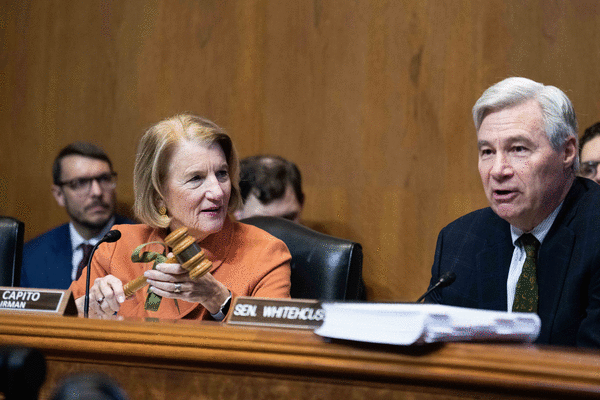
Senate Environment and Public Works ranking member Sheldon Whitehouse, D-R.I., led a group of 41 Democratic and independent senators in launching an investigation into the EPA’s decision.
In a Feb. 13 letter to Zeldin requesting documentation on the agency’s justification and decision-making process, the senators said the rescission “marks a fundamental break from nearly two decades of settled law, science, and regulatory practice under the Clean Air Act.”
They accused Zeldin and the EPA of holding a “predetermined outcome” at the outset of the agency’s reconsideration of the finding, citing Zeldin’s behavior and statements in media appearances. The senators requested a response by Feb. 27.
“Your improper, conclusory statements align with internal EPA documents showing that EPA leadership was moving to finalize the rescission of the endangerment finding before EPA staff had even had the chance to complete the agency’s required regulatory review,” the senators wrote.
©2026 CQ-Roll Call, Inc., All Rights Reserved. Visit cqrollcall.com. Distributed by Tribune Content Agency, LLC.





Comments