Nothing Between Me and the World: Why Some Women Are Ditching Shoes for Good
Published in Fashion Daily News
In the middle of a Saturday farmers market in Richmond, Virginia, 42-year-old graphic designer Maya Hernandez weaves easily between stalls of fresh bread and cut flowers. She carries a canvas tote on one shoulder, coffee in the other hand. She is dressed neatly in loose linen pants and a soft blue blouse.
She is also barefoot.
“I stopped noticing it years ago,” Hernandez said with a shrug. “Other people notice. I don’t.”
Across the United States and in pockets around the world, a growing number of women are quietly opting out of conventional footwear. Some do it full-time. Others go barefoot whenever possible — at work, at home, in public spaces, and even while traveling. Their reasons vary, but many point to the same conclusion: comfort, autonomy and a desire to reconnect with their bodies in a culture that has long treated discomfort as the price of beauty.
What was once considered eccentric is increasingly becoming a personal statement — not of rebellion, but of self-respect.
The Shoe Lie
For decades, women’s fashion has been built on a quiet premise: pain is normal.
High heels compress toes. Narrow shoes restrict movement. Stiff soles interfere with natural gait. Blisters, bunions and chronic foot pain are often treated as unavoidable side effects of “looking professional” or “looking polished.”
“Women are socialized very early to believe that discomfort equals discipline,” said Dr. Lena Morris, a podiatrist in Chicago. “If it hurts, you’re doing it right. That idea is deeply embedded in fashion culture.”
According to the American Podiatric Medical Association, more than 75% of adults will experience foot problems at some point in their lives, with women disproportionately affected. Conditions such as plantar fasciitis, hammertoes and nerve compression are frequently linked to long-term shoe use.
For some women, learning this was a turning point.
“I realized I was spending money on shoes that were slowly damaging my body,” said Rachel Kim, a 35-year-old marketing consultant in Seattle. “It felt absurd.”
She stopped wearing heels first. Then flats. Then most shoes altogether.
“I kept asking myself, ‘Why am I doing this?’” she said. “There was no good answer.”
Real Voices, Real Choices
The barefoot movement, informal and decentralized, is not driven by influencers or brands. It spreads quietly through personal stories.
Hernandez remembers her first barefoot outing clearly.
“I was nervous,” she said. “I brought sandals in my bag, just in case. But after an hour, I forgot they were there.”
For others, the transition was gradual.
“I started at home,” said Denise Carter, a 58-year-old retired teacher in North Carolina. “Then in the yard. Then quick errands. One day I realized I hadn’t worn shoes in weeks.”
Carter said her balance improved and her chronic back pain diminished.
“I felt younger,” she said. “Not in a cosmetic way. In a physical way.”
Younger women are also embracing the practice, often for mental health reasons.
Graduate student Lila Patel, 27, began going barefoot during the pandemic.
“Everything felt disconnected,” she said. “Barefoot walking made me feel present again.”
She now attends classes barefoot whenever campus policy allows.
“It reminds me I’m in my body,” she said.
Style Without Shoes
Contrary to stereotype, barefoot women are not abandoning fashion. Many say they have become more thoughtful about it.
Without shoes as focal points, attention shifts to fabric, silhouette and movement.
“I care more about texture now,” Hernandez said. “Linen, cotton, wool — things that feel good.”
Common elements include:
* Cropped or wide-leg pants/> * Long skirts/> * Soft tailoring/> * Natural fibers/> * Layered neutrals
Fashion stylist Maribel Torres, who works with minimalist clients in Los Angeles, said the trend reflects broader changes.
“People are moving away from rigid, performative dressing,” she said. “Comfort and authenticity are becoming status symbols.”
Torres noted that many of her clients who go barefoot invest more in quality clothing.
“They’re not careless,” she said. “They’re intentional.”
Health, Safety and Reality Checks
Experts caution that barefoot living is not risk-free.
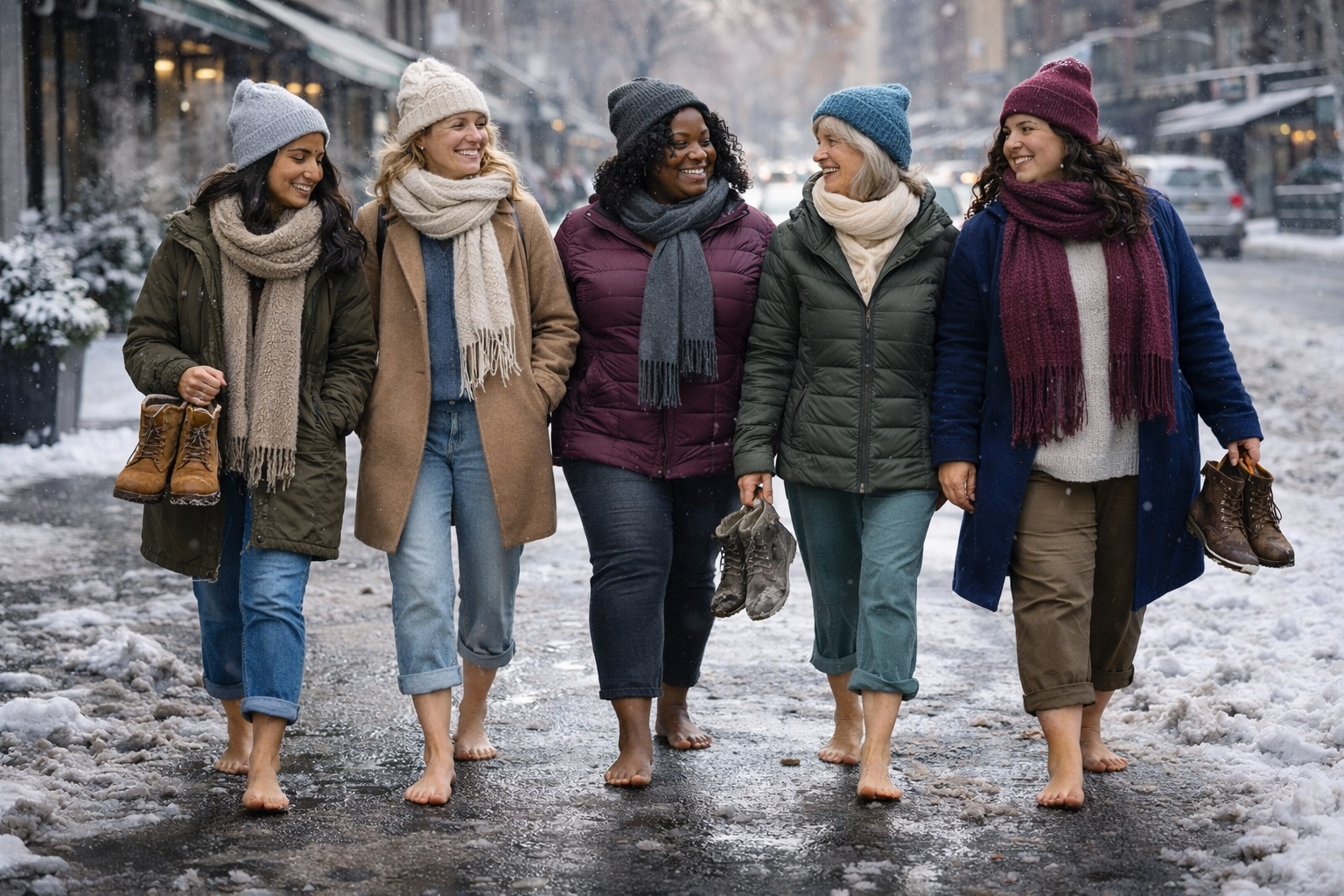
Urban environments contain glass, metal and uneven surfaces. Cold weather poses risks of frostbite. Certain workplaces require protective footwear.
“Barefoot is not appropriate everywhere,” Morris said. “It should be a choice, not an ideology.”
Many barefoot women agree.
“I carry shoes when I need them,” Kim said. “Hospitals, construction zones, winter — I’m not reckless.”
Some use minimalist footwear — thin-soled shoes designed to mimic barefoot walking — as compromise.
“I’m practical,” Carter said. “This isn’t a religion.”
Public etiquette is also part of the conversation. Some businesses prohibit barefoot customers. Some people object.
“You get comments,” Patel said. “Mostly curiosity. Sometimes judgment.”
She pauses. “That fades.”
It’s Not About Feet
Ask barefoot women what motivates them, and few mention aesthetics.
“It’s not about showing anything,” Hernandez said. “It’s about feeling.”
Many describe the sensation of direct contact with the ground as grounding, calming and clarifying.
“There’s feedback,” Carter said. “You’re aware of where you are.”
Psychologists say this is consistent with research on somatic awareness — the connection between physical sensation and emotional regulation.
“When people feel physically present, anxiety often decreases,” said Dr. Hannah Weiss, a clinical psychologist in Boston.
Weiss compares barefoot walking to meditation or yoga.
“It’s embodied attention,” she said.
More broadly, many women frame the choice as reclaiming bodily autonomy.
“For so long, women were told how their bodies should look and feel,” Kim said. “This is me deciding for myself.”
A Quiet Cultural Shift
The rise of barefoot living aligns with several broader trends:
* Remote and hybrid work/> * Post-pandemic comfort culture/> * Sustainable fashion/> * Rejection of fast fashion/> * Aging without apology
In surveys conducted by consumer research firm TrendWatch, comfort consistently ranks as a top priority for women over 35 — ahead of trendiness and brand prestige.
“You’re seeing a generational shift,” Torres said. “Women are tired of suffering for optics.”
Social media has amplified these voices, but the movement remains largely grassroots.
“There’s no manifesto,” Hernandez said. “Just people choosing differently.”
Finding Themselves, One Step at a Time
On a recent afternoon, Hernandez walked home from work along a tree-lined sidewalk, her bare feet darkened slightly by dust. She stopped briefly to brush them off before entering her apartment.
“I’m not trying to make a statement,” she said. “I’m just living.”
For her and many others, that simplicity is the point.
“It’s freedom,” Carter said. “Not dramatic freedom. Everyday freedom.”
Patel put it another way.
“I feel closer to the world,” she said. “There’s nothing between me and it.”
========
Eliza Rowen is a lifestyle and culture writer based in Charlottesville, Virginia, focusing on wellness, identity and modern domestic life. She has contributed to regional and national publications for more than a decade. This article was written, in part, utilizing AI tools.






Comments