A billionaire playbook? How Carnegie Mellon fits in the plan to reinvent Miami
Published in Home and Consumer News
MIAMI — When South Florida billionaires Ken Griffin and Stephen Ross gathered with business leaders in February, they made a powerful pitch for a different kind of South Florida.
Through a statewide initiative powered by the advisory group Florida Council of 100, Griffin and Ross called on CEOs, billionaires and entrepreneurs to bring and build their businesses.
The campaign is designed to reach business leaders in traditional centers such as New York, Chicago and California and persuade them to build or relocate their companies to Florida.
At the conference, Griffin, founder and CEO of the Citadel hedge fund, and Ross, founder of Related Companies and owner of the Miami Dolphins, put their own money behind the effort. Each contributed $5 million to the $10 million campaign.
Eight months later, Griffin announced a $3 billion gift to help bring Carnegie Mellon University to Miami. And Ross is spending millions to bring a Vanderbilt University campus to West Palm Beach.
The two men are approaching the transformation from different directions, but the pieces are beginning to fit together: Recruit companies, attract the people who run them, build the real estate where they can work and live, and create universities capable of supplying the talent, research and startups to keep the cycle going.
Their higher education moves might be among the most important pieces in the puzzle.
The playbook
At the February conference, Griffin and Ross argued that South Florida’s Gold Coast — stretching from Miami to West Palm Beach — had the ingredients companies need to grow: talent, a favorable operating environment and quality of life.
On Wednesday, following the announcement of Carnegie Mellon University Miami, Ross praised Griffin in an email statement.
“Ken Griffin’s decision to bring Carnegie Mellon undergraduate to Miami, alongside Vanderbilt’s graduate campus taking shape in West Palm Beach, marks a defining moment for South Florida,” Ross said. “Together, these investments are building the academic infrastructure this region needs to attract world-class talent and the next wave of major companies to the Gold Coast.”
Griffin made a similar pitch, saying Miami and the broader South Florida area offered deep talent, regulatory clarity and an extraordinary quality of life.
But their investments are moving beyond recruitment.
Griffin and Ross are pursuing universities because universities can do more than educate students. They can attract researchers, generate patents and startups, draw venture capital and give major companies a reason to locate nearby.
And more important, they can create a talent pipeline that makes it easier for companies already here to grow.
So, Griffin and Ross are investing in the pieces they believe can turn South Florida into a self-sustaining business ecosystem — companies attract talent, talent attracts companies and universities help supply both.
They are building pieces of the ecosystem they say they want to attract.
The university bet
Griffin’s Carnegie Mellon commitment gives the vision a powerful new anchor.
The Pittsburgh-based university is known for artificial intelligence, computer science, robotics and engineering. The new Miami campus is expected to begin enrollment in 2028, pending approvals, and eventually serve more than 3,500 students.
The $2 billion Miami investment will support a campus focused on research and education in areas including artificial intelligence, national security, health, energy and climate resilience.
The university also plans industry research labs and venture studios designed to bring researchers and companies together.
For Griffin, that creates a connection between his philanthropy and his broader economic ambitions for Miami.
His moving Citadel’s headquarters from Chicago to Miami helped establish the city as a growing financial center. And his real estate investments have expanded his footprint.
Now, Carnegie Mellon fits into his playbook: helping create the talent and research infrastructure that could feed the next generation of technology companies.
John Boyd Jr., principal of The Boyd Co., a corporate site-selection firm that tracks business and wealth migration to South Florida, said the Carnegie Mellon announcement sends a powerful signal to companies considering the region.
“The news of Ken Griffin’s support for Carnegie Mellon is a major vote of confidence that Miami as a global tech hub has staying power,” Boyd said.
The university could give companies access to a new pipeline of talent in banking, healthcare, robotics, and autonomous and defense technology, he said.
It could also create new connections between Miami and Pittsburgh, a major center for artificial intelligence and quantum technology, Boyd said, potentially opening pathways for faculty collaboration, corporate research and development, startups and venture capital.
In that way, the university is not simply an educational investment. It is part of an economic strategy.
Wynwood’s next chapter
The billionaire playbook strategy is playing out in a neighborhood that has already been reinvented several times.
Wynwood started as farmland and then became an industrial center, a garment district and Little San Juan, the center of a large Puerto Rican community.
After the factories closed and the neighborhood fell into poverty and crime, artists moved into empty warehouses.
The art galleries and murals eventually turned Wynwood into one of Miami’s most internationally recognized destinations.
Now, technology and finance are becoming part of the identity.
Amazon has already leased office space in the neighborhood. Peter Thiel’s Founders Fund and Thiel Capital have offices there. Financial exchange MIAX and cryptocurrency exchange Gemini are among the companies at 545 Wyn, the building Griffin and Goldman Properties acquired for $181 million.
How Carnegie Mellon accelerates the change
“The campus adds a major institutional anchor to a neighborhood that has already developed a strong high-tech identity,” Boyd said. Carnegie Mellon in Miami, he said, “helps put an exclamation mark on Wynwood’s transformation from an arts district into a more mature tech and innovation ecosystem.”
David Weitz, co-founder of Oak Row Equities, which has invested in Wynwood, also sees the new university as a catalyst for the larger transformation of the area.
“Carnegie Mellon’s arrival is a major validation of Wynwood’s evolution into one of Miami’s most important centers for business, technology and innovation,” Weitz said. “It will create a pipeline of students, researchers and entrepreneurs that can deepen the talent pool for companies already here and attract the next generation of businesses to Miami.”
Sharon Novotny, senior vice president of new developments at Douglas Elliman Development Marketing, who oversees The Cloud One Hotel & Residences Wynwood, said the university could also reshape the neighborhood’s residential market.
“Wynwood used to be somewhere people came for a few hours to see the art, grab lunch or a drink and then leave,” Novotny said. “That has now changed dramatically. Carnegie Mellon will bring another wave of people who will work, study and build their lives here, creating a real need for more residential options in a neighborhood that is already incredibly walkable and connected.”
Longtime residents of Wynwood acknowledge that gentrification is largely complete and a new Wynwood is now here.
“The old Wynwood my husband grew up in no longer exists,” said Robin Vasquez, a community liaison for the Wynwood Community Enhancement Association, which represents residents in Wynwood Norte along 29th Street. “We view Carnegie Mellon’s presence as a positive development that will drive housing demand, encourage higher construction standards and improve overall quality in both areas.”
For Griffin, the university also represents a massive real estate investment.
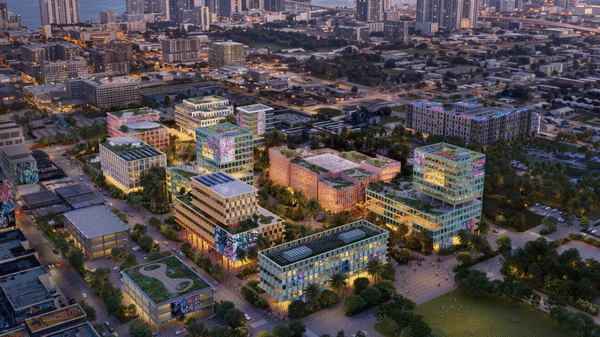
The 35-acre Wynwood property being used for the campus was acquired from developer Moishe Mana for $1.1 billion, the Miami Herald reported Wednesday after an exclusive interview with Griffin and Carnegie Mellon University President Farnam Jahanian.
The university isn’t coming to Wynwood in isolation, but will be part of a much larger investment in the neighborhood encouraged by Griffin.
West Palm Beach playbook
About 70 miles north, Stephen Ross is pursuing a similar strategy.
Through Related Ross, he has invested billions of dollars to help transform downtown West Palm Beach into a concentration of offices, residences, restaurants and retail. He has attracted a string of companies, many of which, including Cleveland Clinic, Andreessen Horowitz and Greenberg & Traurig, have found office space at his new 15 CityPlace tower.
For Ross, the real estate is only one piece.
Like Griffin, he sees the need for high-end universities. He is working to bring Vanderbilt University to West Palm Beach and has committed $50 million toward the planned campus.
The university’s arrival would give West Palm something beyond another office tower: a major academic institution capable of attracting students, faculty, researchers and companies.
Ross has continued building the real estate platform around that vision.
The pieces are beginning to resemble the ecosystem Griffin and Ross were talking about in February.
More than a recruiting campaign
The $10 million campaign through the Council of 100 business leadership group was an early sign that the two billionaires intended to put money behind their pitch.
The Carnegie Mellon gift takes that idea to a new level.
“The bigger South Florida story is the collaboration between influential business leaders and world-class universities — from Ken Griffin and Carnegie Mellon in Miami to Stephen Ross and Vanderbilt in Palm Beach,” said Boyd, the leader of the corporate site-selection firm.
But the transformation is not universally seen as positive.
Critics of the region’s development boom have raised questions about what happens when extraordinarily wealthy people accumulate large concentrations of property and influence in the neighborhoods they are helping to transform.
The same investments that can bring universities, technology companies, jobs and new tax revenue can also drive up land values and rents, accelerate redevelopment and make it harder for existing businesses, artists and residents to remain. And then there is the universal South Florida headache: more traffic in a region with limited mass transit.
In Wynwood, that tension is already familiar.
The inexpensive warehouses that attracted artists eventually became valuable real estate. As property values rose, some of the people who helped create the neighborhood’s identity found themselves struggling to afford it or had to sell and move.
Now the neighborhood is entering another transformation, this time with one of the world’s leading research universities at its center.
©2026 Miami Herald. Visit at miamiherald.com. Distributed by Tribune Content Agency, LLC.







Comments