
Eric's Autos: 2026 Nissan Rogue Plug-in Hybrid
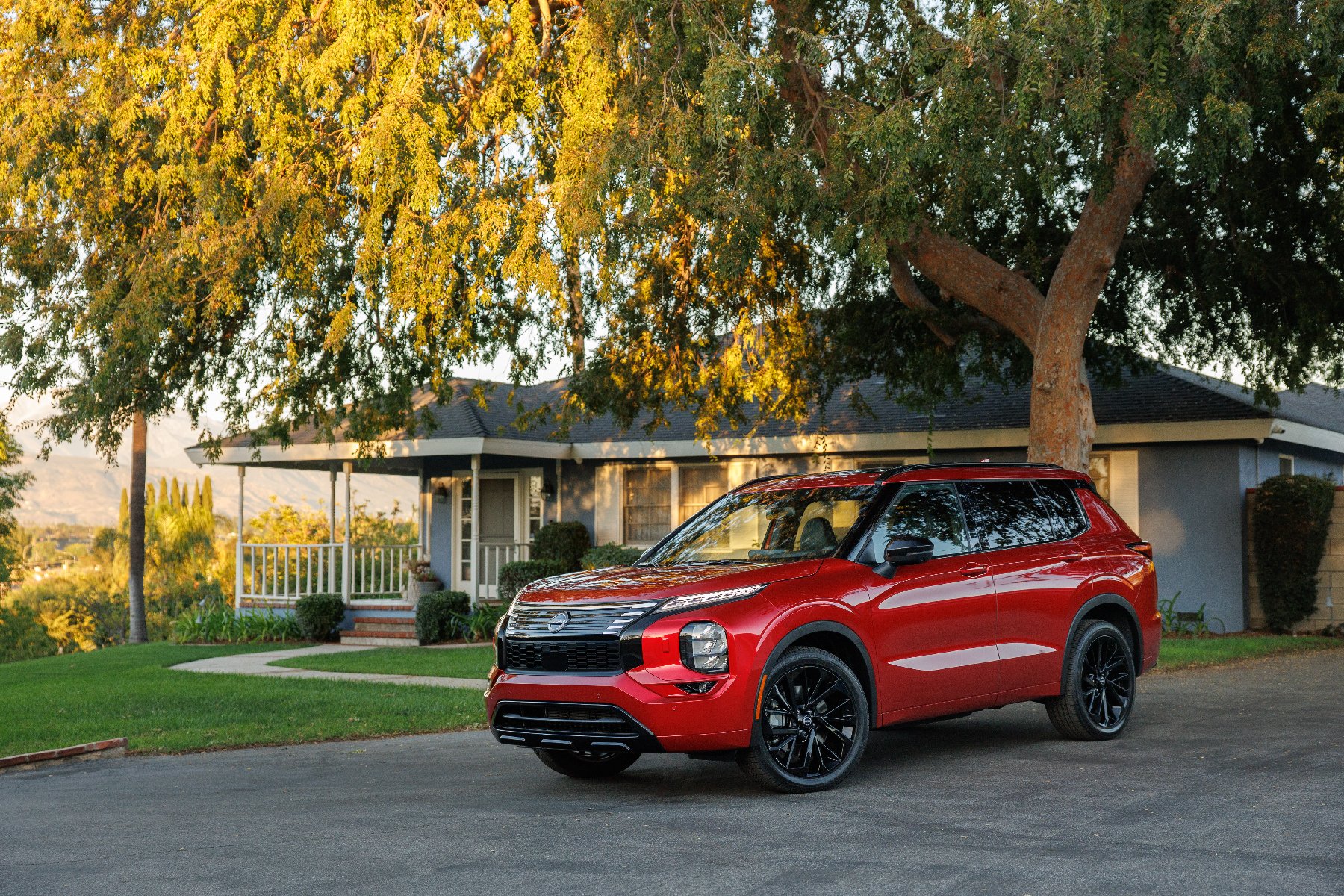
Nissan's Rogue has sold very well -- notwithstanding that it's not especially roguish. It's a competent, attractively priced compact crossover -- and that's been enough.
Now Nissan's offering something more that's also different -- and even a little bit actually roguish: a plug-in hybrid drivetrain without a transmission -- it's got direct drive instead, very much like a full-time electric vehicle -- that can be driven just shy of 40 miles when the battery pack is fully charged but doesn't force you to stop for a charge when it's out of charge. There's also a lot more power and snappier acceleration.
But it's not really a Nissan. And it's only going to be sold for this one model year.
That's pretty roguish, in a way.
What It Is
The Nissan Rogue plug-in hybrid is actually a Mitsubishi Outlander plug-in hybrid that identifies as a Nissan. Its mechanicals are Mitsubishi, but it gets some Nissan styling cues. It also comes standard with a third row, which is not available with the actually Nissan Rogue.
Prices start at $45,990 for the base SL trim -- which comes with 20-inch wheels, synthetic leather seat covers, heated front seats, a wireless charging pad, a heads-up display and a digital/LCD instrument cluster.
The $49,990 Platinum adds three-zone climate control, a panorama sunroof, real leather seat covers, heated rear seats, heated steering wheel and an upgraded nine-speaker Bose stereo.
Both trims come standard with the same plug-in hybrid drivetrain, which consists of a 2.4-liter four-cylinder engine and a battery pack that can be recharged while driving -- using the engine as a generator -- or by plugging it in to an external source of electricity.
What's New for 2026
The Rogue plug-in is a one-year-only badge-engineered stopgap. Next year, Nissan will be offering its own, in-house-designed plug-in hybrid.
What's Good
-- One of the few compact crossovers (besides the Outlander) that comes with a third row.
-- It's an EV that doesn't make you wait around for a charge.
-- Much stronger-feeling (and quicker) than the non-hybrid Rogue.
What's Not So Good
-- Much more expensive than the non-hybrid Rogue (which lists for $29,490 to start).
-- More expensive than the Outlander plug-in hybrid ($43,245 to start), and the Mitsu's got more power and a third row too.
-- If you run low on charge, you'll burn a fair amount of gas.
Under the Hood
Both the "Nissan" Rogue plug-in hybrid and the Mitsubishi Outlander plug-in hybrid are propelled by the closest thing extant to a series hybrid drivetrain. This type of drivetrain is very different from the typical hybrid drivetrain, which relies chiefly on the gas engine to turn the wheels that move the car, with the hybrid side providing additional/supplementary power on demand (when maximum acceleration is wanted) and also to power accessories when the engine is cycled off -- as when the vehicle isn't moving (or decelerating/coasting).
That's a parallel hybrid setup. Almost all currently available hybrids are set up this way.
The Rogue/Outlander combines both ways.
Both the Rogue and the Outlander have a 2.4-liter gas engine, but it does not usually turn the wheels. In Pure EV mode (this assumes a fully charged battery pack), the electric motors (front and rear) are what turn the wheels -- directly, just like the way it works in most EVs. You can drive this way for 38 miles -- again, assuming a fully charged battery pack. In Series mode, the gas engine serves as a carry-it-with-you generator, making electricity to charge the battery, which powers the electric motors (it works similarly to the old Chevy Volt, for those who remember). In Parallel hybrid mode, a clutch system connects the engine directly to the front axle, to provide motive power to the front wheels (along with the electric motors).
There is no transmission acting as an intermediary between the engine and the wheels. This is a huge efficiency gain and also a simplicity gain in that it eliminates a major driveline component (the transmission) and, along with it, a potential down-the-road failure point. Most conventional hybrids have continuously variable transmissions, and these haven't got the best track record for long-term (post-warranty) durability.
There are some differences, though, between these two Mitsubishis.
The "Nissan" version is less powerful -- 248 horsepower versus 297 for the Mitsubishi -- and the "Nissan" goes slightly less far (38 miles) on a fully charged battery, without the gas engine coming online -- versus 40 miles for the Mitsubishi. Regardless, the take-home point here is that either of these two are capable of doing daily short-hop driving without burning a drop of gas, if you start out with a fully charged battery pack. Since this a hybrid, the battery pack isn't as huge as the one in an EV, so it's feasible to fully charge it overnight using a common household (120V) power outlet; it can also be charged faster using a Level II (240V) outlet. However -- unlike the Mitsubishi version -- the "Nissan" cannot use commercial high-voltage DC "fast" chargers.
On the Road
This "Nissan" is technically a hybrid, but it is also functionally an EV. There are other plug-in hybrids that can be driven 20-30-ish miles without burning gas, but only if you drive with a very light foot; push down forcefully and the gas engine comes on. They also have transmissions that you can feel (and hear). The Rogue plug-in hybrid operates like an EV. It has the same right-now/instant torque (332 foot-pounds) and linear forward thrust that is one of the things EVs have that most gas engines vehicles lack. Though not ludicrously quick, the Rogue can get to 60 mph in about six seconds, which is about two seconds sooner than the non-hybrid Rogue. The Mitsubishi-skinned (and badged) version of this vehicle is expectedly quicker given that it has 49 more horsepower. Probably the deal between Nissan and Mitsubishi was that the "Nissan" version of this little crossover was going to offer more power/better performance -- to give the Mitsubishi an advantage over the "Nissan."
When the engine does come on, it's much less noticeable than it is when a conventional hybrid's engine comes on because you feel it as well as hear it -- because the engine isn't connected to a transmission and isn't connected to the wheels. There is some running engine noise in the background, and that's about it.
On the downside, this little "Nissan" isn't especially fuel efficient. Once the gas engine is running, you're looking at about 25 mpg on average (25 mpg city, 27 mpg highway) which is initially startling given just 2.4 liters of engine. But when you find out that the Rogue plug-in weighs 4,674 pounds before anyone gets in, it all makes sense. It takes energy to move a thing, and heavy things take more energy to move. This little crossover weighs nearly as much as a mid-1970s Cadillac Sedan de Ville, which was a massive land yacht with a full-perimeter bolt-on steel frame that was powered by a massive cast iron V8.
To make this thing work -- from a gas-savings point of view -- it's necessary to keep the gas engine from coming on to the extent possible. If most of your daily driving is no more than about 40 miles, this is doable and -- given how expensive gas has gotten -- it could possibly end up saving you a lot of money. But if you regularly drive longer distances, you may be disappointed by what you end up having to spend on gas.
At the Curb
It looks like an extended Rogue, but it's really a reskinned Mitsubishi. Not -- as Seinfeld used to say -- that there's anything wrong with that. There are very few small crossovers that offer a standard (or even optional) third row, and none that are plug-in hybrids like these two hybrids. The third row is a squeeze for anyone but kids, but that's just the point. This is a vehicle for families that need the extra seats for kids but maybe don't want the extra size (most crossovers with three rows are midsize or larger). It's also a way -- as regards the Nissan-badged version of this vehicle -- to get a three-row "Rogue" and stay within the Nissan family, even if this three-row "Rogue" is something like an adopted kid who isn't biologically related to the rest of the family.
There is a downside to having a third row in a compact crossover. Just open the rear liftgate to see for yourself. The third row takes away a lot of room for cargo. There's only 12.8 cubic feet left behind the third row -- versus 31.6 cubic feet behind the second row in the actually Nissan Rogue. You can, of course, fold forward the third (and second) row to make more space, but it's not the same as having the completely open space you get when there's no seat in the way.
While Mitsubishi offers its version of this vehicle in five different trims, the "Nissan" is available in just two: the SL and Platinum. The base SL lists for more than the base ES trim of the Mitsubishi -- which stickers for $43,245. The latter also comes standard with a larger (12.3-inch versus 9-inch) secondary touch screen as well as a nicer, eight-speaker Yamaha-sourced audio system.
The Rest
Next year -- which is just six months away -- Nissan will have a full series hybrid iteration of the Rogue on offer. It is likely that it will be more efficient than the current rebadged Mitsubishi, and it may be able to go farther on electric power alone. But it's also likely to be more expensive, since it'll be "all new." Meanwhile, you may be able to wrangle a great deal on the current model, as Nissan dealers are probably wanting to clear out the inventory they have to make space for the new model (and to avoid having to try to sell the old model and the new model side-by-side).
The Bottom Line
If you need a three-row Rogue -- and can't wait until next year -- you could buy one this year. But only for about six months longer.
========
Eric's latest book, "Doomed: Good Cars Gone Wrong!" will be available soon. To find out more about Eric and read his past columns, please visit the Creators Syndicate webpage at www.creators.com.
Copyright 2026 Creators Syndicate, Inc.






Comments