
Eric's Auto; 2026 Hyundai Ioniq 5
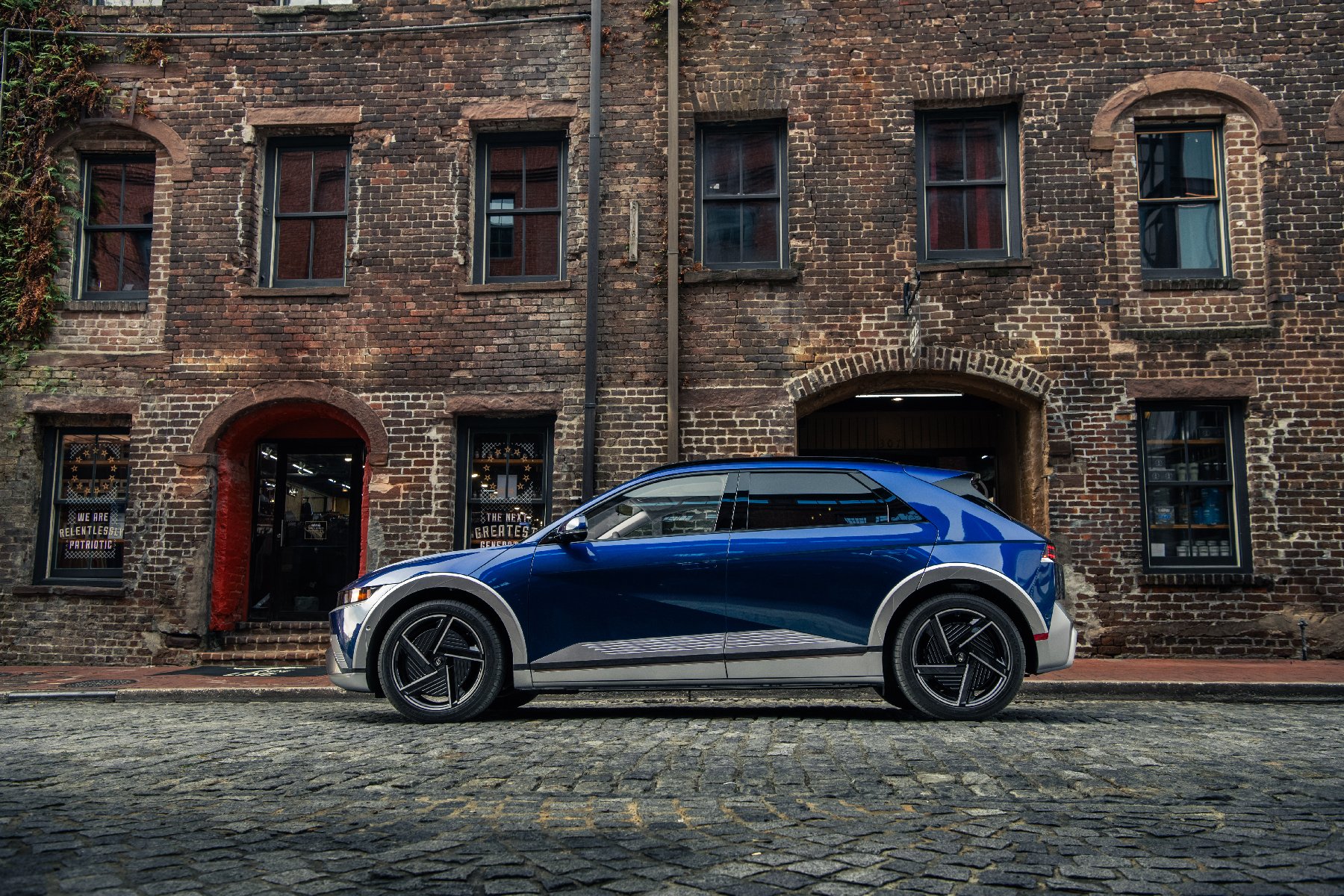
Even without the no-longer-available $7,500 federal tax credit, the Hyundai Ioniq 5 is affordable for an electric vehicle. And not just for an EV, either. This electric crossover's $35,000-to-start base price is competitive with the starting prices of same-size nonelectric crossovers such as the Toyota RAV4 ($31,900), Honda CR-V ($30,920), Subaru Forester ($29,995) and several others that also cost gas money.
The Ioniq 5 is also not fixated on getting to 60 mph as quickly as possible -- at the expense of range. Or cost. The base trim is powerful enough -- not overpowered. That's why it doesn't come standard with a big price. And that price is thousands lower this year than it was last year.
You can buy more performance -- and range -- if you want either (or both).
But it's not one size fits all -- and it's not ludicrously expensive -- which is often the case with EVs.
What It Is
The Ioniq is a compact crossover-ish/hatchback-esque EV available in several different configurations, beginning with the $35,000 SE standard range, which emphasizes affordability rather than horsepower and driving range. This trim also comes with 19-inch wheels, LED headlights, a six-speaker audio system and a flatscreen main gauge panel with a secondary 12.3-inch LCD touch screen.
You can get more horsepower (225 versus 168) and range (318 miles versus the SE standard's 245 miles) in the $37,500 SE, which comes with an 84-kWh battery pack that can store more electricity than the base trim's 63-kWh-capacity battery pack. Both of these versions of the Ioniq 5 are rear-wheel drive. All-wheel drive (dual-motor) is available optionally with the SE. If ordered, the output of the electric drivetrain goes up to 320 horsepower.
So equipped, the price goes up to $41,000.
The $39,800 SEL adds synthetic leather seats, a power rear liftgate, rear air vents, wireless phone charging pad and adaptive cruise control with lane centering. This iteration also comes standard with the single-motor/RWD layout, but AWD (dual-motor) can be added. This increases the MSRP to $43,300.
Limited trims ($45,075) come standard with a panorama sunroof, seat heaters for both rows, plus a heated steering wheel, a sliding center console, digital rearview mirror, rear sunshades and ambient interior lighting, among other upgrades. This model is also RWD, but AWD is available optionally. So equipped, the MSRP goes up to $48,975.
There is also an XRT trim, which is a kind of EV take on the "off-roady" versions of many nonelectric crossovers, such as the Wilderness versions of Subaru models such as the Forester and Outback. Like them, the XRT comes standard with more ground clearance than the other versions of the Ioniq 5, as well as standard AWD -- which includes the higher-output EV drivetrain -- plus all-terrain tires, tow hooks and different front and rear clips designed to look different and to offer improved angles of approach/departure to enable the XRT to traverse uneven terrain with less risk of damaging (tearing off) those front and rear clips -- which (as is generally true of most new vehicles) are literally clipped on, which is why they are so easily torn off.
You also get an upgraded Bose stereo with eight speakers and a 360-degree/bird's-eye camera system.
The XRT lists for $46,275.
What's New for 2026
All trims come standard with a charge cord compatible with both Level I (115V standard household outlet) and Level II (240v, electric stove-type) charging as well as an adapter that allows this EV to use pretty much any commercial Level III fast charger. Two colors that were previously restricted to the XRT trim -- Ultimate Red and Cosmic Blue Pearl -- are now available with other trims.
But the really big news is that the 2026 Ioniq 5 is much less expensive than the '25 Ioniq 5. The base price last year was $42,600 -- or $7,600 higher than the price of the same Ioniq 5 (just one model year newer) today.
What's Good
-- Standard model is affordably priced.
-- More power -- and range -- is available.
-- Fast-charges faster than some other EVs.
What's No So Good
-- Standard range isn't much.
-- Even fast-charging still takes much longer than the time it takes to gas up a nonelectric car.
-- Faster-than-average depreciation is a cost that comes along for the ride with every EV.
Under the Hood
The Ioniq 5 can be a sensible EV or a performance EV -- or something in between.
As detailed above, the SE Standard Range is the sensible pick, if you're not wanting to spend a small fortune on a small EV. It isn't powerful -- just 168 horsepower. Nor is it quick. But it's also not slow. Zero to 60 mph takes about eight seconds, which is on par with the 0-60 mph times of many nonelectric small crossovers.
If faster acceleration is wanted, the SE's powertrain steps it up to 225 horsepower (and the same 258 foot-pounds of torque), which is enough additional scoot to reduce the time to get to 60 mph to about seven seconds; range also goes up to 318 miles on a full charge; adding the dual-motor/AWD setup kicks up the power to 320 horsepower and 446 foot-pounds of right-now torque, which is more than most V8s make and much sooner. So equipped, the Ioniq 5 can easily out-accelerate most V8 muscle cars of the '60s and '70s -- because not one V8-powered muscle car of the '60s and '70s was able to get to 60 mph in four seconds.
Very much the same as was the case with the old V8 muscle cars (as well as today's muscle cars), the additional power and performance comes at a cost -- in range (rather than mileage, though it kind of amounts to the same thing). The highest-powered/highest-performance versions of the Ioniq 5 have about 269 miles of fully charged driving range, a loss of 49 miles versus Ioniq 5s equipped with the 225-horsepower/RWD combo.
On the upside, the Ioniq 5 fast-charges more quickly than many other EVs.
AWD-equipped versions can tow up to 2,700 pounds. RWD versions are rated to pull up to 2,200 pounds.
On the Road
The Ioniq 5 -- like every other EV -- is almost as silent when it is under way as it is when it's parked. The sense of movement -- that immediate thrust -- is how you tell it's not parked.
There are some things that differentiate this Hyundai EV from other EVs. One of them is the pair of paddle shifters mounted on the steering column. These look like the paddle shifters you see in many cars that have engines, because they also have transmissions, and the paddle shifters are there to allow the driver some control over the shifting of the gears. But this EV (like most EVs) doesn't have a transmission, so there's nothing to shift. But Hyundai has included the paddle shifters to emulate -- sort of -- the operation of paddle shifters in a vehicle that has a transmission. If you tap the paddle shifter on the left-hand side of the column, the regenerative braking effect increases, giving you something like the feeling of a downshift. You can use this during cornering or when descending a steep grade to slow the vehicle without manually applying the actual brakes. If you tap the paddle shifter on the right, the regenerative braking eases up and your momentum increases, kind of simulating an upshift.
Another different thing about this Hyundai is the way its driving range is estimated. Instead of a single number of miles left to go, a range -- from best case to worst case and a likely in-between range -- is displayed. This gives you a much better -- much more accurate -- feel for how far the Ioniq 5 will actually go before you need to stop to charge it up.
Hyundai says the Ioniq 5 charges faster (or can be charged faster) at commercial "fast" chargers than some other-brand EVs. I added 51 miles of driving range after a 25-minute hookup at an EV Go fast charger. It is possible Tesla-style superchargers are faster than that; Hyundai says it is possible to go from 10% to 80% charged in 20 minutes. But the catch is, you'd have to find one to plug the Hyundai into. In my area, the EV Go fast chargers are the only conveniently situated fast chargers. And they're not very fast. That's not Hyundai's fault, per se. But the reality is that the rate at which an EV can be charged depends as much on the EV as it does on the charger.
On the upside, Hyundai does include a Level 1 (standard 115V household outlet) power cord that you can use to get a charge anywhere there is electricity.
At the Curb
The Ioniq 5 can be considered either a small, sporty-looking crossover or a small, sporty-looking hatchback. All the trims except the XRT are pretty low-sitting (6.1 inches of ground clearance), and that plus the standard 19-inch wheels and raked windshield give it a zippy appearance. The XRT's slight lift (ground clearance goes up to 7 inches) and off-roady affectations move the needle more to the crossover side of the dial. Either way, the little EV has a lot space inside: 26.3 cubic feet of storage space behind the second row, and 59.4 cubic feet with the second row folded forward.
Both of this little EV's rows have ample legroom (41.7 inches and 39.4 inches, respectively) as well as headroom (39.8 inches and 38.7 inches, respectively) notwithstanding the low-looking roofline. The flat floor (no hump in the middle for the driveshaft tunnel that isn't needed) increases the feeling of space and allows for a really deep center console that is available in a sliding fore-aft configuration. Three people can sit pretty comfortably in back because the middle seat isn't the hump seat.
Most of the secondary controls are tap-swipe, but there is still a knob for adjusting the volume of the sound system as well as useful button controls on the steering wheel hub. All trims come standard with five USB power points, two 12V power points and, in all but the base SE standard range, a wireless phone charging pad.
The charge port is located on the passenger-side rear-quarter panel, so you'll have to back up to many commercial fast chargers.
The Rest
It is very rare to find a new vehicle that costs thousands less than it did the previous year -- but this is one of those rare instances. Last year's base trim Ioniq 5 SE standard Range cost more than this year's SEL -- two trims up from the base trim. And this year's SEL ($39,800) is priced nearly $10,000 less than last year's SEL ($49,600).
Last year's XRT listed for $55,500. This year's lists for $46,275.
That -- as President Donald Trump likes to say -- is yuge. And, for once, in favor of the buyer.
The Bottom Line
There's a lot to like about the Ioniq 5 -- and it costs thousands less now to like it.
========
Eric's latest book, "Doomed: Good Cars Gone Wrong!" will be available soon. To find out more about Eric and read his past columns, please visit the Creators Syndicate webpage at www.creators.com.
Copyright 2026 Creators Syndicate, Inc.






Comments