Sen. Adam Schiff signals he's ready to brawl in looming oversight battle
Published in News & Features
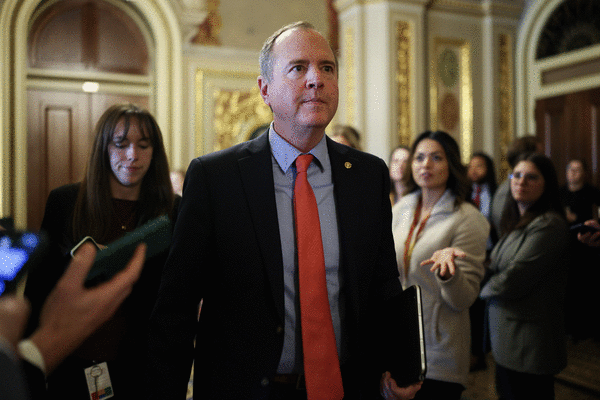
California Sen. Adam Schiff, an antagonist of President Donald Trump with years of experience investigating the White House, sent a copy of the U.S. Constitution on Tuesday to a federal prosecutor in Texas who has suggested that future congressional oversight of the president and his allies could be illegal.
Schiff's message, reiterated in a formal letter and a video designed for public consumption, was unambiguous and barbed: U.S. Attorney Aaron Reitz needs to read up on the law.
"I've read the Constitution. I know that we have both the right and the duty in Congress to do oversight. And it is bats--t crazy to threaten senators for doing their jobs," Schiff, a Democrat, says in the video — before adding that he is "full speed ahead" and won't be deterred from oversight by a "fourth rate prosecutor in Texas."
Reitz has accused Schiff of using alleged corruption as a pretext to "vindictively" go after private citizens working with the president. He did not immediately respond to a request for comment Tuesday.
With just over a month to go until Democrats take power in both chambers of Congress and launch a barrage of investigations into Trump, his family and his extended network of political allies and business associates, the battle to frame those probes as legitimate oversight or a coordinated partisan attack is well underway.
On the right, there is Trump, who has put allegations of corruption back on his accusers; Attorney General Todd Blanche, a former personal attorney for the president who has suggested he remains ready to defend Trump and those around him; and White House counsel Will Scharf, who has warned that Democrats "may cross the line into blatant criminality" if their investigations aren't backed by a "legitimate" legislative purpose.
There is also Reitz, who has become an unlikely player by using his prosecutorial post in Houston to issue warnings to a slate of Democrats set to chair powerful oversight committees come January, such as Rep. Robert Garcia, D-Calif., poised to head the House Oversight Committee, or Sen. Richard Blumenthal, D-Conn., poised to chair the Permanent Subcommittee on Investigations.
On the left, there are those Democrats, who have outlined an array of Trump dealings that warrant investigation, and there is also Schiff, who despite his relatively junior status in the Senate is smack in the middle of the debate — again.
As chair of the House Intelligence Committee during the first Trump administration, Schiff helped oversee investigations into the president's campaign ties to Russia, allegations that he solicited political favors from Ukraine and his fomenting of the Jan. 6, 2021 attack on the U.S. Capitol by Trump's supporters. Schiff helped lead the impeachment of Trump for withholding aid to Ukraine in 2019, though Trump was later acquitted by the Senate.
Since winning his Senate seat in 2024, Schiff has kept up his pressure on the president, including by accusing Trump and his family of corruptly enriching themselves, which they have denied. Among other things, he has called for investigations into payments to Trump's White House ballroom and his "Freedom 250" celebration, and into payments and services from media organizations and law firms that have settled administration lawsuits.
Earlier this month on the social media platform X, Schiff criticized a comment Blanche made defending a letter Reitz sent to Blumenthal demanding that the senator preserve records pertaining to his stated plans to investigate Trump's ballroom and those who donated to the project. Reitz responded that Americans have a 1st Amendment right to "associate" with the president without being targeted "by vindictive Senators."
Then, four days later, Reitz sent Schiff a letter, demanding that he also preserve records related to his "intent to weaponize congressional investigations" against Trump's associates. On X, Reitz wrote that Schiff "seems bloodthirsty to weaponize Congress starting in January."
Schiff scoffed at Reitz's claims.
"This is exactly the kind of dishonorable and abusive conduct by the Justice Department and other agencies that the American people soundly rejected on November 3, when they stripped the Republican Party of its control of Congress," he wrote in his letter Tuesday.
Stanley Brand, a former general counsel for the House and an expert on Congressional investigations, said Schiff and other Democrats are rightfully dismissive of Reitz's threats — just "not dismissive enough."
"I'd advise people informally to ignore it. Don't give it any air, because it's harebrained," he said.
Courts have repeatedly affirmed the notion that Congress is "absolutely immune" from prosecution when it is "operating within its legitimate legislative sphere in an oversight investigation and issuing subpoenas," Brand said. "There's no if, ands or buts."
Meanwhile, "the notion that some U.S. attorney could order people to retain records inside the House or Senate, related to this activity, is also ludicrous," he said. "Once the committee is operating within its core investigative realm, it's immune. It's immune for having a hearing. It's immune for writing a report. It's immune for issuing subpoenas."
If Reitz were to subpoena Congress members, judges would immediately reject the effort, Brand said.
Whether Schiff and the other Democrats will have success in obtaining records from the Trump administration, he said, is far less clear.
"The playbook from Trump 1.0 was to stonewall. You saw that during the impeachment inquiry. To the extent that Congress is able to get into court, and that's not a foregone conclusion that they can, you're talking about months, maybe years of delay," he said.
It's further complicated by the fact that, while defying a Congressional subpoena is illegal, the recourse for lawmakers is to refer such cases to the Justice Department, which isn't likely to side with the lawmakers. The Justice Department also issued an opinion earlier this year that even private parties' communications with the administration are protected by executive privilege.
The Democrats will likely try to push their investigations forward by bringing in whistleblowers and other friendly witnesses, to "create a narrative that resonates publicly," Brand said, but it won't be easy.
Federal government contractors, for example, may find themselves in the unenviable position of facing a subpoena from Congress and a directive from the administration not to comply with it — creating "a very difficult and delicate line to walk."
Jon Michaels, a constitutional law professor at UCLA, called Reitz's efforts "a lot of bluster" that legal scholars "kind of roll our eyes at."
"The law says that Congress is completely within its justification to be using its investigatory powers fully — and in this particular context, it might be that anything short of their doing so energetically and aggressively would be something of a dereliction of duty," he said.
At the same time, "we know that this administration can be incredibly vindictive and expend a ton of political capital, human resources, money, etc., on chasing after and really trying to punish political opponents," Michaels said, "so it can't just be laughed off."
©2026 Los Angeles Times. Visit at latimes.com. Distributed by Tribune Content Agency, LLC.





Comments