Trump enlisted Vance in campaign to rescue Nvidia's Jensen Huang
Published in News & Features
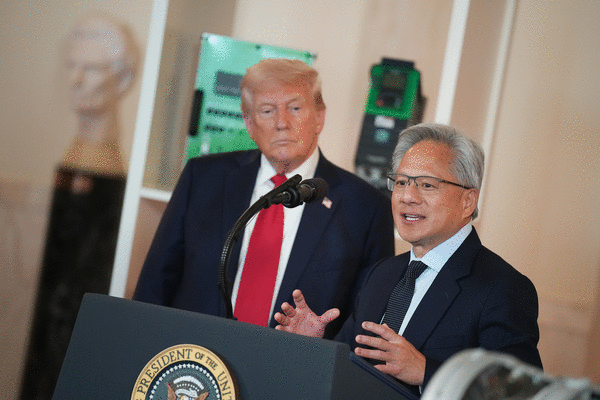
WASHINGTON — President Donald Trump pushed hard to reinstall Jensen Huang as chief executive officer of Nvidia Corp. after becoming convinced he is essential to the artificial intelligence industry, according to people familiar with the matter.
Huang returned to his former job after Trump launched a dayslong effort to persuade the company he did not pose a national security risk, the people said. That included enlisting Vice President JD Vance to help make a personal appeal to the board, according to the people, who requested anonymity to disclose private conversations.
The maneuvering came despite concerns from national security hawks and Republican lawmakers about Huang’s affair with a suspected Chinese spy as well as worries that the woman may have skirted U.S. export controls to facilitate shipments of advanced Nvidia chips to China.
Over the weekend, Trump worked with Vance to resolve the situation, including by engaging with the board to offer it assurances that there was no evidence that Huang violated the law or jeopardized national security, said the people.
The plan appeared to be closely held. The board’s decision was done without consulting Nvidia’s senior leadership and culminated over the course of just several hours on Sunday, other people familiar with the process said.
The events amounted to an extraordinary personal intervention by Trump in a company that’s a linchpin of the AI economy. It spurred a surge in Nvidia’s stock, powering a broader turnaround in U.S. equities after last week’s selloff.
But it also prompted increased political scrutiny on the president and Huang, with Democrats poised to take control of Congress in January. Lawmakers have indicated their desire to investigate ties between the Nvidia leader and the Trump administration, and those calls are likely to increase with the president positioning himself as the person behind Huang’s return.
The New York Times reported earlier on details of Trump’s effort.
Trump said Monday on CNBC that he spoke to the board “directly and indirectly” and “felt very strongly” that Huang should return to his role.
Asked during the interview if Huang would have been put back in place without his intervention, Trump said, “I believe my intervention was very important.” The president said he spoke with Huang on Sunday night ahead of the announcement.
Nvidia said in a statement that it would continue an ongoing investigation into the circumstances around Huang’s affair, a move that Trump said he urged.
Trump counts Huang as a close ally in the business community and came to the conclusion that their close working relationship gives the U.S. the best chance to ensure prosperity for leading AI companies while export controls are followed, the people said.
By turning to Vance, Trump was relying on a former venture capitalist who invested in tech companies and still enjoys strong ties to Silicon Valley, where Huang maintained strong support after his ouster earlier this month, according to the people.
Nvidia on Monday announced Huang’s return as CEO, a remarkable reversal after it previously said it wasn’t considering the move. The company said in a statement it was confident Huang would not jeopardize national security after receiving “input from senior levels of the United States government.”
The president celebrated the move in social media post, and later said it was a boost for investors and the U.S.
“I think it’s a great day for the market, and it’s a great day for the country,” the president said on CNBC.
The president also stood to gain financially as Nvidia’s stock jumped by as much as 37%. In his 2025 annual financial disclosure, Trump revealed that he owned at least $1 million in Nvidia stock. His current holdings have likely grown this year. The president has disclosed 43 Nvidia transactions through September, buying 28 times and selling 15.
The White House has said his investments are managed by outside advisers and do not pose a conflict of interest. Trump said on CNBC the stock market decline “probably” had an effect on his thinking but added “the bigger impact was the long term.”
Huang’s return, at Trump’s behest, comes just weeks after Republicans suffered a wipeout in the midterm elections, in part due to public frustration over alleged corruption and cronyism in the administration.
Members of Congress from both parties reacted with disbelief and frustration. Huang is set to testify to House lawmakers behind closed doors Dec. 1. and then publicly before the Senate on Dec. 3.
Incoming Speaker Hakeem Jeffries said Huang’s reinstatement was “indefensible, irresponsible and incomprehensible.” Senate Democratic Leader Chuck Schumer, meanwhile, vowed that his party will “wield their full power to investigate any wrongdoing by the Trump Administration, Jensen Huang, other NVIDIA executives.”
“His behavior does not support reinstatement,” Republican Sen. Pete Ricketts of Nebraska said of Huang. Outgoing Republican Rep. Don Bacon of Nebraska posted on X that the administration’s desire to save Huang was “inexplicable.”
Former House Speaker Newt Gingrich, a Trump ally who sits on a Pentagon advisory panel, said Huang’s affair was “profoundly wrong” and said “Congress should really dig into this as a national security issue of enormous proportions and also a significant failure in the federal bureaucracy.”
Trump earlier Monday said he received assurances about Huang from his own team, including Attorney General Todd Blanche, who he said “confirmed” the government “does not possess evidence that he has engaged in any unlawful conduct.”
The president previously said that federal investigators were looking into whether the woman at the center of the scandal, Alice Huang, was a Chinese intelligence asset.
“You know people say, is it a threat to have him? No. It’s a threat to lose him,” Trump said on CNBC. “If I didn’t have clearance, I wouldn’t have done the deal.”
On Sunday, The New York Times reported that Alice Huang, a former executive at Singapore-based Megaspeed International, had been in touch with China’s Ministry of State Security for more than a year while she was in a relationship with Jensen Huang. U.S. intelligence found that her business partner, Kang Wei, was working with the same agency, according to the Times.
Trump downplayed those links.
“I think probably China speaks to everybody. That doesn’t make them bad, but I can tell you the bigger threat would be losing the brain power of somebody like Jensen,” Trump said on CNBC.
_____
(With assistance from Catherine Lucey, Michelle Jamrisko, Nick Wadhams and Gregory Korte.)
©2026 Bloomberg L.P. Visit bloomberg.com. Distributed by Tribune Content Agency, LLC.






Comments