GAO chief nominee triggers partisan clash at Senate hearing
Published in News & Features
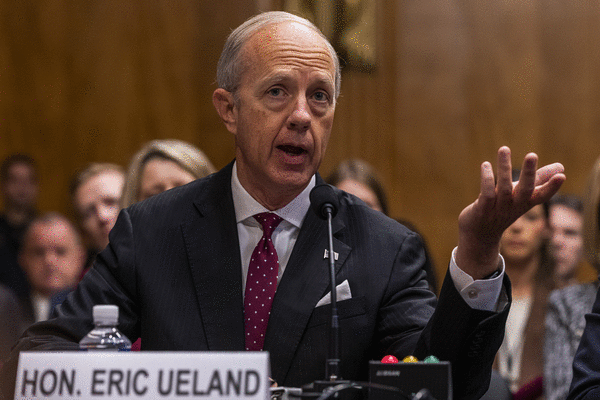
WASHINGTON — Eric Ueland, President Donald Trump’s pick for comptroller general, promised to be independent and impartial if confirmed, amid criticism from Democrats and outside groups, during a confirmation hearing Thursday.
“I’m not here as a plant, a stooge, a lackey for anybody,” he told Senate Homeland Security and Governmental Affairs Chairman Rand Paul, R-Ky., after Democrats on the panel accused him of being a “rubber stamp” for the administration.
Democrats have criticized Ueland, a longtime GOP Senate aide and administration official during both Trump terms, saying he is too politically biased to lead the nonpartisan watchdog agency that conducts investigations and audits for Congress. They also said Republicans ignored a law that Democrats say requires the convening of a special legislative commission to make recommendations for the post.
Ueland said if the Senate confirms him to lead the Government Accountability Office, “We can at the end of the day ... see a GAO which is more effective, which provides better information for Congress in a quicker way so Congress is able to take policy actions and drive change itself at this end of Pennsylvania Avenue.”
At the root of the partisan clash is a suspicion by Democrats that Trump is trying to install a puppet to lead an agency that has fought the administration repeatedly over the power of the purse and other matters.
Democrats blasted Paul for rushing the hearing, which included a dozen other nominees for administration and judicial posts.
“It’s so apparent that this is a box-checking exercise,” said Sen. Gary Peters of Michigan, the ranking Democrat on the panel. “This committee is not doing due diligence, despite some of our members’ best efforts, because the chairman has chosen not to carry out his responsibility to provide advice and consent on nominations.”
Democrats said Paul did not allow Peters to make an opening statement at the hearing and restricted the amount of time given to senators to ask questions. A GOP aide disputed this, noting that Paul did not give an opening statement himself, Peters arrived late and all senators were given five minutes to ask questions.
Ueland has served as deputy director for management at the Office of Management and Budget under Russ Vought, the OMB director. Trump nominated Ueland to head the GAO, a legislative branch agency, Monday.
Democrats noted that the GAO has concluded multiple times that the administration violated the law by "impounding," or refusing to spend, appropriated funds. OMB has argued that the GAO misread the law and that it does not have any authority over the executive branch.
Peters told Ueland that the GAO had issued 12 reports accusing the administration of violating the law, and he asked if Ueland agreed.
Ueland did not give a direct response.
“First, many of those items indicated by those reports, I have not participated in,” he said. Ueland said he had not reviewed the reports that Peters provided to him earlier, and that he would not offer an opinion on them.
He also said it was critical that he “not prejudge or come to this committee with informed conclusions about what it is that GAO has rendered as advice to Congress.” Ueland said he has a “clear commitment to follow the process.”
Peters said when Ueland appeared before the committee last year after being nominated for the OMB post, he voiced support for the presidential authority of impoundment.
“We’re going to expect you to continue to basically ignore Congress,” Peters said. “You’re going to be a rubber stamp for the administration.”
“That’s not so,” Ueland replied.
Ueland said his experience as deputy overseeing the management side of OMB would be a “value add to GAO.” He cited his work “examining how the government actually functions, how it is organized, how it can be better optimized to deliver results.”
Sen. Bernie Moreno, R-Ohio, asked Ueland how he would grade GAO’s work to date.
Ueland said he would give it a “medium grade over time.”
For example, he said GAO has 38 government operations on a “high-risk list … some of which have been on there for 36 years.”
By contrast, Ueland referred to his work at OMB, where he said “you have seen a very swift and aggressive effort by this administration in this term to set up systems and processes to ensure that we are not sending money out the door that we shouldn’t.”
Paul asked Ueland what he would do if administration officials told him they did not like a GAO investigation or conclusion.
Ueland said he would “fully follow through on charges from Congress and in the event of obstacles figure out ways to proceed to try to elicit information.” He said when he was a young staffer in the Senate, when there were disagreements between the legislative and executive branches, GAO and the administration had conversations “to see if there were appropriate paths forward.”
Responding to another question from Paul as to whether he would ignore a potential request from the White House to stop an investigation, Ueland said, “To be clear, yes.”
Sen. James Lankford, R-Okla., who is seeking to be the ranking Republican on the committee in the next Congress, said he was satisfied that Republicans followed the letter of the law requiring a commission to make recommendations to the president for comptroller general. He added that he was not “completely sure they have followed the entire spirit of the law.”
“For me, personally, Mr. Ueland is a great candidate in this role for GAO,” Lankford said.
Paul sent three recommendations for comptroller general, including Ueland, to the White House last week from the six Republican members of a 10-member bipartisan, bicameral commission. But he never convened the body to seek applications from and interview candidates for the post.
And he gave the four Democrats on the commission less than 24 hours’ notice last week to offer their recommendations. Democrats charged that Paul subverted the process, and they did not offer recommendations.
In a separate interview Wednesday, the president of the union that represents GAO employees decried the decision not to follow the commission process that characterized past comptroller general nominations.
“We see that bipartisan process as extremely important to preserving and keeping the trust that GAO has with the entire Congress,” said Benjamin Emmel, president of Local 1921 of the International Federation of Professionals and Technical Engineers.
Emmel, a senior analyst at GAO, said by sidestepping that procedure, “there is a cloud that hangs above any nominee where one party dominates that process.”
He said GAO’s credibility depends on members of both parties trusting that the organization is “nonpartisan, objective, independent and fair. If we lose that ability, we become less useful.”
The union is not advocating for or against Ueland or any nominee for the office. The Homeland Security panel is not expected to vote on the nominations until after Thanksgiving.
_____
©2026 CQ-Roll Call, Inc. Visit at rollcall.com. Distributed by Tribune Content Agency, LLC.






Comments