$395 million flood control project in Bay Area finished just in time for El Niño winter
Published in News & Features
SAN JOSE, Calif. — Since the 1930s, Downtown Morgan Hill and neighborhoods around it have flooded at least 18 times — an average of once every five years. In 2009, more than 20% of the city’s roads were submerged, forcing evacuations of homes, stalling vehicles and inundating local businesses and farm fields.
Flooding also happened in 2017 and 2023. But now, the chances of that muddy, messy, costly history repeating itself again have gone down dramatically.
Just in time for the historically strong El Niño conditions in the Pacific Ocean that are increasing the odds of a wet winter this year across California, construction workers have finished a $395 million project to significantly reduce the flood risk in downtown Morgan Hill and its surrounding neighborhoods.
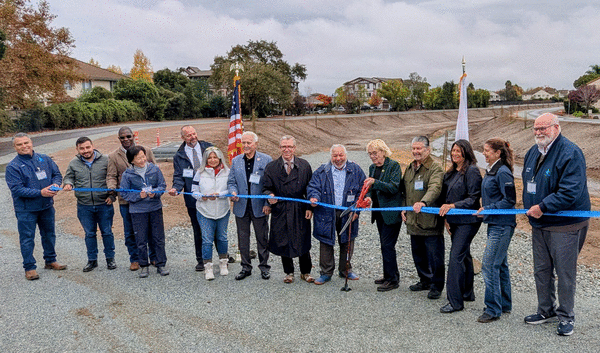
At a ceremony Monday morning with U.S. Rep. Zoe Lofgren, D-San Jose, who helped secure $80 million in federal funding for the work, officials from the Santa Clara Valley Water District, city of Morgan Hill, and other agencies celebrated the project, which has been under construction for the past seven years.
“I was told this project would never be funded,” Lofgren said after morning showers stopped. “I am so delighted that it has been done in time for this year’s El Niño. You can see there’s water there right now. I never gave up and neither did you. Thank goodness the residents of Morgan Hill feel secure, and can sleep safely knowing they are not going to be flooded out.”
The work was the largest such project completed by the water district, a government agency based in San Jose, since 2005, when the district, the city of San Jose and the Army Corps of Engineers finished a $350 million flood safety project along the Guadalupe River from Interstate 280 to I-880. At the center of that construction was the creation of the Guadalupe River Park & Gardens adjacent to SAP Center at San Jose, where the San Jose Sharks play.
Construction on the Morgan Hill Llagas Creek project began in 2019. Crews widened and deepened about 4.5 miles of Llagas Creek and its tributaries on Morgan Hill’s southern edges and Gilroy’s western edges. They finished that work in 2022.
For the second phase, they dug a 2,300-foot-long tunnel under Morgan Hill, 12 feet high and 14 feet wide, near West Main and Hale avenues to take excess floodwaters and move them away from downtown. That work finished in 2023.
For the final phase, GraniteRock Construction, based in Watsonville, built improvements along 9.4 miles of Upper Llagas Creek and its tributaries, East and West Little Llagas creeks, from Highway 101 to Llagas Road.
Altogether, the project widened and deepened more than 13.9 miles of channels through Morgan Hill, San Martin and Gilroy. Crews also rebuilt three bridges, upgraded storm drains and modernized bicycle and hiking paths along levees.
Over the coming months, workers intend to plant thousands of native plants, trees and shrubs along the banks of the creeks.
Across 4.5 miles of the creek channel in the urban area of Morgan Hill, the project now provides 100-year-flood protection — the ability to handle floodwaters so high that they have just a 1% chance of happening in any given year — to 1,100 homes, 500 businesses and 1,300 acres of agricultural land. With that level of projection, the water district will apply to FEMA to allow residents in that area to waive a federal requirement that they have flood insurance.
Another 9.4 miles of the channel in the rural areas now have a 10% level of flood protection — or waters so high they occur on average just once every 10 years.
The project was not without its setbacks. Like many huge flood control projects, it took decades to complete. The project was first authorized by Congress in 1954 — when President Eisenhower was in office and Elvis Presley released his first record.
Funding was difficult to obtain and progress stalled. The Army Corps of Engineers began environmental studies, then dropped out as a partner. The project’s costs increased 64% from $241 million two years ago to $395 million today. The water district had to purchase more than 150 pieces of land and obtain dozens of permits and approvals.
In the end, the district contributed $264 million, or about two-thirds of the total funding, much of it through a parcel tax originally approved by voters in 2000 and renewed several times, called the “Safe, Clean Water and Natural Flood Protection Program.”
Lofgren secured the $80 million in federal funding in Congress from the Natural Resources Conservation Service, a division of the U.S. Department of Agriculture. The state of California provided $38.2 million. The city of Morgan Hill paid $12.3 million.
Steady rain came down across the Bay Area over the weekend and Monday. More was forecast for Wednesday and next weekend. Scientists say January and February could have the biggest El Niño storms.
“When we see heavy rainfall, we see flooding,” said Morgan Hill Mayor Mark Turner, a 33-year resident of the city. “This being completed is a major relief.”
©2026 MediaNews Group, Inc. Visit at mercurynews.com. Distributed by Tribune Content Agency, LLC.






Comments